

 1 hour ago
6
1 hour ago
6
ARTICLE AD BOX
The NIA's chargesheet in the 2025 Pahalgam terror attack positions the incident within a broader pattern of cross-border terrorism allegedly backed by Pakistan, detailing the role of LeT/TRF operatives, local facilitators, and Pakistani handlers.
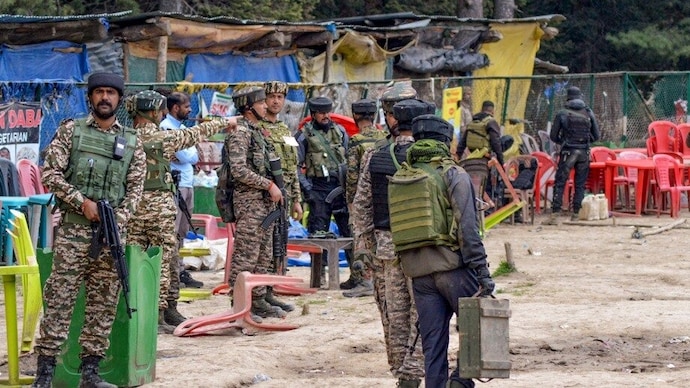
The Pahalgam attack is not an aberration. The record maps a continuum. (File Photo: ITG)
New Delhi,UPDATED: Apr 19, 2026 15:20 IST
The National Investigation Agency’s chargesheet filed on December 15, 2025, in the Pahalgam terror attack case reads less like a one-off case file and more like a chapter in a decades-long dossier. Seven accused, including Pakistan-based Lashkar-e-Taiba/The Resistance Front operatives, stand charged with religion-based targeted killings that left 25 tourists and one local dead.
The 1,597-page document names Pakistani handler Sajid Jatt and three terrorists — Faisal Jatt alias Suleman Shah, Habeeb Tahir alias Jibran, and Hamza Afghani — who were killed in Operation Mahadev in Dachigam in July 2025. Two locals, Parvaiz Ahmad and Bashir Ahmad Jothad, were arrested for harbouring them.
The NIA’s probe under RC-02/2025/NIA/JMU traces the conspiracy directly to Pakistan, invoking charges under the Bharatiya Nyaya Sanhita, 2023, the Arms Act, and the UAPA, including “waging war against India.” The agency states that Pakistan “has been unabatedly sponsoring terrorism against India.”
A 25-YEAR BLOOD TRAIL
The Pahalgam attack is not an aberration. The record maps a continuum:
- Kaluchak massacre, 2002: Pakistani terrorists attacked an Army family quarters bus, killing 31, including women and children.
- Parliament attack, 2001: Five terrorists attempted to strike at the heart of Indian democracy.
- Mumbai suburban train blasts, 2006: Coordinated IEDs ripped through first-class compartments, killing 189.
- 26/11 Mumbai, 2008: Ten LeT terrorists held India’s financial capital hostage for 60 hours. The burning Taj Mahal Palace became a global symbol of cross-border terror.
- Pathankot airbase, 2016: JeM terrorists infiltrated the IAF base, exposing gaps in base security.
- Uri, 2016: Four terrorists attacked an Army brigade headquarters, killing 19 soldiers — an assault that preceded India’s first surgical strikes.
- Pulwama, 2019: A JeM suicide bomber rammed a CRPF convoy, killing 40 personnel and triggering the Balakot airstrikes.
Each case points to a common denominator in Indian investigations: training, funding, and operational direction from Pakistani territory, often by groups like LeT and JeM operating with impunity.
MODUS OPERANDI: FROM INFILTRATION TO ‘HYBRID’ TERROR
The Pahalgam chargesheet highlights an evolution. The attack relied on local harbourers and targeted killings based on religious identity, aiming to create communal fissures and damage Kashmir’s tourism revival.
TRF, widely seen as an LeT front, has increasingly adopted this ‘hybrid’ model: Pakistani handlers, foreign terrorists, and local logistical support.
Operation Mahadev, which neutralised three Pakistani terrorists in Dachigam in July 2025, underscores that the kinetic track remains active. Yet the NIA’s emphasis on “waging war” signals New Delhi’s view: this is not merely terrorism, but state-enabled proxy warfare.
THE STRATEGIC COST
The cumulative effect extends beyond casualties. As CDS General Anil Chauhan noted at ‘Ran Samwad’, the objective of modern conflict is “paralysis” — deception, confusion, and systemic disruption.
Attacks on institutions such as Parliament, financial hubs like Mumbai, military installations like Pathankot, and tourist centres like Pahalgam are designed to freeze decision-making, deter investment, and push India into a reactive posture.
WHY IT MATTERS NOW
With the first anniversary of Operation Sindoor approaching on May 7, 2026, and the Joint Commanders’ Conference in Jaipur scheduled for May 6–8, India’s military is formalising multi-domain responses that integrate kinetic and non-kinetic tools.
The Pahalgam chargesheet provides the evidentiary backbone for India’s diplomatic and legal push — from FATF mechanisms to UN forums — aimed at sustaining pressure on Pakistan and constraining terror financing.
THE PATH AHEAD
India’s response is unfolding across three layers:
- Military: Precision operations like Mahadev and the induction of longer-range BrahMos systems to hold cross-border infrastructure at risk.
- Legal-diplomatic: NIA investigations, UAPA/BNS charges against foreign entities, and structured dossiers for international platforms.
- Societal: Initiatives such as the Vibrant Villages Programme and border-area development to reduce local support networks for, as reflected in CDS Chauhan’s Harsil visit.
The images, from Kaluchak to Pahalgam, are not just archival records. They are exhibits in an ongoing case – that Pakistan’s use of terror as an instrument of statecraft has not ceased, only adapted.
The December 2025 chargesheet is India’s latest filing. The verdict will be shaped by sustained counter-terror posture, global pressure, and the systematic denial of space, funding, and narrative to Pakistan-based groups.
- Ends
Published By:
Priyanka Kumari
Published On:
Apr 19, 2026 15:20 IST
Tune In





 English (US) ·