

 1 hour ago
3
1 hour ago
3
ARTICLE AD BOX
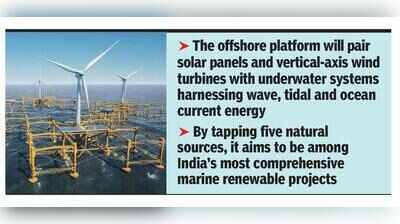
Hybrid floating platform to generate multiple forms of renewable energy
Panaji: The Goa-based CSIR–National Institute of Oceanography (NIO) is developing a hybrid floating platform anchored offshore that will generate multiple forms of renewable energy from a single structure.The proposed platform will integrate five renewable energy technologies — solar, wind, wave, tidal and ocean current energy — making it one of the country’s most comprehensive marine renewable energy projects.“Our idea is to develop a floating platform that does not occupy valuable land space while simultaneously harvesting energy from multiple natural sources available in the marine environment,” CSIR-NIO director Sunil Kumar Singh told TOI.The floating structure will be installed in coastal waters, with solar panels and vertical-axis wind turbines mounted above the platform. Beneath it, specialised converters will generate electricity from waves, tidal movements and ocean currents.“During the monsoon there may be less sunlight because of cloud cover, but wind, waves and ocean currents are stronger. During the non-monsoon period, solar generation increases while wave and current energy may reduce.
Together, these systems complement one another and provide a more reliable source of renewable energy,” Singh said.The pilot project is expected to come up off the South Goa coast, where wind conditions are considered more favourable than in other parts of the state. The platform will be anchored offshore using mooring systems while retaining enough flexibility to adapt to changing sea conditions.A prototype is expected to be ready within a year.“We are very excited about this project. The pilot version should be visible within a year, although several engineering challenges remain,” Singh said.He said that designing a structure capable of withstanding rough seas remains one of the key challenges.“If the platform is completely rigid, powerful waves and strong winds could damage it. Future designs will allow the structure to flex and adapt to changing sea conditions,” the CSIR-NIO director said.Initially, researchers will test a smaller pilot platform, which may be shifted closer to the coast during severe monsoon conditions for safety. In the long term, however, the team aims to develop a permanently deployed system capable of operating throughout the year.Looking ahead, Singh said future versions of the platform could incorporate offshore hydrogen production units. Instead of transmitting electricity to shore through expensive subsea cables, the power generated offshore could be used to produce green hydrogen directly on the platform.The concept involves desalinating seawater and using renewable electricity to generate green hydrogen, which can then be stored and transported for industrial and energy applications.“Hydrogen is one of the future energy carriers. Rather than bringing electricity to shore through large transmission cables, we may eventually produce hydrogen directly at sea,” he said.“Goa can lead by example in this new form of renewable energy. If successful, the project could demonstrate how marine resources can contribute to India’s clean energy transition while reducing carbon emissions and supporting the country’s net-zero ambitions,” Singh said.









 English (US) ·