

 1 hour ago
8
1 hour ago
8
ARTICLE AD BOX
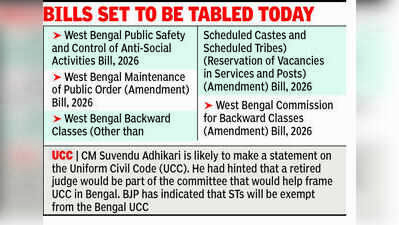
Kolkata: The Bengal bill seeking to allow 12 months’ preventive detention of potential violators, which is likely to be tabled in the assembly on Monday, includes a clause that seeks to prevent detainees from engaging lawyers to argue against the internment, except in “appropriate cases and for reasons to be recorded in writing.
” The detainees, however, can make their own submissions.The draft West Bengal Public Safety and Control of Anti-social Activities Bill, 2026, copies of which have been shared with MLAs, says every detention made under the proposed law has to be ratified by an “Advisory Board” within nine weeks of the start of the internment. The three-member board will be chaired by a serving or a retired high court judge.Section 10(4) of the draft bill says, “A detained person shall not ordinarily be entitled to be represented by a legal practitioner before the Advisory Board.”
An exception clause says, “Provided that the Advisory Board may, in appropriate cases and for reasons to be recorded in writing, permit representation by a legal practitioner.”Restating the restriction, Section 10(7) states that “nothing in the section” entitles a detainee to appear through a legal practitioner in matters connected with the reference before the Advisory Board.Section 7, however, allows detainees to consult lawyers.
The draft bill lists those who can be taken into preventive detention — any person or a member of a group, gang, or syndicate that habitually commits, attempts to commit, abets, promotes, finances, or facilitates anti-social activities, or has been chargesheeted under Section 111 or 112 of BNS, or is implicated under Arms Act, NDPS Act, Explosive Substances Act, or Immoral Traffic (Prevention) Act.It describes the Advisory Board as the first step to challenge detention, saying the body can confirm or revoke detention orders.“Where the Advisory Board reports that there is sufficient cause for detention, the State Govt may confirm the detention order and continue the detention for such period as it thinks fit. Where the Advisory Board reports that there is no sufficient cause for detention, the State Govt shall revoke the detention order and cause the person to be released forthwith,” the draft bill states.A confidentiality clause included in the draft bill says: “The proceedings of the Advisory Board and its report, other than the portion containing its opinion, shall be confidential.”The proposed legislation, modelled on Gujarat’s Prevention of Anti-Social Activities Act, 1985, seeks to give police wide powers to deal with cases.It says a person could appeal within 15 days of receiving a detention order and could appeal to the state govt “which may, after giving such opportunity of hearing as it deems fit, annul, modify or confirm the order.” The authorities issuing the detention orders could at any point in time “rescind, modify or relax the order, either wholly or in part.”Persons found shielding detainees from the law “shall be punishable with imprisonment for a term which may extend to three years, and shall also be liable to a fine.”Former advocate-general Jayanta Mitra advised caution before rushing through bills that could fall foul of the Constitution’s Articles 14, 19, and 21. “The intent may be good, but hurrying with such bills, which seem to contradict a person’s fundamental rights...
will be legally challenged,” he said.Trinamool dubbed the Bill the 2026 version of the Rowlatt Act, a repressive law passed by the British in 1919 that allowed the arrest of anyone suspected of “sedition or revolutionary activities” without a warrant and their detention for up to two years without a trial. Trinamool MP and lawyer Kalyan Banerjee said, “BJP is now following the path taken by Indira Gandhi during the Emergency...
Those who will speak against them will be detained and labelled as goons.
”Speaking about the proposed bill, junior Union minister Sukanta Majumdar said, “CM Suvendu Adhikari said in his last assembly speech that the govt is planning to bring a new law to deal strictly with rioters and others who engage in violence, assault and arson... He said that in the coming days, strict action will be taken against such elements under the proposed law.”




 English (US) ·