

 1 hour ago
3
1 hour ago
3
ARTICLE AD BOX
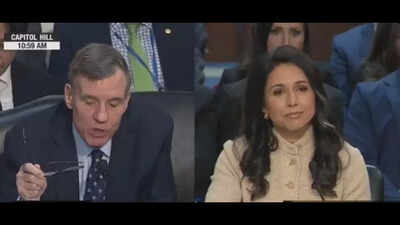
DNI Tulsi Gabbard faces grilling at Congressional hearing as she's asked about Iran.
Director of National Intelligence Tulsi Gabbard said she was not aware of President Donald Trump's reaction that he was shocked when Iran decided to strike US allies in the Gulf region. As Gabbard testified before Congress, she was asked whether she provided any intelligence to the POTUS that a counterattack from Iran was likely.
"I am not aware of those remarks. I think those of us at the table can point to the fact that, historically, the Iranians have always threatened to leverage their control over the Strait of Hormuz," Gabbard said. Did you brief him that if a war starts, Iran is likely to strike back and close the Strait of Hormuz, Gabbard was asked specifically. Gabbard said the intelligence community provides all the best available information for his objective decision.
Trump publicly commented that nobody expected Iran strikes on Middle East countries. "They weren't supposed to go after all these other countries in the Middle East. So they hit Qatar, Saudi Arabia, UAE, Bahrain, Kuwait. Nobody expected that," Trump said.The annual threat assessment report presented by the intelligence said China, Russia, North Korea, Iran and Pakistan have been researching and developing an array of novel, advanced, or traditional missile delivery systems with nuclear and conventional payloads that can strike the US.
The intelligence said it projects threats to the US will expand to more than 16,000 missiles by 2035, from the current figure of more than 3,000 missiles.
"North Korea has successfully tested ICBMs capable of reaching the entire Homeland, and prior to Operation Epic Fury, Iran had developed space-launch vehicles that it could use to develop a military-viable ICBM by 2035 should Tehran decide to do so," the report said. "Adversaries will seek to understand US plans for advanced missile defense for the Homeland, almost certainly for the purposes of shaping their own missile development programs and assessing US intentions regarding deterrence. China, Russia, and North Korea almost certainly will continue enhancing their own missile and counterspace capabilities during the next five years," the report said. "Chinese officials probably fear that the Golden Dome for America will reduce Washington’s threshold for initiating military action against Beijing in a crisis, which is likely driving China to focus on using international arms control discussions, particularly on its space-based elements," it added.








 English (US) ·