

 4 days ago
5
4 days ago
5
ARTICLE AD BOX
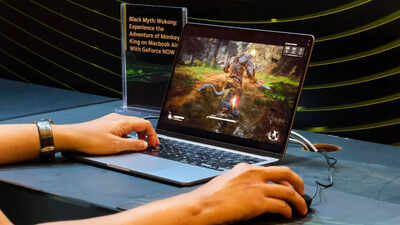
NVIDIA previewed GeForce NOW in Mumbai ahead of its India launch, running on RTX 5080 servers the company operates itself. The demo impressed—Cyberpunk 2077, ARC Raiders, and Wukong ran smoothly across devices. But questions remain: no pricing revealed, servers only in Mumbai, no ISP partnerships, and India's inconsistent internet could undermine the experience outside controlled conditions. An open beta comes next.
NVIDIA is bringing GeForce NOW to India, and I got to try it early. If you haven't been following—this is NVIDIA's cloud gaming service. The idea is simple: instead of buying a Rs 1.5 lakh gaming PC, you stream games from NVIDIA's servers to whatever screen you have.
Your phone, your old college laptop, a tablet, whatever. The RTX hardware sits in a data centre, and you get the output.Now, I know what you're thinking. We've heard this before. And yeah, we'll get to that. But first—what I saw.
First impressions: It works
I walked into this expecting the usual cloud gaming experience—the one where you can feel the lag, where everything looks slightly mushy, where you spend more time noticing the compression than playing the game.
Because that's how cloud gaming works at my own home on Xbox Cloud Gaming. That's not what happened here—though, to be fair, this was a wired ethernet setup in Mumbai, probably a stone's throw from the actual servers.The setup had us playing across a range of devices—a high-end monitor, a TV, phones, and a regular Dell Inspiron, the kind sitting on every office desk in the country. The game lineup was varied: Cyberpunk 2077 hitting around 100 fps on the PC, ARC Raiders pushing close to 300 fps on a high-end monitor, Black Myth: Wukong running at about 100 fps plus on a MacBook Air, Hogwarts Legacy at a steady 60 fps on the TV, and Forza Horizon 5 alongside Skillsong holding 60 fps on a phone.
DLSS—NVIDIA's AI upscaling tech—was doing the heavy lifting, rendering at a lower resolution and intelligently upscaling so the server doesn't have to brute-force every pixel. The newer DLSS 4 Multi-Frame Generation takes it further by generating extra frames between rendered ones. In plain terms: games look and run better than the raw hardware would manage alone.It felt responsive too. NVIDIA's low latency streaming, backed by Reflex, targets click-to-pixel response times as low as 30 milliseconds.
During the demo, the ping hovered around 1-2 ms—essentially negligible. ARC Raiders—an online extraction shooter where you'd notice input lag instantly—ran without hitching. Even on the Inspiron, the stream held up.Gillooly put it simply: "It's one of those products that is really hard to explain to people until they get their hands on it." That's fair.But I want to be clear—this was ethernet, in Mumbai, in the same city as the servers.
My Xbox Cloud Gaming experience at home—on Wi-Fi, hundreds of kilometres from the nearest server—is a different reality entirely. Whether GeForce NOW holds up in those conditions is the actual test, and that's still ahead of us.
Okay but what actually is GeForce NOW
Quick explainer if you need it. GeForce NOW is not like Game Pass. You're not getting a library of games with your subscription. What you're getting is access to NVIDIA's hardware—essentially a remote gaming PC powered by RTX 5080-class GPUs sitting in a data centre.
You bring your own games. Connect your Steam account, your Epic library, whatever you've got, and play those titles on NVIDIA's machines.A couple of things worth noting: NVIDIA is running the India servers itself—not through a local alliance partner like in some other markets. The game library gets new additions every Thursday, currently supports over 4,500 titles, and there's a Cinematic Quality Streaming mode that pushes YUV 4:4:4 chroma sampling, 10-bit HDR, and bitrates up to 100 Mbps for the sharpest possible picture—if your connection can handle it.So if you already have a Steam library with 200 games you bought during sales and never played (we all do), GeForce NOW lets you run them at settings your actual laptop would laugh at.The servers for India are in Mumbai, and the service is launching as an open beta first—not a full commercial product right away.
Now let's talk about the India problem
Here's where my brain started doing the math during the presentation.Gillooly spent a good chunk of time talking about network optimisation and the work NVIDIA has done on the streaming stack.
On the tech side, GeForce NOW uses AV1 encoding on newer servers—about 40% more efficient than H.264 at similar quality—and adaptive bitrate streaming that scales quality in real time based on your connection. That's all solid engineering.But there's a fundamental reality about India that no amount of server-side optimisation can fix—our internet is chaos.I don't mean the speeds. On paper, Indian broadband looks fine.
Your ISP will happily tell you you're on a 100 Mbps plan. What they won't tell you is that your actual experience involves random jitter at 9 PM when the whole neighbourhood is streaming, bandwidth drops that come and go without reason, and a last-mile connection that varies not just city to city but literally building to building. And that's the fibre crowd.
A massive chunk of this country is still on 4G, some on 3G, and the 50 Mbps that NVIDIA's slides assume is simply not everyone's reality.I asked Gillooly about this directly—how has NVIDIA tuned things for Indian conditions, and when the connection inevitably dips mid-game, what does the player actually see?He didn't sugarcoat it. "It's ultimately going to be performance dependent on your internet connection," he said. NVIDIA has built in multiple quality tiers—25 Mbps gets you 1080p, 100 Mbps gets you Cinematic Quality Streaming—and the system adjusts on the fly.
But there's only so much they can control.I pushed further. What about someone sitting 2,000 kilometres from Mumbai—say, in the northeast or down south? "It obviously won't be the same as being in Mumbai," Gillooly said. He pointed to the open beta as the phase where they'll learn how the service performs across the country.No telco partnerships were announced. No additional data centres beyond Mumbai. And there's one more thing—NVIDIA's Low-Latency Streaming mode, which further reduces lag, won't be available in India at launch.
It requires ISPs to support the L4S (Low Latency, Low Loss, and Scalable Throughput) network protocol, which hasn't been implemented here yet. So the best version of GeForce NOW's streaming tech isn't even on the table until Indian ISPs catch up.
Who is this even for?
This is the part I kept coming back to. India is a mobile gaming country. The vast majority of gamers here play free-to-play titles on their phones. BGMI, Free Fire, that's the mainstream.
The PC gaming crowd exists—it's passionate, it's growing—but it's a fraction of the overall base.And then there's the spending habits. Indian gamers, broadly speaking, don't like spending money on games. Free-to-play dominates mobile. PC gamers wait for Steam sales like it's a festival. Gaming cafés in smaller cities do solid business at Rs 30-50 an hour because that's what people are comfortable paying.GeForce NOW walks into this and asks for a monthly subscription.
And remember—the subscription is just for the streaming. You still need to buy the games. So the actual cost of using GeForce NOW is the subscription fee plus whatever you're spending on your Steam or Epic library. Compare that to Game Pass, where the subscription includes the games, and you can see why the value equation isn't straightforward.Gillooly's answer to this was interesting. He sees GeForce NOW as a bridge—a way for mobile gamers to experience "a whole different level of game" without buying hardware.
Free-to-play titles on Steam and Epic work on GeForce NOW. Game Pass titles from Microsoft are supported too. You don't have to have a massive library to get started.And there's the old hardware angle. If you've got a laptop from five years ago that can barely run Chrome without sweating, GeForce NOW turns it into something that can run modern AAA titles. That's a legitimate value proposition—especially in a country where a lot of people have decent screens attached to underpowered machines.But NVIDIA didn't reveal pricing. Didn't confirm whether the free tier that exists in other countries will be available here. And in a market this price-sensitive, that's the detail that'll determine everything.
The hardware thing
There's another angle to this that's worth thinking about. PC hardware prices in India (and everywhere else) right now are painful. GPUs are overpriced—an RTX 4060 costs well over Rs 30,000, and the 50-series cards are either unavailable or marked up beyond MSRP.
And it's not just GPUs anymore—memory prices have been climbing too, making the overall cost of building or upgrading a gaming PC even harder to justify.GeForce NOW positions itself as the workaround—skip the hardware, pay for the cloud. Makes sense.But think about who makes those GPUs. NVIDIA. The same NVIDIA that's now offering you a subscription because the hardware is too expensive. There's a circularity to this that's hard to ignore.
Gillooly's take was that the two coexist. "It will always coexist with dedicated PC," he said. Cloud gaming is for people who can't or won't buy a rig, not a replacement for those who already have one.Fair enough. But as cloud gaming gets better and hardware gets more expensive, that line between "complementary" and "competing with yourself" gets thinner.
The graveyard conversation
I brought up the track record. Cloud gaming has not had a good run—globally or in India.
Stadia's dead. Luna's barely relevant. Jio tried cloud gaming in India and quietly moved on. Xbox Cloud Gaming exists here, for what it's worth. And NVIDIA itself had a version of GeForce NOW in India about a decade ago. Then it disappeared.Gillooly didn't engage with the competitor comparisons. "We're not our biggest competitor—we're always pushing ourselves to get better," he said. On India specifically, his position was simple: "We wouldn't enter a market like India if we didn't think we'd be successful."Starting with an open beta rather than a full commercial launch is a smart move—it gives NVIDIA room to learn how the service performs across the country and adjust before putting a price tag on it.
Where things stand
Here's what I know after the preview. The technology works. In the right conditions, GeForce NOW delivers an experience that's closer to local gaming than anything I've tried in the cloud gaming space.What's still unknown is everything around it. The pricing that hasn't been revealed.
The infrastructure that's currently limited to Mumbai. The internet conditions that NVIDIA can optimise for but can't control. The spending habits of a market that's been gaming for free on mobile.But there's something to be said for the fact that NVIDIA is here—running its own servers, putting its own hardware in Indian data centres, and letting people test it before asking them to pay. That's more skin in the game than most cloud gaming attempts in India have shown.NVIDIA is entering a review period next, followed by the open beta. That's when we'll see how GeForce NOW performs on real Indian internet, in real Indian conditions, with real Indian price expectations. The demo sold me on the tech. The open beta will tell us the rest.







 English (US) ·