

 1 week ago
5
1 week ago
5
ARTICLE AD BOX
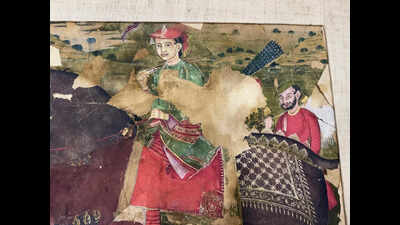
The 1853 portrait of Rani Jhansi recently surfaced during archival work under the Gyan Bharatam Abhiyan. Maharaja Kishan Singh Ju Dev, then MP from Datia, donated royal documents and paintings during the Datia state museum’s inauguration in 1986. This portrait was a part of the donations.
Bhopal: For decades, it lay quietly inside Datia Museum’s archives — a fading royal portrait mounted on ancient paper, its gold dust still glinting under light. Now, experts believe the artwork is the oldest surviving contemporary depiction of Rani Lakshmibai of Jhansi.The painting surfaced during archival work under the Gyan Bharatam Abhiyan after Madhya Pradesh archaeology commissioner Madankumar Nagargoje — a former Datia collector — discussed the museum’s little-known Maratha paintings with current Datia collector Swapnil Wankhede and proposed bringing them under the conservation programme.What followed was an intensive examination of the relic by archives expert and Gyan Bharatam mission nodal officer Nilesh Lokhande, archaeologist Wasim Khan and Datia Museum deputy director PC Mahobiya.“Use of natural pigments, extensive use of gold, and intricate detailing that was the hallmark of Datia’s Bundela painters and detailed study guided us towards the final conclusion that the portrait was definitely that of Rani Lakshmibai, dating around 1853. It gave us goosebumps,” Lokhande said. “The portrait shows Lakshmibai in elaborate Maratha attire, wearing a jewelled kalagi (crown) and riding a richly ornamented Arabian horse during what appears to be a temple procession.
Maratha soldiers walk behind her beneath a ceremonial peacock ‘chavar‘ (ceremonial fly-whisk),” he added.Though part of the artwork is damaged, experts believe the partially visible cap behind the queen belongs to her adopted son, Damodar Rao.Wasim Khan, an archaeologist who is an expert on Jhansi history and a direct descendant of Lakshmibai’s ADCs Kasim Khan and Gul Mohammad, believes the work was “likely commissioned during celebrations surrounding Damodar Rao’s adoption — the event that challenged the British Doctrine of Lapse”.“The procession shows a happy queen on a temple visit,” Khan said. “After Jhansi fell, British forces looted the palace and there was bloodshed everywhere. Historical records mention that cleaners from Datia were later sent to Jhansi. Possibly, the painting hanging inside the palace found its way to Datia at that time and finally to the archives.”Mahobiya said the painting had remained preserved in the museum since 1986, when Maharaja Kishan Singh Ju Dev, then MP from Datia, donated royal documents and paintings during the museum’s inauguration.
“The discovery of what is most likely the first real portrait of Rani Lakshmibai fills us with pride and will give a greater push to conservation,” he said.What about a popular portrait that is all over the Internet with Lakshmibai in her armour suit? Wasim Khan explained, “Records point out that this popular version of the queen was commissioned years after her death in Indore by her adopted son; he was 13 at the time of her death, so the popular version was made using his memory. But the one found from Datia archives is the oldest and most authentic because it was commissioned by the queen herself in all likelihood to announce the adoption, years before her death by an artist who saw her up close.
”




 English (US) ·