

 3 days ago
5
3 days ago
5
ARTICLE AD BOX
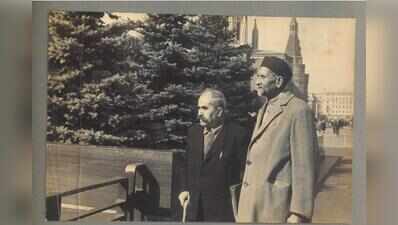
Rafiq Ahmed with Avanes Baratov at the Kremlin in 1967. Both of them participated in the struggle against counter-revolutionaries in 1920
Bhopal: Bhopal’s Rafiq Ahmed carried a distinction that very few in the global history of resistance could claim credit for — an Indian freedom fighter who was honoured by both his homeland and Russia.
To the people of Bhopal, he was the soft-spoken ‘Rusi Miyan’ of Retghat. To Vladimir Ilyich Lenin and his Red Army, he was a towering comrade who spilled his blood for the revolution. This is the incredible, cross-continental odyssey of a man who fought mighty empires. It went thus.In 1920, a hot-headed Rafiq, in his 20s, strode into Delhi’s Khilafat Movement, burning with righteous indignation, with the fiery resolve to free his motherland.
As the British cracked down on the movement and started putting the revolutionaries in handcuffs, he slipped away with a handful of friends towards Kabul where the third Anglo-Afghan war was raging at the time.In Kabul, fate brought him to Maulvi Abdul Rab, an early Indian revolutionary. Rab spoke glowingly of the 1917 October Revolution in the USSR, a crucial part of the Russian Revolution, and of Mohammad Barkatullah and Raja Mahendra Pratap, who had formed an Indian government in exile and travelled to Moscow.
That conversation lit a fuse: Despite lacking money, papers or winter gear, sixty young Indians decided to walk to the Soviet Union.What followed was a brutal, epic trek. They crossed 400–450 kilometres of rugged mountains, forests and burning deserts, until they met a Red Army unit in Termez, in modern-day Uzbekistan.On being told that these Indians meant to meet Lenin, the commander ordered boats for them along the Amu-Darya to the fort of Kerki in Turkmenistan.But back then, Central Asia was itself singed by the flames of a raging civil war. Stranded for weeks in Termez, Rafiq and his comrades did not idle, they picked up rifles. Alongside the Red Army, they fought the British colonial empire’s proxy forces.When they finally set sail for the Soviet Union, tragedy struck as they were ambushed by the Basmachis—counter-revolutionaries lured by British gold. Captured and thrown into Fort Kerki, Rafiq spent a harrowing month in captivity.
Then, a Red Army detachment came to their rescue. What followed was a 10-day battle.“Twenty of my comrades died fighting there,” Rafiq would later recount to the Russian press in 1967, his voice choking, “They were all courageous people who had committed every drop of their blood to the revolution.”When it ended, a military orchestra played ‘Internationale’, USSR’s anthem, on the parade ground as the surviving Indians were sent off, armed, toward Moscow.In 1921, Rafiq arrived in Moscow on a steamer. He subsequently enrolled at the Communist University, a cradle for anti-colonial leaders. He met revolutionaries from across the globe, including Mohammad Barkatullah. But the moment that etched itself into his soul was his meeting with Vladimir Lenin.Lenin told the contingent of Indian revolutionaries: “Study as much as you can, but not just from books. See how people are revolting.
Once you return to India, continue your struggle against imperialism.”In 1922, Rafiq and his comrades returned to India, armed and ready for a renewed struggle for freedom.However, the British were waiting. In Oct 1922, they were arrested and tried in the infamous “Moscow-Tashkent Conspiracy Case”. Ahmed spent the next six months as an undertrial and one year, after conviction, in Peshawar jail, in present-day Pakistan.The court order, dated May 18, 1923, sentencing him to one year RI, is still preserved in the National Archives.When he was released from incarceration, the revolutionary fire hadn’t dimmed.Back again in Retghat, Ahmed lived a quiet life. Letters, books, magazines, even calendars arrived from Russia. Kailash Munshi, whose father Sundarlal Munshi was Ahmed’s close comrade, recalled, “He used to come and get it read by my father as he was not well-versed in English.
As a child, I loved to hear the stories of his travels.”Rafiq even chronicled a book on Lenin in Urdu.In 1967, the Soviet government invited the 75-year-old Rafiq as a state guest for the 50th anniversary of the USSR. Alexei Kosygin, the then-Russian Prime Minister, met him. He was awarded the Soviet Medal ‘For Battle Merit.’Accepting the honour, he said: “Many of us, who survived and later returned to India, died in jails.
I think they all deserve this honour much more than me.” During that visit, he spoke at schools, universities, and factories. He was also taken back to Fort Kerki in Turkmenistan.Then, in Aug 1972, the Union government invited him to Delhi. On Aug 15, he received the ‘Tamra Patra’, the copper plaque given to freedom fighters to mark the 25th anniversary of India’s independence.Those who knew Rafiq remembered a gentle soul. His grandson, Shahab Jameel, told TOI: “The govt had offered him land under freedom fighter’s quota, but he politely refused. He was working on a book on his twin visits to the USSR. The Russian government was supposed to publish it. When his manuscript was ready, he gave it to a friend for review. A few days later, the friend told him that he had lost it. He didn’t say a word in anger to him.”Rafiq Ahmed breathed his last on Aug 4, 1982. A revolutionary to Moscow and a freedom fighter to India, but for Bhopal, he was ‘Rusi Miyan’ — the man who walked for a revolution and came home.






 English (US) ·