

 1 hour ago
5
1 hour ago
5
ARTICLE AD BOX
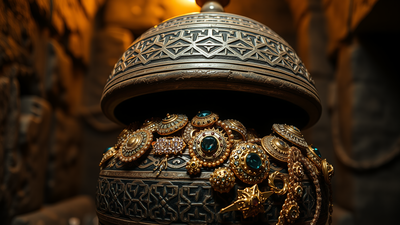
Archaeologists excavating the ancient site of Diriyah in Saudi Arabia's Al-Qassim region have made one of the most dazzling discoveries in recent Middle Eastern archaeology: a ceramic jar packed with over 100 pieces of gold, silver, and gemstone-encrusted jewellery buried more than 1,200 years ago.
Dubbed the "Diriyah Treasure" by the Saudi Heritage Commission team that found it, the hoard dates to the early Abbasid period and was discovered along what was once a busy medieval Hajj pilgrimage route connecting Basra in southern Iraq to Mecca on Saudi Arabia's west coast. Researchers believe the collection may have belonged to a pilgrim who buried it at a settlement stop along the route, though exactly who owned it, and why it was never retrieved, remains one of archaeology's most intriguing new mysteries.
Diriyah gold hoard discovery: What was found inside the ceramic jar
The Saudi Heritage Commission, which has been conducting excavations at Diriyah for six seasons, unearthed the buried jar during its most recent dig. Inside, archaeologists found a collection of pieces that appear to have originally formed a single, matching jewellery set. The hoard includes floral gold pendants, decorated discs, multi-coloured beads, finely crafted gold spacers, and a large circular ornament inlaid with coloured stones arranged symmetrically around a central design.
According to the Saudi Heritage Commission's official announcement, the pieces were produced using advanced techniques, including hand-hammering of gold sheets, decorative embossing, and stone inlay work that reflect a high level of metalworking skill. The same excavation season also turned up gypsum water basins and the walls of residential buildings, alongside fragments of pottery, glass, and metal tools, pointing to a functioning permanent settlement rather than a temporary stopping camp.
The Abbasid Caliphate era: The Islamic Golden Age behind the jewellery
The jewellery has been dated to the early Abbasid caliphate, which rose to power in 750 CE and would go on to rule much of the Islamic world until its destruction by the Mongols in 1258. Named after one of the Prophet Muhammad's uncles, the Abbasid dynasty is closely associated with what historians call the Islamic Golden Age, a period of extraordinary advancement in science, medicine, literature, mathematics, and the arts.Geographically, the Abbasid Empire stretched from North Africa to present-day Iran, but its beating heart was the Arabian Peninsula and modern-day Iraq, with its capital established at Baghdad. The empire's prosperity funded remarkable patronage of the arts, and this included goldsmithing. Relatively little gold and silver metalwork from this era has survived, making the Diriyah Treasure not just visually striking but historically significant.
The floral and geometric motifs seen on the recovered pieces are consistent with the Abbasid artistic tradition, which blended Persian, Mesopotamian, Byzantine, and Arabian design influences into a distinct aesthetic that would shape Islamic art for centuries.
The ancient Basran Hajj pilgrimage route through Saudi Arabia
The location of the find is just as telling as the objects themselves. Diriyah, situated on the outskirts of present-day Riyadh, sat along the historic Basran Hajj route, the overland pilgrimage road that connected the Iraqi port city of Basra to Mecca.
Radiocarbon analysis of organic material at the main settlement puts the site's active occupation between 743 and 753 CE, placing it squarely in the early Abbasid period.The Basran route was one of several major pilgrimage roads that funnelled the faithful toward Mecca each year. The most famous of these was the Darb Zubaydah, a comprehensive road network stretching over 1,400 kilometres from Kufa to Mecca, named after Zubaydah bint Ja'far, wife of Caliph Harun al-Rashid, who commissioned it. The UNESCO World Heritage tentative listing for the Darb Zubaydah describes this infrastructure as one of the most ambitious civil engineering achievements of the medieval world, complete with paved sections, water cisterns, milestones, and rest stations all built to serve the tens of thousands of pilgrims who made the journey each year.The Hajj, considered a religious obligation for every adult Muslim who is physically and financially able to perform it, drew pilgrims from across the vast Abbasid Empire. Diriyah was one of the key stations along this route where travellers would rest, resupply, and take shelter before continuing westward.
Why was the Diriyah treasure buried? The pilgrim theory
The central question surrounding the discovery is straightforward but unanswered: why was such a valuable and carefully assembled collection of jewellery buried in a ceramic jar and never recovered? Researchers have not yet been able to identify the owner or establish definitively whether the hoard belonged to a pilgrim en route to Mecca.The pilgrim theory is, however, plausible given what we know of medieval travel conditions. Long-distance Hajj journeys were not without risk. Pilgrims carried their wealth with them, and routes, even the well-maintained Abbasid ones, were vulnerable to robbery and banditry, particularly in the later Abbasid period as central authority weakened. A traveller passing through Diriyah who felt their valuables were at risk might have buried the jar with the intention of collecting it on the return journey, an intention that, for reasons lost to history, was never fulfilled.It is also possible that the jewellery belonged to a wealthy resident of the Diriyah settlement itself, hidden during a period of local unrest. The architectural remains at the site, stone building foundations, mud walls, plastered rooms, and fire hearths, confirm that real families lived there. A study on Hajj history and Abbasid-era pilgrimage organisation notes that pilgrims in the Abbasid period sometimes suffered attacks and plunder on the roads, which may have prompted locals and travellers alike to conceal valuables underground.
What the Diriyah treasure reveals about medieval Arabian trade networks
Beyond the mystery of its burial, the collection offers a vivid window into just how connected the medieval Islamic world was. The presence of semiprecious coloured stones in the jewellery points to active trade networks that moved luxury goods across vast distances during the Abbasid period. Materials would have arrived in the Arabian Peninsula via sea routes through Basra, a major port and overland caravan roads that threaded through sites like Diriyah.The craftsmanship itself reinforces this picture of prosperity. Artisans who produced pieces of this quality had access to specialist tools, fine materials, and a tradition of accumulated skill. The Diriyah find stands as rare physical evidence of that world, all the more precious because, as historians note, Abbasid-era gold and silver objects have survived in very small numbers; precious metals were frequently melted down and repurposed in later centuries.








 English (US) ·