

 1 hour ago
5
1 hour ago
5
ARTICLE AD BOX
Last Updated:June 25, 2026, 08:09 IST
Official documents show a bigger threat awaits the country as the storage capacity of its key Tarbela Reservoir has depleted


Faced with uncertainty over river inflows, Pakistan initially projected a system-wide water shortage of around 21 per cent for the Kharif season. (AI-Generated Image)
Pakistan’s water authorities feared a major irrigation crisis after India put the Indus Waters Treaty in abeyance following the Pahalgam terror attack in April 2025, with official Pakistani records showing an anticipated water shortage of up to 21 per cent at the start of the crucial Kharif crop season last May.
An official Pakistani report reviewed by CNN-News18 shows that Pakistan entered the Kharif season last May expecting significant shortages, with dwindling reservoir levels, uncertainty over river inflows and growing concern over reduced flows in the Jhelum-Chenab system. Then, floods saved the day for Pakistan.
These recent internal documents show officials repeatedly expressed concern over reduced inflows in the Jhelum-Chenab river system and approved plans to manage significant shortages during the season.
ALSO READ | India Launches Two Major Chenab Projects Amid Indus Treaty Freeze | Exclusive
At one meeting, the report notes that Pakistani officials explicitly referred to a “crisis created by India short supplies in Chenab River" and decided that reservoirs would need to be operated carefully to protect provincial water allocations.
But the crisis Pakistan was preparing for never arrived.
Instead, a combination of stronger-than-expected snowmelt and massive floods in August 2025 transformed the country’s water outlook, leaving reservoirs nearly full by the end of the season and eliminating fears of a major shortfall.
Bigger Danger Ahead
But the same report also highlights an impending danger. If the Indus River is Pakistan’s lifeline, the Tarbela reservoir in Pakistan is its water bank as it helps regulate water supplies to the vast Indus Basin Irrigation System, which supports nearly 90 per cent of Pakistan’s agricultural production.
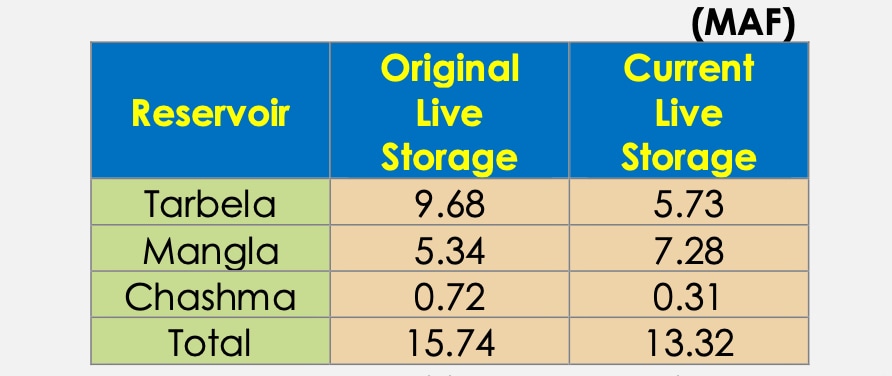
When Tarbela was originally commissioned, it had a live storage capacity of 9.68 MAF. Today, that figure has fallen to about 5.73 MAF, meaning the reservoir has lost roughly 48 per cent of its original storage capacity due to decades of sediment accumulation, the report says.
Tarbela also plays a critical role in electricity generation and drought management.
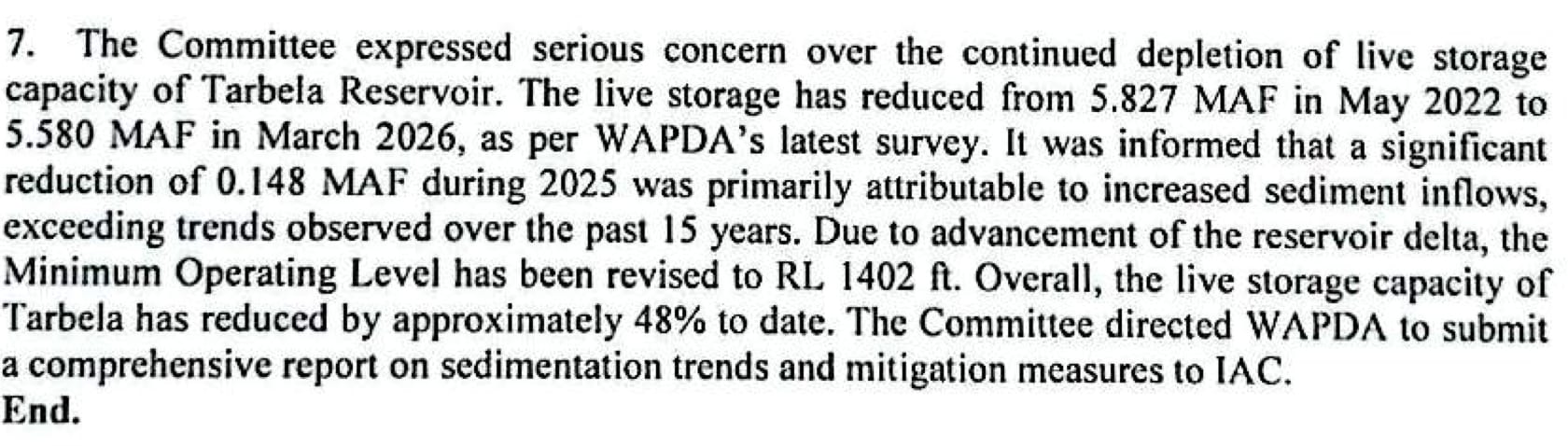
That is why a warning contained in Pakistan’s latest water assessment has attracted attention. According to the report, Pakistan’s water authorities have expressed “serious concern" over the continued depletion of Tarbela’s live storage capacity.
Government surveys show that Tarbela’s live storage declined from 5.827 MAF in May 2022 to 5.580 MAF in March 2026, with a particularly sharp loss recorded during 2025.
Officials attributed the reduction primarily to unusually high sediment inflows that exceeded trends observed over the previous 15 years. The numbers highlight a challenge that floods cannot solve.
How Pakistan Was Saved Last Year
According to official figures, Pakistan had projected Kharif-season inflows of 104.03 million acre-feet (MAF). The actual inflow turned out to be 122.36 MAF, around 18 per cent higher than projected and well above recent averages.
The anxiety inside Pakistan’s water establishment was not without reason.
The Kharif season began in May with the country’s two biggest reservoirs — Tarbela and Mangla — operating close to dead storage levels. Carry-over water from the previous season was negligible and live storage was at a minimum.
Faced with uncertainty over river inflows, Pakistan initially projected a system-wide water shortage of around 21 per cent for the Kharif season and deferred approval of a full-season water distribution plan. Punjab and Sindh, which account for the bulk of Pakistan’s irrigated agriculture, were expected to absorb most of the reductions.
The picture changed dramatically in the second half of the season.
Rising temperatures in the upper Indus basin accelerated snowmelt, increasing flows into the river system. Then, in late August, intense rainfall over the catchments of the Chenab and eastern rivers triggered exceptionally high floods.
The floodwaters fundamentally altered Pakistan’s water balance.
Instead of grappling with shortages, the country suddenly found itself receiving far more water than anticipated. Total inflows at rim stations reached 122.36 MAF, substantially higher than both official projections and historical averages, the report says.
The impact was visible almost immediately.
By September 2025, Pakistan’s major reservoirs had filled to nearly 99 per cent of capacity, a remarkable turnaround from the near-dead storage conditions that prevailed at the beginning of the season. The abundance of water was evident elsewhere too, as per the report.
The Pakistani report shows that escapages downstream of Kotri Barrage touched 30.85 MAF, more than three times the volume originally anticipated and about 71 per cent higher than the recent five-year average.
The episode offers a rare glimpse into how Pakistan’s water planners viewed the months immediately after India’s decision on the Indus Waters Treaty.
The records show authorities were clearly preparing for a difficult season and repeatedly flagged concerns over reduced flows in parts of the western river system. Yet by the end of Kharif 2025, it was not diplomacy or treaty politics that shaped the outcome. It was a season of exceptional snowmelt and floods that turned an anticipated water crisis into one of the strongest water years in recent memory.
Any change in Indus Basin flows has major implications for food security, as 90 per cent of agricultural production depends on the Indus Basin Irrigation System.
Handpicked stories, in your inbox
A newsletter with the best of our journalism
About the Author

Aman Sharma, Executive Editor - National Affairs at CNN-News18, and Bureau Chief at News18 in Delhi, has over two decades of experience in covering the wide spectrum of politics and the Prime Minister...Read More
News india Pakistan Feared Major Water Crisis After India's Indus Treaty Move, Floods Saved It | Exclusive
Disclaimer: Comments reflect users’ views, not News18’s. Please keep discussions respectful and constructive. Abusive, defamatory, or illegal comments will be removed. News18 may disable any comment at its discretion. By posting, you agree to our Terms of Use and Privacy Policy.
Read More









 English (US) ·