

 1 hour ago
6
1 hour ago
6
ARTICLE AD BOX
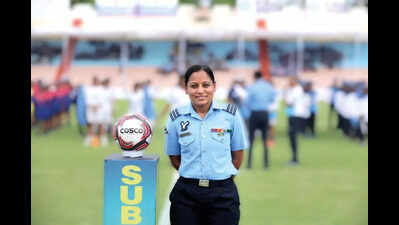
Panaji: She watched military aircraft during the Balakot airstrikes of Feb 2019. Just three years earlier, she officiated a Fifa World Cup final. Wing Commander Uvena Fernandes never did anything the ordinary way.
Her life began at Palolem, Canacona, where she lost her father before she was old enough to remember his face, and she was raised in her aunt’s home while her mother worked abroad to keep the family afloat.Before flying back to Bengaluru, where she is posted, Uvena spoke to TOI about training other women in the Armed Forces, the Fifa Under-17 World Cup finals in Jordan, and her role as a mother to a son answering his board exams.
“As a child, I always wanted to be an officer, but the idea of joining the armed forces struck me when I went to officiate a football match at the 3 Military Training Regiment (3MTR), at Margao. I was studying my master of laws (LLM) at that time,” said Uvena.Today, at 44, she has the distinction of playing for the country, cracking the Service Selection Board for the Indian Air Force and the Indian Army, and wearing the Fifa badge in not one but two World Cup finals, the first Indian ever to do so.
Uvena cannot talk about her role in the Indian Air Force’s pre-emptive strikes targeting a suspected Jaish-e-Mohammad (JeM) terrorist camp in Balakot, Pakistan. But her voice lifts a little as she talks about her posting at a frontline airbase in North India.For Goa, a small state that quietly punches above its weight in sport and the Armed Forces, Uvena is something rare.Her early life was difficult. The loss of her father at an early age meant that her mother was compelled to move abroad to support the family.
Uvena grew up in the shelter of her relatives in Quepem until she found her home in football. She rose to represent Goa at the state level and India internationally, including in the AFC Women’s Asian Cup. She played for Mohun Bagan, the Kolkata club whose green-and-maroon jersey carries more than a century of sporting mythology.In 2003, she picked up the whistle. Making the transition from player to referee is not a common one, and rarer still for women in India, where football officialdom was an almost exclusively male preserve.
But Uvena was not interested in what was common.“The loss of my father and when my mother went to work abroad really shaped me. I saw my mother working really hard to support us, and that made me really strong,” said Uvena.She was commissioned into the Indian Air Force as an administrative and air traffic control officer in Dec 2006. At the Air Force Academy, she became the first and only woman cadet to be appointed Academy Cadet Captain, the highest cadet position, and won the best-in-outdoor-training award for two consecutive terms.Since then, she served at Allahabad, Bagdogra, Chabua, Ambala, and currently at Air Force station, Yelahanka, maintaining a flawless record: zero incidents, zero accidents. In a profession where a momentary lapse in air traffic control can cost lives, that record is not incidental. It is everything.In 2016, she walked out to officiate the final of the Fifa U-17 Women’s World Cup in Jordan. The significance of the moment was not lost on Indian football: no Indian, of any gender, ever stood as an official in the final of any Fifa World Cup.“It was overwhelming to officiate a Fifa final. But I told myself that every match is important,” said Uvena.Her most recent chapter in uniform was at the Airmen Training School in Belagavi, where she was tasked with something unlike anything before: training the first five batches of Agniveervayu women and men.“I was very fortunate to be selected to train one of the first batches of Agniveers. It was a great opportunity to work with the young Agniveer girls.
Many of them continue to stay in touch,” Uvena said.“When a woman wants to lead, it is not by talking but leading by example. Pressure will come everywhere, and we must learn to handle this in life,” Uvena said.In 2010, she became a mother. Waiting patiently outside the examination centre in Margao, she describes her son, who is now 15 and representing Goa in BCCI’s under-16 cricket, as both her weakness and her strength. It is a phrase that sits quietly and says a great deal.Married to an Indian Army officer, theirs is a home built on two uniforms, two careers, and the daily negotiation of duty and family.





 English (US) ·