

 1 hour ago
4
1 hour ago
4
ARTICLE AD BOX
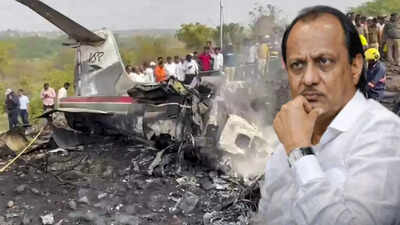
MUMBAI: The Aircraft Accident Investigation Bureau (AAIB) in its preliminary report on the fatal Jan 28 Learjet crash at Baramati has flagged pilots' non-adherence to standard operating procedures, low visibility and absence of basic meteorological facilities at the uncontrolled airfield.
The report said that the crew attempted the visual landing despite being informed that the visibility was only 3 km. A minimum visibility of 5 km is mandated for visual landing. The factors given in the preliminary report were put forth in the early narratives that emerged after the accident.On Jan 28, a Learjet operated by VSR Ventures took off from Mumbai and crashed before landing at Baramati. All five persons on board were killed in the accident, including the then Maharashtra deputy chief minister Ajit Pawar.
The preliminary report, which carries the timeline of the occurrence shows the last proper communication between the pilot and the Baramati air traffic controller was at 08:43:55 seconds when the co-pilot radioed, "Field in sight". At 08:44:13 the pilot can be heard saying "Oh s**t, oh s**t" before the aircraft crashed at the left side of the runway. The report does not give details of what transpired in the final 18 seconds before the impact.
CCTV footage from a local gram panchayat office showed the aircraft banking sharply just before the crash. The preliminary report instead has a satellite image tracing the probable flight path of the aircraft after the go-around. A green-marked flight track shows the aircraft approaching from the right of the runway centreline, never properly aligned with the strip visible at the end of the path.
Based on the depicted track, the aircraft appears to have remained offset to the right of runway 11 before making a pronounced left turn in the final moments.The report states: "As per the CCTV footage installed in a nearby village, the aircraft was observed to have banked towards right before impacting the terrain. The aircraft first impacted the trees before hitting the ground which is at a lower elevation than the runway surface. The ground impact of the aircraft was at a lateral distance of about 50 meters on the left edge of runway 11," the report said.Safety experts pointed out the confusion over whether the aircraft sharply banked right or left.
Capt Amit Singh of Safety Matters Foundation said: "The plotted track shows the aircraft to the right of the runway whereas the report's own narrative indicates the aircraft impacted terrain left of the runway and that the aircraft was in a right bank at impact." He added that the report "remains data-light against reasonable public expectations for evidence-backed transparency, especially given that it confirms that Flight Data Recorder (FDR) data was successfully downloaded".
"It contains a flight track plot presented without a stated data source, despite apparent inconsistencies when compared with the reported wreckage location and aircraft attitude at impact... The public does not need conclusions at the preliminary state, but it does need sourced facts," he said.Rohit Pawar posted on X that the AAIB did not prepare the report with seriousness.The final report is expected to carry more details. If the deadline has to be met, it should be released on or before Jan 2, 2027. In its interim safety recommendations, the AAIB has asked the DGCA to ensure stricter compliance with standard operating procedures for flights operating to uncontrolled airfields, particularly adherence to minimum visibility requirements. It has called for directions to aerodrome operators to permit operations only when weather conditions meet prescribed criteria. The Bureau has also recommended that safety standards at uncontrolled airfields be strengthened through oversight and audits, that basic meteorological facilities and improved landing aids be introduced to support non-scheduled and charter operations, and that the feasibility of formally licensing such aerodromes for safe, regulated operations be examined.








 English (US) ·