

 1 hour ago
4
1 hour ago
4
ARTICLE AD BOX
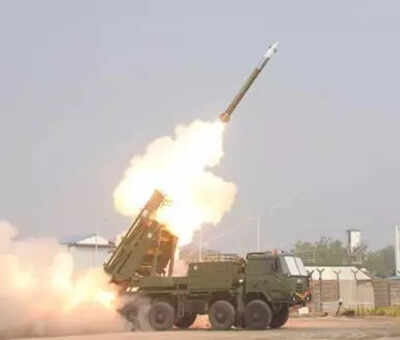
Pinaka (Image courtesy: PIB)
In December last year, the Defence Research and Development Organisation (DRDO) successfully carried out the maiden flight test of the Pinaka Long Range Guided Rocket. The system is now being compared to the BrahMos supersonic cruise missile, which played a decisive role in compelling Pakistan to seek a ceasefire at the end of the four-day conflict in May 2025.Developed by DRDO in collaboration with Tata Advanced Systems Limited (TASL) — marking the first public-private partnership in India’s defence systems — the Pinaka Multi Barrel Rocket Launcher (PMBRL) is designed to deliver a high volume of fire in a very short time against critical and sensitive area targets.Pinaka: The 'baby Brahmos'Known for its area-saturation capability, Pinaka has steadily evolved from a support rocket system into a precision-guided platform.
Owing to its growing accuracy and destructive power—comparable in impact, though not in range or speed, to the BrahMos—the system is now informally being referred to as “baby BrahMos.” However, the label is not a marketing gimmick; it reflects a shift in military doctrine. Upendra Dwivedi recently underscored this logic, stating that advanced yet affordable weapons are vital if India is to sustain operations during a prolonged and intense conflict.
In essence, quantity has regained strategic significance in modern warfare.Parliament backs shift in doctrineThe Parliament’s Standing Committee on Defence has endorsed this strategic shift. In its recent report, the committee emphasised that India must be capable of manufacturing weapons domestically in large numbers and at low cost—especially during a prolonged, high-intensity conflict. This recommendation aligns with the government’s Aatmanirbhar Bharat push in defence.
A growing share of the defence budget is now earmarked for indigenous procurement, reducing reliance on foreign suppliers who could be constrained by geopolitical considerations during wartime.How Pinaka fits into economics of warfareRecent global conflicts have reshaped the economics of warfare. In the Israel–Hamas war, Israel reportedly deployed interceptor missiles costing lakhs to neutralise rockets worth only a few thousand.
In the Russia-Ukraine war, relatively inexpensive drones destroyed tanks and armoured vehicles worth crores. In Sudan and Myanmar, non-state actors have used improvised or low-cost systems to disrupt conventional military forces. The pattern is clear: cost asymmetry now defines modern conflict. Wars are no longer won solely through a handful of technologically superior platforms; they are sustained by large stockpiles of affordable, domestically produced weapons. This is where Pinaka fits in. Unlike a cruise missile such as the BrahMos—designed for high-value targets—Pinaka rockets can be manufactured in far greater numbers and deployed repeatedly.No longer a domestic programmeArmenia is already receiving the Pinaka system from India under an agreement signed in September 2022 and is its first foreign buyer. France has also shown interest. This matters because exports strengthen production lines, and robust production lines, in turn, reinforce war readiness.








 English (US) ·