

 1 hour ago
5
1 hour ago
5
ARTICLE AD BOX
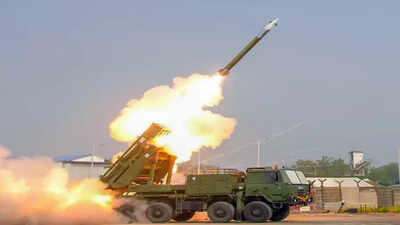
Washington, (IANS) India's new Pinaka Long Range Guided Rocket (LRGR-120) marks a major doctrinal shift for the Indian Army, transitioning from "volume saturation to precision strike", a report said on Tuesday
India’s development of long-range rocket systems such as Pinaka and the upcoming Suryastra marks a decisive shift in how the country will approach future wars, especially in the era of non-contact warfare.Traditionally, artillery and rocket systems were battlefield support weapons, providing firepower close to troops, as in the Kargil War or the use of Katyusha rockets in World War II. With ranges now extending hundreds of kilometres, these systems are evolving into strategic assets capable of shaping the battlefield well beyond the frontlines.Pinaka, already combat-proven, has advanced from an initial 40 km range to guided variants offering precision strikes up to 120 km.
Suryastra, envisaged as a next-generation long-range rocket system, is expected to push those boundaries further, potentially rivaling missile systems in reach and accuracy. Together, they embody a new philosophy: delivering massed, precise firepower deep into enemy territory without direct troop engagement.This capability is central to non-contact warfare, where the emphasis is on striking from a distance, disrupting logistics, neutralising command centres, and degrading air-defence networks before ground forces move.
Long-range rockets enable India to impose costs on adversaries while minimising exposure of its own forces. They also provide flexibility—useful for punitive strikes across contested borders or as a deterrent against larger adversaries.Many targets struck during the active phase of Operation Sindoor fall within the 120 km range of the latest Pinaka variant under development.A similar long-range effect was recently demonstrated by the US military in strikes against Iran, with US Central Command claiming the longest field-artillery strike in army combat history — notable because the action was described as a field-artillery strike.
The integration of advanced guidance, modular warheads and networked targeting makes these systems precision tools rather than blunt instruments. In future conflicts, India’s reliance on long-range rocket artillery should reduce dependence on manned platforms for deep strikes, complementing drones, cruise missiles and air power within a structured strike doctrine.Pinaka and Suryastra thus symbolize India’s shift toward a modern, technology-driven military posture, where wars are increasingly decided by who can dominate the battlespace without direct contact.









 English (US) ·