

 1 hour ago
7
1 hour ago
7
ARTICLE AD BOX
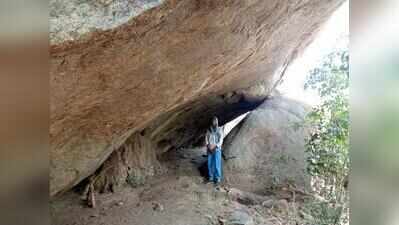
V Srimalini at the rock shelter at Ayilam village in Ranipet district
Chennai: A student from the University of Madras has found a new prehistoric site with rock shelter, rock art, stone tools and pottery fragments at Ayilam village in Ranipet district, some 127 km from Chennai.The rock shelter was situated on the elevated hillock within the isolated hill ranges of the Eastern Ghats where the student found a variety of stone tools including discoidal and multiplatform cores, scrapers, burins, notched tools and debitage primarily made from quartz.Researchers said the rock shelter was a big one and an ideal habitation site for the Stone Age people. Scrapers were found in good numbers, indicating the site could belong to the Middle Palaeolithic period, they said.
However, the site needs to be studied to assign the time period.“Pottery fragments such as red ware, red slipped ware, rusticated ware, red and black ware were found within the rock shelter, suggesting continued occupation of the site,” said V Srimalini, a student from the department of ancient history and archaeology, University of Madras, who found the site.In addition to these artefacts, four small megalithic burial structures were identified.
“Out of these four burials, two were located at the foothills and two at the hilltop. These burials, likely dolmens, consist of small chambers constructed with orthostats and capstones, measuring approximately 20 cm to 30 cm in height and 50 cm to 60 cm in width,” she said.The exploration was carried out under the guidance of J Soundararajan, associate professor and head, department of ancient history and archaeology.“One of the most intriguing discoveries is the presence of rock art on the shelter’s surface. Though largely faded, an abstract motif created using white ochre was identified. The discovery suggests that the rock art may date to the Iron Age or Early Historic Period, supported by similar findings in nearby regions and the associated pottery assemblage,” said Jinu Koshy, excavation in charge, department of ancient history and archaeology.“However, calcium deposits have obscured portions of the artwork, indicating the need for further conservation efforts. This is the first recorded instance of such a combination of rock art and quartz-based lithic tools in this region,” he added.Researchers said the Ayilam site is an important site for understanding prehistoric life and the evolution of early human societies in south India. University of Madras is planning to excavate the site to date the period.







 English (US) ·