

 1 hour ago
5
1 hour ago
5
ARTICLE AD BOX
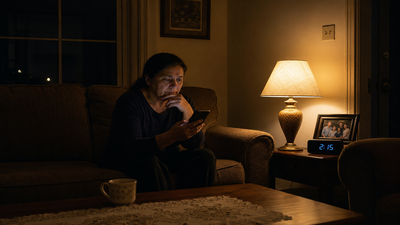
Parents staying awake until their adult children return home aren't overreacting; their brains are hardwired to protect loved ones. This innate alarm system, driven by evolutionary biology, can override logical thinking, especially when a child is out late or in potentially risky situations. Image Credit: ChatGPT
It is very late, and apart from the light from one lamp burning in the living room, everything around is dark. Here, sitting on the couch in the living room, the parent is wide awake while constantly playing with their mobile phone and checking the time every now and then, while listening attentively for any signs of shutting the door somewhere outside the house.
The teenager is no longer a teenager but an adult who works and drives on their own. From the point of view of logic, the parent knows that the child can manage alone in the evening, but cannot sleep.To an adult child, discovering that a parent has stayed up waiting for them can feel incredibly frustrating. It is easily interpreted as a total lack of trust, an annoying overreaction, or a passive-aggressive attempt to keep strings attached to their independence.
Grown children often ask why their parents can't just go to bed, feeling that their maturity is being brought into question.However, a recent study by the journal Behavioral Sciences claims that such sleep deprivation has a strong connection to how attachment models function during the interaction of adults with their children or parents. In this regard, the article describes how the attachment of adults to their parents depends on the inherent attachment system.
Despite the fact that adult children do not have much opportunity to give care due to daily stresses, parents might be more able to adapt to the needs of their children.
The brain of parents is a dynamic caregiving system that detects signs of distress in the child. Thus, due to automatic functioning in different generations, a parent's innate alarm system is always ready to respond to the situation when the child is in danger.The hardwired biological alarm systemIt should be noted that keeping a watch at night is just an unconscious decision of a parent, rather than a deliberate choice of worrying about something or treating their adult child like a kid. This process is the work of the deep evolutionary software of their brain. For a long period of time, parents are highly motivated to make sure that the child is not in danger.When an adult child stays up past bedtime, the analytical side of the parent's brain knows there is nothing wrong.
However, the more primitive side of the brain is not as sensitive to schedules or years passed. It sees nothing but a raw reality: someone they are programmed to safeguard is outside at night, and they have no way to ensure that they are safe. In order to make sure the parent remains vigilant and prepared for any eventuality, stress hormones are secreted constantly in small amounts.
It is difficult to sleep when your internal warning system feels like it is functioning.

Understanding this involuntary caregiving impulse can foster empathy and improve family dynamics, encouraging open communication instead of defensiveness. Image Credit: ChatGPT
Why late nights override logical thinkingThe internal urge to stay awake becomes particularly intense when environmental triggers mimic the dangers of early childhood. This automatic behavioural shift is heavily backed by data from a University of Michigan Health Poll, which focused on the psychological factors driving how parents manage young adult independence.The findings suggest that even parents who want to give adult children space may still react strongly in certain situations.
If a child is out later than expected, travelling in a risky situation, or moving through an unfamiliar place, a parent's brain may go into panic mode. The brain shifts into its usual protective role.Changing the conversation from control to empathyUnderstanding that this late-night watch may be driven by involuntary neurobiology rather than a desire for control can change family dynamics. It may reduce defensiveness.
When a grown child realises their parent isn't trying to police their freedom or judge their maturity, they can stop viewing the behaviour as an insult.The next time you walk through the front door late at night and see that single living room light turned on, try not to roll your eyes or start an argument. Recognise that you are looking at a parent who has spent the last few hours feeling a strong caregiving impulse. Sending a simple text when you are heading home or saying hello when you arrive can reassure your parents and help them relax.









 English (US) ·