

 49 minutes ago
7
49 minutes ago
7
ARTICLE AD BOX
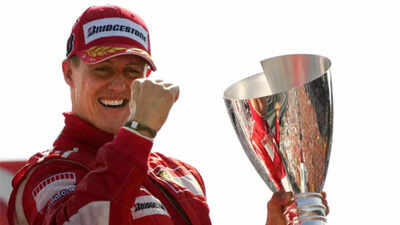
You Have to Prove Yourself Every Time: Why Michael Schumacher’s Words Still Define Excellence
Picture an athlete standing on the podium, champagne still dripping from a hard-earned victory. The crowd is roaring, cameras are flashing, and for a brief moment the world seems settled: This is the champion. Yet within days, perhaps even hours, that certainty disappears. A new race begins, the stopwatch returns to zero, and yesterday's triumph offers no guarantee of tomorrow's success.That relentless reality is captured in one of Michael Schumacher’s most revealing observations:“You win a race, the next race it’s a question mark. Are you still the best or not? That’s what is funny. But that’s what is interesting. And that’s what is challenging. You have to prove yourself every time.”At first glance, the quote seems to describe motorsport alone. Look closer, however, and it speaks to a universal truth. Achievement is temporary. Reputation helps open doors, but performance keeps them open. Whether in sport, business, science or the arts, excellence is not a destination—it is a standard that must be met again and again.
The driver behind the words
Michael Schumacher, the German Formula One legend, dominated one of the most demanding eras in motorsport. Between 1994 and 2004, he won seven Formula One World Championships and established records that stood for years. His success with Ferrari transformed a team that had endured a long championship drought into the dominant force of the early 2000s.
The quote has been attributed to Schumacher for many years and appears consistently in major quotation collections and interviews compiled from his public remarks.The sentiment shows Schumacher's well-documented approach to racing. Former teammates, engineers and rivals frequently described his extraordinary preparation. He was known for spending countless hours with engineers, testing relentlessly and treating each Grand Prix as a fresh challenge regardless of previous victories. Winning a championship never convinced him that the work was finished. In Formula One, every weekend began with the same question: Who is fastest today?That perspective resonated because Formula One is uniquely unforgiving.
Mechanical reliability changes. Weather shifts unexpectedly. Rival teams introduce upgrades. A driver celebrated one Sunday can struggle the next. Schumacher understood better than most that success in such an environment is always provisional.
The philosophy hidden inside the quote
Schumacher's words display an idea that philosophers and psychologists have explored for centuries: Identity should not rest on past accomplishments.The ancient Stoics argued that people control only their own effort and conduct, not external rewards.
Victory can be influenced by countless factors outside one's control, but discipline remains a personal choice. Schumacher's emphasis on proving oneself echoes this outlook. Yesterday's trophy is outside today's control; today's preparation is not.Modern psychology offers a similar interpretation through the concept of the "growth mindset," popularized by psychologist Carol Dweck. Individuals who believe abilities can be continually developed tend to focus less on protecting their reputation and more on embracing new challenges.
Schumacher's quote embodies that mentality. Instead of fearing the next race because it might expose weakness, he welcomed it because it created another opportunity to improve.There is another psychological insight at work: humans quickly adapt to success. Researchers call this "hedonic adaptation." Promotions, awards and victories generate excitement, but the feeling fades remarkably fast. Schumacher recognized this long before the term became widely known outside academic circles.
The next competition resets expectations, making continued performance—not past celebration—the true measure of excellence.This explains why the quote continues to resonate across cultures. It is not about insecurity. It is about understanding that mastery is an ongoing practice rather than a permanent title.
Why these words matter even more in 2026
Few eras have placed greater emphasis on continuous performance than today's world.In professional sport, champions face instant comparison after every match.
A footballer who scores a winning goal one weekend may be criticised the next for missing a decisive chance. Social media compresses the cycle of praise and criticism into hours rather than weeks.Business operates similarly. Technology companies release successful products only to face immediate questions about the next innovation. Investors rarely reward yesterday's breakthrough for long. Companies that once dominated entire industries have discovered how quickly leadership can disappear when competitors adapt faster.The same principle shapes education. Degrees remain valuable, but employers increasingly look for evidence that applicants continue learning new skills. In fields such as artificial intelligence, cybersecurity and biotechnology, knowledge acquired only a few years earlier can become outdated. Continuous learning has become part of professional survival.Leadership offers another example. Effective leaders cannot rely indefinitely on past achievements or popularity.
Every decision presents another test of competence and judgment. History is filled with executives, politicians and military commanders whose earlier successes created confidence but whose later failures demonstrated that reputation alone cannot sustain authority.The quote even applies to everyday life. Parents continually adapt as children grow. Teachers refine lessons for each new class. Artists face the blank page again after every finished work.
Personal relationships require ongoing trust rather than memories of past kindness.Schumacher's insight reminds us that consistency often deserves more admiration than isolated brilliance.Interestingly, elite performers across different disciplines frequently express similar ideas. Basketball legend Michael Jordan famously spoke about earning respect every season. Tennis champions continue adjusting their games despite decades of success.
Nobel Prize-winning scientists often describe each research project as beginning with uncertainty rather than certainty. Different fields, same principle.What distinguishes Schumacher's wording is its honesty. He does not pretend the constant pressure is pleasant. He calls it "funny," acknowledging the strange nature of competitive life. Yet he immediately adds that this uncertainty is also what makes achievement meaningful.
If yesterday's victory permanently settled the question of who was best, competition itself would lose its purpose.That perspective remains refreshing in an age increasingly obsessed with rankings, followers and permanent labels. Schumacher suggests that real confidence does not come from believing you will always be the best. It comes from accepting that every new challenge offers another chance to earn your place.Long after the checkered flag falls, that lesson continues to travel far beyond the racetrack. The stopwatch may belong to Formula One, but the challenge belongs to everyone: yesterday's success can inspire today's effort, yet it can never replace it. That is precisely why excellence remains worth pursuing.









 English (US) ·