

 57 minutes ago
1
57 minutes ago
1
ARTICLE AD BOX
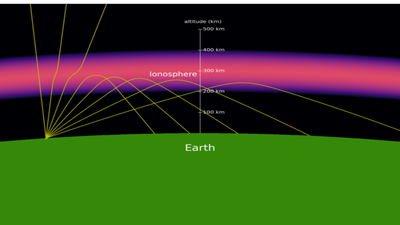
Radio Signal Reflection & Refraction on a Simple Ionosphere Model| Image Credit: Wikimedia Commons
An extremely strong signal of radio waves that originated more than 10 billion years ago has reached our planet, offering scientists an unprecedented opportunity to look back into the era when our cosmos was relatively young.
Known as FRB 20240304B, the new signal is reported to be the most distant localised fast radio burst reported. According to researchers, the fast radio burst originated when the universe was about 3 billion years old, during the universe’s early rapid star-formation phase. This period is referred to as “cosmic noon.”The new discovery was made with the help of the MeerKAT radio telescope located in South Africa by an international team of scientists, including astronomers at the University of Sydney, according to results published on the preprint website arXiv in August 2025.A millisecond-long flash from deep spaceFast radio bursts are very brief but powerful radio pulses that can only be measured in milliseconds. Despite hundreds of FRBs that have been detected over the past decade, the exact reason that causes these fast radio bursts is still not understood by scientists. However, according to the research paper, astronomers have proposed several possible origins, such as magnetars, which are neutron stars with magnetic fields, among other celestial phenomena.
FRB 20240304B was first discovered on March 4, 2024, by Transient User Supplied Equipment connected to the MeerKAT telescope. It had a remarkably high “dispersion measure”, which refers to a parameter used by scientists to estimate the amount of material a radio wave has travelled through the cosmos.They measured the blast wave’s redshift at 2.148 ± 0.001. In astronomy, the redshift allows scientists to understand how far away an object is, and thus, how long its energy has taken to reach the Earth.
They believed that this means the burst took place about three billion years ago after the Big Bang.According to Phys.org, the signal travelled for more than 11 billion years before it was observed on Earth.Why this discovery mattersMost fast radio bursts detected up until now had originated from much closer regions of the universe, usually with redshifts below 0.5. High-redshift fast radio bursts like FRB 20240304B are very useful to scientists, as they can provide insights into the early stages of the universe and the distribution of matter throughout space.According to the paper, the researchers wrote that the discovery “underscores the potential of FRBs as powerful probes of the cosmic web”. The "cosmic web" refers to the vast network of matter and gas stretching between galaxies. These radio bursts are viewed by scientists as useful probes of the cosmic web due to changes in their radio signals while travelling through matter.Moreover, according to the research, the latest discovery has doubled the highest redshift reached by localised fast radio bursts.
Image of a radio telescope| Image Credit: Wikimedia Commons
JWST helped identify the host galaxyOnce the burst was detected, scientists used the James Webb Space Telescope to trace the signal back to its home galaxy. According to the research, the host galaxy is a clumpy and star-forming galaxy that has a stellar mass of about 10 million times that of the Sun. Star formation rates within the galaxy have been estimated to be roughly 0.2 solar masses annually.JWST’s NIRCam and NIRSpec were the instruments used for the discovery, thus enabling the researchers to establish the spectroscopic redshift of the galaxy.
Scientists added that this galaxy is characterised by fairly low metallicity levels, approximately 0 to 20 per cent of the Sun’s metallicity.A signal carrying information about cosmic magnetic fieldsThe event also displayed some very unusual polarisation characteristics. The scientists reported that the linear polarisation fraction for FRB 20240304B was 49 per cent, while its circular polarisation fraction was only 3 per cent.As per the scientists, it may indicate the presence of weak or complex magnetic fields in the signal propagation path.Astronomers believe that studies like this may one day assist scientists in solving the mystery of galactic formation, how matter is distributed through space, and even the origin of FRBs.









 English (US) ·