

 1 week ago
7
1 week ago
7
ARTICLE AD BOX

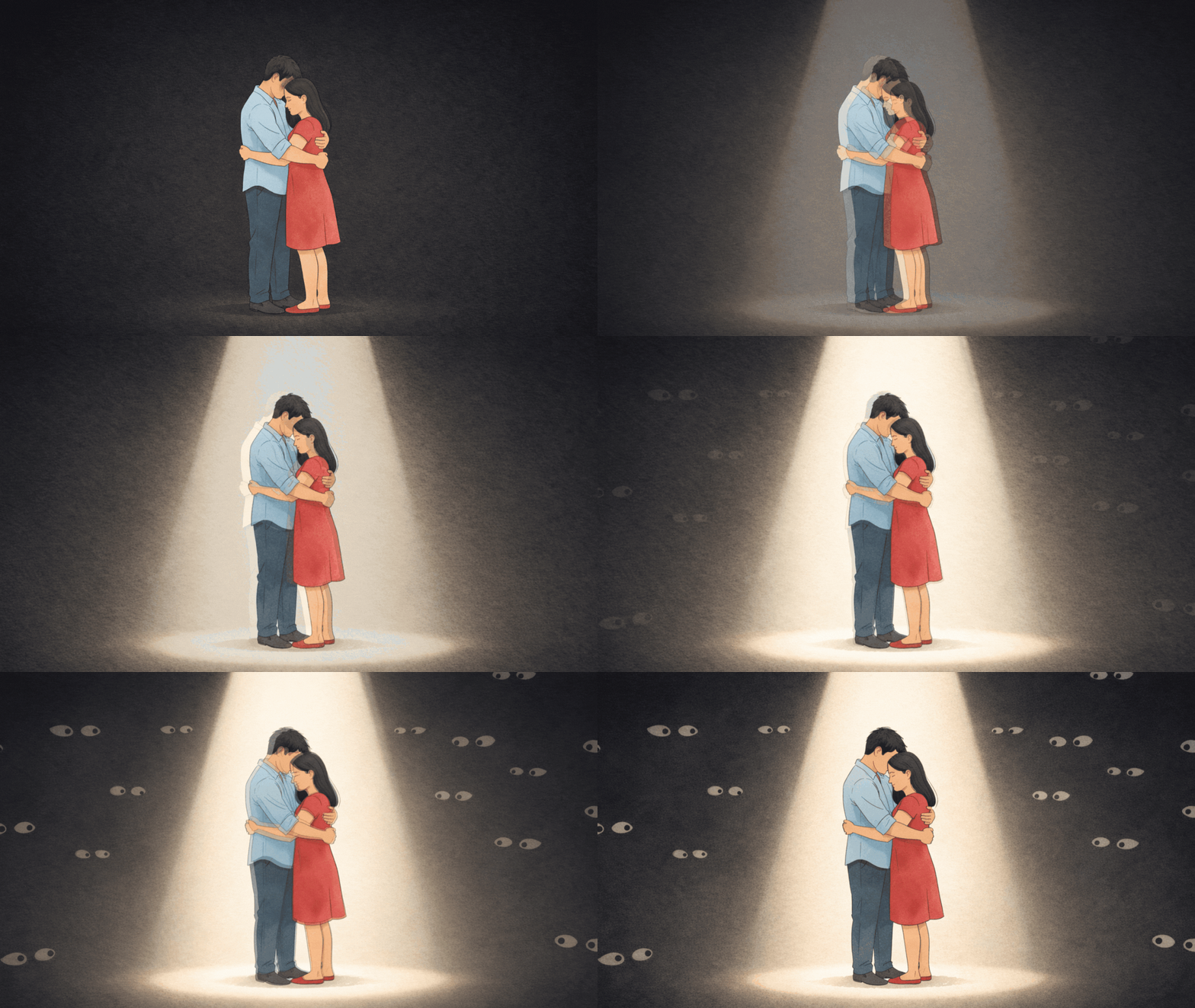
As modern relocated Indian couples embrace urban parenting, they often encounter feelings of disconnection due to the absence of their extended families. This void creates an additional layer of stress for parents, which can restrict children's ability to form a well-rounded view of relationships.
There was a time when raising a child was never just the parents’ job.Someone was always around. A grandparent. An aunt. A neighbour who knew the family history better than the parents themselves.
A cousin who could distract the child when things got tense.Today, in many urban homes, parenting happens in isolation.No backup.No emotional bench strength.No one to step in when both parents are stretched thin.And as much as independence has enabled families to be more efficient, it made parenting more of a burden than it appears.In Indian cities, particularly in the working couples who relocate out of hometowns, children are growing up without the stratified support systems that previous generations had took for granted.This shows up in very ordinary moments.When a child falls sick and both parents are juggling office calls.When school holidays arrive and there is no extended family to absorb the long days.When discipline becomes emotionally exhausting because there is no elder voice to soften or balance it.In many cases, childcare becomes outsourced. Daycare centres, nannies, structured activity schedules.The solutions are useful but they do not substitute emotional continuity.
And parents know it, though they hardly ever say it aloud.Recent urban parenting discussions on social platforms often reflect the same quiet concern. Many first-time parents talk about how every decision feels heavier when there is no experienced elder nearby to offer perspective.A toddler’s tantrum feels like a personal failure.A sleep regression becomes a crisis.A difficult school phase becomes overwhelming because there is no generational reassurance that says, “This passes.”Without roots, everything feels urgent.There is no long memory inside the household to normalise childhood phases.And this is where modern parenting can become emotionally intense.In traditional family setups, discipline was distributed. So was affection. So was responsibility.Now, both parents must play every role.Caretaker.Emotional anchor.Teacher.Mediator.Entertainer.And often, income provider at the same time.This constant role-switching can create fatigue that quietly affects the parent-child dynamic.Not in dramatic ways.But in tone.In patience.In how quickly frustration replaces empathy.This emotional pressure is felt by children particularly in their tender years even when they have no idea about it.They are brought up in secure households, but households in which there is little room to make mistakes.Because when you are raising a child without backup, mistakes feel riskier.There is no safety net.Urban studies on nuclear parenting trends have noted that parental stress levels are significantly higher in households without nearby family support.Not because parents are less capable.But because parenting becomes a closed loop.There is no shared responsibility.No emotional diffusion.And no lived examples for children to observe beyond their parents.This can sometimes narrow a child’s understanding of relationships.They see love mostly through parental roles. They see conflict mostly through their parents. They see care mostly through structured interactions.And they miss out on the layered, imperfect relationships that extended family once offered.So what does parenting without roots require?Not perfection.But intentionality.It may mean building chosen support systems.Friends who feel like family.Community spaces. Neighbourhood bonds. Regular interaction with cousins, even if it needs travel or planning.It may also mean allowing children to experience varied adult relationships so they learn that care does not come from one source alone.And perhaps most importantly, it requires parents to be kinder to themselves.Because raising a child in isolation is not a failure.It is a reality shaped by mobility, ambition, and changing social structures.But recognising its emotional weight helps because children do not need a perfect village. They need a sense that the world is larger than two exhausted adults trying to do everything right.Roots today may not be inherited.But they can still be grown.






 English (US) ·