

 5 days ago
11
5 days ago
11
ARTICLE AD BOX
The programme, aimed at building six advanced AIP-equipped submarines in partnership with ThyssenKrupp Marine Systems and Mazagon Dock Shipbuilders Limited, is seen as critical to modernising the Indian Navy's ageing fleet and countering China and Pakistan's growing maritime presence.
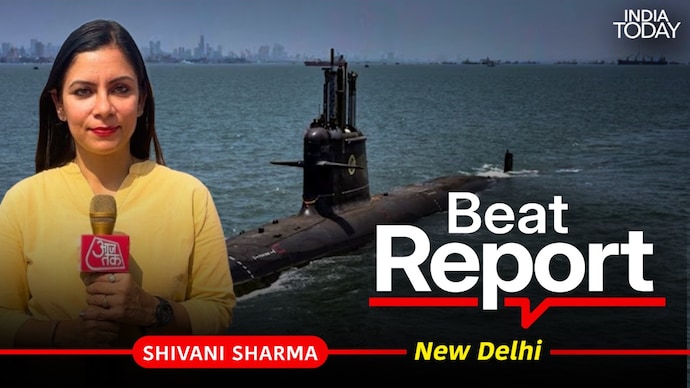
While the visit may not directly conclude negotiations, it is expected to lend momentum to the strategic defence partnership, with cost talks already at an advanced stage.
New Delhi,UPDATED: Apr 21, 2026 09:30 IST
Defence Minister Rajnath Singh is on a three-day official visit to Germany beginning April 21, aimed at strengthening defence industrial collaboration, enhancing military-to-military engagements, and exploring cooperation in emerging domains.
The visit assumes significance as it is his first to Germany since taking office in 2019. The last visit by an Indian defence minister to the country was by Nirmala Sitharaman in February 2019. Germany’s Defence Minister Boris Pistorius had visited India in June 2023, when both sides held extensive discussions on expanding defence ties.
Singh is expected to meet his German counterpart and other senior officials to further deepen the strategic partnership. The visit also comes at a time when India and Germany are in advanced negotiations to finalise a next-generation submarine deal under Project 75I, estimated to be worth around Rs 90,000 crore.
Sources told India Today that while the visit may not directly advance negotiations on the submarine deal, it is likely to provide momentum as both countries look to strengthen long-term defence cooperation.
WHAT IS PROJECT 75I
Project-75 (India), or P-75I, is a key programme aimed at significantly enhancing the Indian Navy’s conventional submarine fleet. The project involves the construction of six advanced diesel-electric attack submarines equipped with fuel cell-based Air Independent Propulsion (AIP) systems, enabling greater stealth and endurance.
The submarines are proposed to be built in India under a strategic partnership between Mazagon Dock Shipbuilders Limited (MDL) and Germany’s ThyssenKrupp Marine Systems (TKMS). The project targets 45–60 per cent indigenisation, in line with the government’s ‘Make in India’ initiative.
First conceptualised nearly a decade ago, the project entered formal discussions in 2020. Sources said cost negotiations are now at an advanced stage, with MDL and TKMS close to finalising the contract. Once signed, it is expected to be one of the largest defence deals between India and Germany.
The P-75I submarines will build on the capabilities of the existing Scorpne-class fleet, incorporating more advanced technologies, sensors and weapon systems.
WHY INDIA NEEDS PROJECT 75I
Recent conflicts globally, including tensions in West Asia, have underscored the importance of maritime security and a robust naval presence. The Indian Navy has played a critical role in safeguarding shipping lanes, including escorting Indian vessels through sensitive routes such as the Strait of Hormuz amid ongoing regional tensions.
Project 75I is seen as crucial for modernising India’s ageing conventional submarine fleet and addressing the growing maritime presence of China and Pakistan in the Indian Ocean Region.
The AIP-equipped submarines will be capable of remaining submerged for longer durations, enhancing stealth and operational effectiveness in complex maritime environments.
INDIA’S CURRENT SUBMARINE FLEET
As of April 2026, India operates a total of 20 submarines. Of these, 17 are under the Indian Navy, while three nuclear submarines are operated by the Strategic Forces Command.
The most recent addition to the nuclear fleet is INS Aridaman. Among conventional submarines, INS Vaghsheer — the latest Scorpne-class submarine — was commissioned in January 2025 by Prime Minister Narendra Modi in Mumbai.
Other Scorpne-class submarines in service include INS Kalvari, INS Khanderi, INS Karanj, INS Vela and INS Vagir. These submarines, built at MDL under the ‘Make in India’ initiative, are equipped with advanced stealth features, modern sonar systems and precision weaponry.
The Navy also operates older conventional submarines, including the Shishumar-class (German-built Type 209) — INS Shishumar, INS Shankush, INS Shalki and INS Shankul — as well as the Sindhughosh-class (Russian-origin Kilo-class), such as INS Sindhughosh, INS Sindhuraj, INS Sindhuratna and INS Sindhushastra.
TIMELINE AND DELAYS
Although Project 75I has faced delays over the years, sources indicated that once the contract is finalised, the first of the new-generation submarines could be delivered within four to five years.
- Ends
Published By:
Priyanka Kumari
Published On:
Apr 21, 2026 09:30 IST
Tune In









 English (US) ·