

 1 hour ago
8
1 hour ago
8
ARTICLE AD BOX
Rajnath Singh laid the foundation stone for a Large Cavitation Tunnel at the Naval Science and Technological Laboratory in Visakhapatnam to boost indigenous naval research.
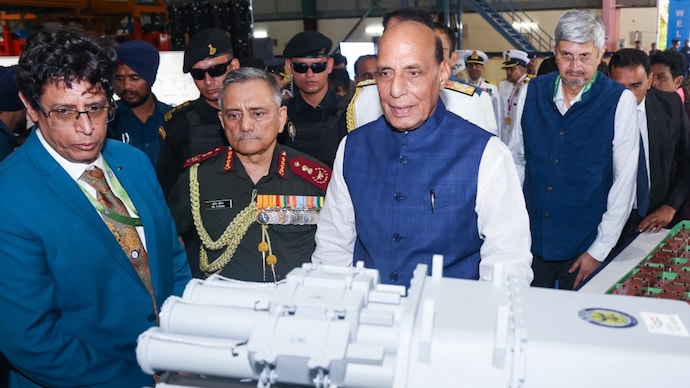
Rajnath Singh laid the foundation stone for a Large Cavitation Tunnel at Naval Science and Technological Laboratory.
New Delhi,UPDATED: Apr 3, 2026 23:45 IST
Raksha Mantri Rajnath Singh on April 3, 2026 laid the foundation stone of a state-of-the-art Large Cavitation Tunnel (LCT) facility at the Naval Science and Technological Laboratory (NSTL) in Visakhapatnam, marking a major step towards strengthening India’s naval research and testing capabilities.
The facility, being developed under the aegis of the Defence Research and Development Organisation (DRDO), is aimed at enhancing indigenous capabilities in hydrodynamic research and reducing dependence on foreign testing infrastructure. Singh said the project would enable India to design, develop and test equipment, systems and sub-systems domestically using its own resources.
Addressing scientists and personnel, the Defence Minister said that the initiative would position India as a strong naval power and a leader in defence technology. “Until now, even after successfully developing systems, we often had to look abroad for critical testing. This situation will now change,” he said, adding that the facility would act as a backbone for submarine and ship design, propulsion systems, noise reduction and stealth capabilities.
Singh described the project as a symbol of Prime Minister Narendra Modi’s vision of Aatmanirbhar Bharat, linking self-reliance directly with national security. He credited domestic industry, academia, MSMEs, youth and researchers for driving India’s progress towards technological independence.
During the visit, Singh was briefed on ongoing projects by DRDO Chairman and Secretary, Department of Defence R&D, Samir V Kamat. He also visited the Seakeeping and Manoeuvring Basin, where advanced underwater systems such as torpedoes, naval mines, decoys and autonomous underwater vehicles (AUVs) were showcased.
A live demonstration of a swarm of man-portable AUVs highlighted India’s growing capabilities in autonomous maritime operations and next-generation underwater warfare technologies. Singh also reviewed spin-off technologies developed by naval systems materials cluster labs following Operation Sindoor.
Commending NSTL’s work in areas including torpedo systems, underwater mines, decoys and AUVs, the Defence Minister noted that advancements in swarm technology and lithium-ion battery development would be crucial for future warfare preparedness. He emphasised that reliable and robust technological systems enhance the confidence and operational effectiveness of sailors deployed at sea.
Chief of Defence Staff Anil Chauhan, Chief of the Naval Staff Dinesh K Tripathi, Flag Officer Commander-in-Chief, Eastern Naval Command Sanjay Bhalla and other senior officials were present at the event.
Conceived as a strategic national asset, the Large Cavitation Tunnel project is being executed in turnkey mode with international technical collaboration, combining global expertise with indigenous innovation. The facility will support both closed-loop simulations for submarine studies and free surface simulations for surface ship research within a single integrated setup.
Once operational, the LCT is expected to significantly boost India’s shipbuilding ecosystem by enabling precise validation of hydrodynamic designs and propulsion systems for major naval platforms, including destroyers and aircraft carriers.
- Ends
Published By:
Akshat Trivedi
Published On:
Apr 3, 2026 23:45 IST







 English (US) ·