

 5 days ago
7
5 days ago
7
ARTICLE AD BOX
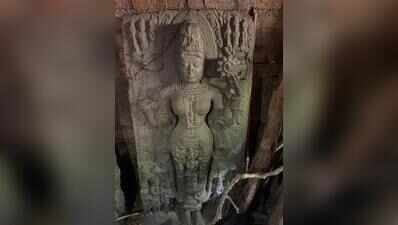
Enigmatic Parmar-era Vaishnavi-Maheshwari idol offers rare evidence of how Indian philosophical thought evolved through synthesis rather than separation. The right half represents Maheshwari, identified by the jata-mukut, while the left is Vaishnavi, wearing the kirita-mukut and bearing the chakra
Bhopal: Long before scholars described Shaiva and Vaishnava traditions as distinct streams of Hindu worship, an anonymous sculptor in the Parmar kingdom imagined something remarkably different.
He carved a goddess who was both. One half embodied Shiva’s power, the other Vishnu’s. Then she disappeared.For nearly a thousand years, the sculpture lay buried beneath the hills of Devbadla in Sehore district of Madhya Pradesh, waiting for archaeologists to uncover a story that stone had preserved but history had almost forgotten.Unearthed recently after excavation resumed at the Parmar-era temple complex at Devbadla after a three-year pause, archaeologists believe the extraordinary Vaishnavi-Maheshwari idol could become Devbadla’s defining legacy — not merely because no comparable female composite deity is known in Indian temple art, but because it offers rare evidence of how Indian philosophical thought evolved through synthesis rather than separation.Veteran archaeologist Ramesh Yadav, who has worked extensively at Devbadla since excavations began in 2016, calls it one of the site’s most intellectually significant discoveries.“It is, to our knowledge, perhaps the only known example where Shaiva and Vaishnava traditions merge in a female deity. Dating back to the 11th-12th century, the idol, carved in volcanic black stone, represents the finest traditions of Parmar art,” Yadav told TOI.
The mystery, however, extends beyond iconography. Why would a medieval sculptor create such an image when sectarian identities were becoming increasingly defined?“The answer lies in the way Indian philosophy evolved — not by replacing one belief with another, but by absorbing, adapting and synthesising ideas. The Devbadla goddess is less a religious icon than a stone manuscript chronicling that evolution,” said state archaeology commissioner Madan Kumar Nagargoje.That, he said, is precisely why the directorate of archaeology has chosen the sculpture to become the face of Madhya Pradesh’s upcoming advanced centre for heritage 3D printing in Bhopal.“This sculpture will be one of the centre’s unique USPs. Through authenticated 3D printing, augmented reality and virtual reality, we want people not merely to see heritage but to experience it. Museums will be able to access replicas on demand while the originals remain protected,” Nagargoje said.He said the facility is also being conceived as a first-of-its-kind practical laboratory for humanities education.Arvind Jain, historian and secretary of Indore’s Kund Kund Gyanpeeth, a research centre for ancient languages and Jain & Buddhist traditions, said: “The Parmar period was marked by an extraordinary spirit of religious inclusiveness. Across Madhya Pradesh, Shaiva, Vaishnava and Jain temples from that era stand side by side, reflecting mutual respect rather than sectarian divides. Khajuraho is a classic example, where Jain temples coexist with Hindu shrines.
The Devbadla Vaishnavi-Maheshwari sculpture is another rare testament to the evolved philosophical and artistic vision that flourished during the Parmar age.”







 English (US) ·