

 1 hour ago
7
1 hour ago
7
ARTICLE AD BOX
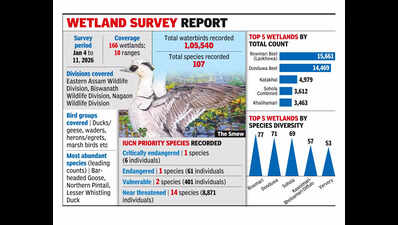
During the 7th Waterbird Count at Kaziranga Tiger Reserve, observers recorded a remarkable first: the elusive Smew duck. This striking winter migrant, never before documented in the UNESCO World Heritage site, stood out among more than 105,000 waterbirds counted, underscoring the global ecological importance of Assam’s wetlands.
Guwahati: The smew (Mergellus albellus), a striking ‘white’ diving duck with males sporting a black-masked white body and females in mottled brown, was sighted for the first time in the Unesco world heritage site Kaziranga during the 7th Waterbird Count at Rowmari-Donduwa beels (Laokhowa) buffer of Kaziranga Tiger Reserve sites.This striking duck is a rare winter migrant to India from Eurasian taiga breeding grounds.It emerged as the ‘star species’ among fresh highlights of the survey, which recorded over 1.05 lakh waterbirds in Kaziranga this year. Smew sightings are sporadic and localised, mainly in northern and central wetlands like Haiderpur (Uttar Pradesh), where it was sighted in 2021, with first records in India noted around Corbett.According to ornithologists, the smew favours fish-rich, sheltered waters during winters, rarely exceeding singles or small flocks. It is globally abundant, with a population of around 1.3 lakh mature individuals, but is declining due to habitat loss and nesting snag removal.State forest minister Chandra Mohan Patowary posted on social media about the smew’s spectacular debut, noting that the first-ever sighting stole the spotlight.
“Thrilled by the 7th Kaziranga Waterbird Count! First-ever sighting of Smew steals the spotlight in a record-breaking census of 105,540 birds! This spectacular debut reaffirms Assam’s wetlands as vital biodiversity hotspots, ” Patowary stated.The report was compiled by Kaizranga Park Authority in collaboration with the Assam Bird Monitoring Network team led by Dr Nilutpal Mahanta, Dr Smarajit Ojah, and Dr Bishwajit Chakdar.
Park officials said the report provided a critical baseline for wetland health, habitat use and conservation strategies.Nilutpal Mahanta, a ornithologist, said, “Smew signals wetland health in India — its vagrant status flags climate-driven range shifts and the need to protect refuelling stops amid hunting and oil pollution threats.”In Kaziranga’s Important Bird Areas( IBAs), this bird underscores floodplain resilience for flyway migrants and guides anti-encroachment efforts, said Smarajit Ojah, another bird conservationist.Kaziranga carries a conservation legacy spanning more than 119 years. With distinctive terrestrial and aquatic habitats, it ranks among the world’s finest protected areas. The tiger reserve shelters the Big Five mammals and is a favoured destination for birders, supported by a diversity of more than 500 bird species.The Tiger Reserve includes numerous wetlands and encompasses two IBAs recognised for their significance to waterbirds — Kaziranga National Park and Laokhowa and Burhachapori wildlife sanctuaries.Over time, Kaziranga’s waterbird count developed into a key instrument for wetland management in one of India’s most premier Tiger Reserves.Park officials said large perennial wetlands recorded high counts, while seasonal wetlands enhanced diversity, underscoring the need for holistic river-beel conservation amid hydrological shifts. They said this tally reaffirmed Kaziranga’s vital role on the Central Asian Flyway for migrants from Siberia and Central Asia, along with resident species.Conducted in phases from Jan 4 to 11 using standardised protocols, the survey involved over 120 enumerators and 50 volunteers, staff and enthusiasts.









 English (US) ·