

 5 days ago
8
5 days ago
8
ARTICLE AD BOX
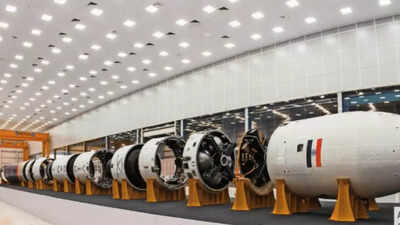
A model of the Vikram-1 rocket at the Skyroot HQ in Hyderabad
Hyderabad-based Skyroot Aerospace is gearing up to launch Vikram-1, India’s first private orbital rocket. The startup is hoping to become a key player in the niche launch segment. But the ultimate aim is to enable space travel for allAs he’s talking up future plans for one of India’s pioneering space startups, Pawan Kumar Chandana, the co-founder of Skyroot Aerospace, employs an analogy that’s unexpectedly, and literally, grounded.
“Think of SpaceX as a transcontinental train or an A380. We’re aiming to become the cab or business jet that drops you at a specific slot in a unique orbit in space with our smaller rockets,” he says.It’s a reference intended to pinpoint where the company sees itself in the vastness, and vast potential, of space operations. The baby steps have been taken with the sub-orbital rocket, Vikram-S, which Skyroot launched successfully in Nov 2022 on its very first attempt, a feat that even Elon Musk’s SpaceX could not achieve.
That distinction burnishes credentials for a company looking for a foothold in the space game even as Chandana’s clear that it’s not aiming at competition with the space giants.What it’s aiming for is a slice of the market that most spacetech giants ignore or don’t cater to — the dedicated launch market or the bespoke, door-to-door missions. The analogy of the train is deployed once again. “The market for train is different and that for cab is different.
SpaceX and all other companies go to some specific orbits, collate all the customers and launch them. It’s a very large market. But we want to address a different niche in the market where people have unique requirements,” he says.The vehicle for those ambitions is already at the launchpad, at least the major bits of it with the rest to follow not much later. The starting point for India’s first private orbital rocket launch is a sprawling, high-ceilinged assembly hall just a stone’s throw away from the busy international airport at Shamshabad.
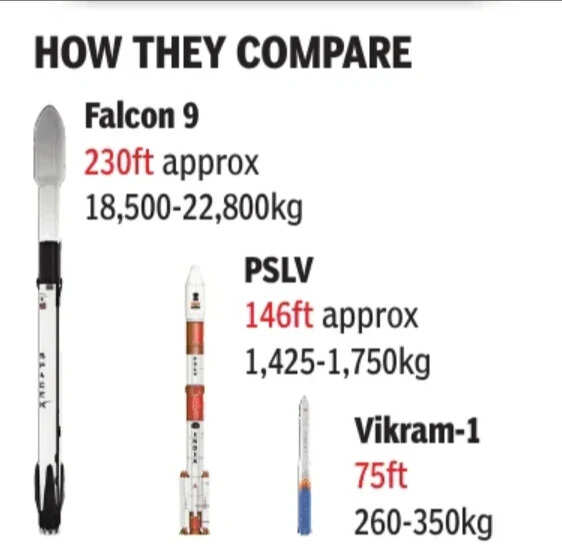
Known as Max-Q, it’s Skyroot Aerospace’s headquarters and the place where the seven-storeyed (75-feet) Vikram-1, named after Vikram Sarabhai, the father of India’s space programme, is coming together.
The rocket has a payload carrying capacity of around 300kg. but in the first orbital mission the payload may be just half that.The blast-off is expected to happen soon, but Chandana is tightlipped. All he will say is that three stages (Kalam-1200, Kalam-250 and Kalam-125), filled with solid propellant, are already at the launch site at Sriharikota.
The rest of the sections — which have a lot of electronics and software — are going through tests in Hyderabad as they gear up to be shipped via specially fitted trucks to the launch site.“The topmost stage, which is the orbit adjustment module (OAM) equipped with the 3Dprinted liquid engine Raman-2, and the other interstages housing all the avionics are undergoing final integration checks. Hopefully, within weeks, we can move them to the launch site,” Chandana said.
The slot for launch, he adds, will be announced after it is formally assigned.
Affordability, accessibility
Being a space startup is different from being a national space programme — budgets, resources, and timelines are tighter, margins of error smaller. The company has raised close to $100 million in funding so far, with some reports indicating that it could emerge as India’s first spacetech unicorn (valuation of over $1 billion) whenever it heads into its next round of funding.
But the output is not about inflows.“To start with we chose to build a smaller rocket that has a very niche market rather than a bigger rocket that caters to the mass market but requires large capital. We will eventually build big rockets but we are taking our initial steps with a niche, growing market as there are very few companies in the world who are doing this,” he says. Even though the tone is measured, the scale of Skyroot’s ambition is nothing short of universal.
‘Opening Space for All’, Chandana points out, is the company’s motto.While a lot hinges on the success of Vikram-1, Skyroot has already laid the groundwork for its mission by prioritising affordability and accessibility. Founded in 2018 by Chandana, now 35, and Naga Bharath Daka, 36, both former ISRO engineers, the company has been steadily working towards developing and launching on-demand rockets for small satellites. VIKRAM-1 AT A GLANCE
- Vikram-1 is set for its first launch this year from Andhra’s Sriharikota
- The rocket has an all-carbon composite structure, uses solid fuel boosters & 3D-printed liquid engine
- It can carry satellites of around 300kg to space, though the first mission may have a payload half that weight
With the IIT-Madras incubated Agnikul Cosmos also gearing up to launch its first orbital rocket, christened Agnibaan — it successfully launched its sub-orbital tech demonstrator, Agnibaan SOrTeD, in May 2024 — India’s private space players are looking set to make waves.Skyroot uses advanced carbon fibre structures and 3D-printed engines (liquid stage) to propel their Vikram series of launch vehicles. And it has also achieved another critical milestone — setting up their Infinity Campus, also near the airport, last year, which will allow them to get one Vikram-class rocket out of the door every month.“Hopefully, we want to reach that cadence next year,” says Chandana. While Vikram-1 will take to the skies from Isro’s Satish Dhawan centre at Sriharikota, Skyroot is looking to conduct subsequent launches from Kulasekarapattinam, where Isro’s private rocket launch pad is expected to be ready by March-end. Eventually, the plan is to have Skyroot’s own launch pad (either at Sriharikota or Kulasekarapattinam) as business grows, indicates Pawan.The business side is shaping up through MoUs with players such as French newspace operator Promethee to launch its satellite constellation (‘newspace’ is a reference to the private enterprise-led space sector), and German satellite aggregator Exolaunch for deploying their satellites on Vikram-1. Skyroot has also inked MoUs with Indian spacetech startups like Dhruva Space and Bellatrix Aerospace.But timelines can be tricky when it comes to space. The company had originally aimed for a 2024 launch timeframe and, more recently, a Q1 2026 timeframe, but section-level testing and the time required to interconnect systems is taking longer than expected. The ultimate goal, however, remains the same: to make human space travel as affordable as air travel. That mission, Chandana says, is very much on track. “In future, we will build reusable rockets that will be much bigger.
That is our aspiration before the end of the decade. It’s already on the drawing board.”








 English (US) ·