

 54 minutes ago
6
54 minutes ago
6
ARTICLE AD BOX
Last Updated:May 25, 2026, 12:09 IST
India is only major economy in the world to have cut retail fuel prices through Russia-Ukraine window and held retail prices unchanged through first 78 days of Hormuz disruption


A worker updates the revised prices of petrol and diesel at a petrol pump, in Nadia, West Bengal, on Monday. (PTI)
In what came as the fourth increase in less than two weeks, petrol and diesel prices were raised by Rs 2.61-2.71 per litre on Monday. With the latest revision, cumulative increases in petrol and diesel prices have nearly touched Rs 7.5 per litre since fuel price revisions resumed on May 15 after a prolonged freeze, stoking concerns over inflationary pressures and higher transportation costs across the economy.
A phased revision of just over Rs 7 across four OMC moves after 78 days of complete absorption still makes India’s hike the lowest in the world, say experts.
The price hike: The local ground reality
The latest revision pushed petrol prices higher by Rs 2.61 per litre and diesel by Rs 2.71, according to industry sources. Petrol prices were raised to Rs 102.12 a litre in Delhi from Rs 99.51 previously, while diesel rates were increased to Rs 95.20 per litre from Rs 92.49.
The back-to-back increases follow a prolonged freeze in retail fuel prices and come amid elevated crude oil prices in the global market, tightening refining margins, and a weaker rupee, which have sharply raised the cost of imports.
Petrol and diesel prices were increased on May 15 by Rs 3 per litre each, and on May 19 by 90 paise a litre. This was followed by an 87-paise per litre increase in petrol and a 91-paise hike in diesel rates on May 23.
After Monday’s increase, petrol at PSU pumps in Mumbai now costs Rs 111.21 per litre and diesel Rs 97.83, while prices in Kolkata rose to Rs 113.51 and Rs 99.82, respectively. In Chennai, petrol is priced at Rs 107.77 and diesel at Rs 99.55. Prices vary across states due to local taxes.
State-owned Indian Oil Corporation (IOC), Bharat Petroleum Corporation Ltd (BPCL) and Hindustan Petroleum Corporation Ltd (HPCL) together control 90 per cent of India’s fuel market.
The back-to-back increases come after global crude oil prices surged more than 50 per cent since late February following US-Israeli strikes on Iran and disruptions to shipments through the Strait of Hormuz, a critical global oil transit route. Fuel retailers had in the first two-and-half-months of the conflict kept pump prices low despite rising input costs, a move the government said was aimed at shielding consumers from inflation. Opposition parties, however, accused the government of delaying price revisions until after key state elections.
The global scenario
Through the 78 days from the closure of the Strait of Hormuz on 28 February 2026 to the OMC revisions of May 15, 19, 23, and 25, India held petrol and diesel prices essentially unchanged while the rest of the world raised prices by 10, 20, 50, and in some cases 90 per cent.
The cumulative Indian revision across the four May moves, just over ₹7 a litre, takes the headline movement on the Indian retail price to roughly seven and a half per cent.
Most countries have raised fuel prices significantly, with increases ranging from 22% to over 100%, and retail prices often exceeding ₹150 per litre, especially in Europe and neighboring countries. India’s prices remain among the lowest among non-subsidising economies, roughly half of European levels, and below many developing nations despite recent increases
The number story: The observations
A look at the the country-by-country percentage change in local-currency pump price between 23 February 2026 and May 2026, alongside the post-Hormuz absolute pump price as of mid-to-late May 2026 in equivalent Indian rupees.
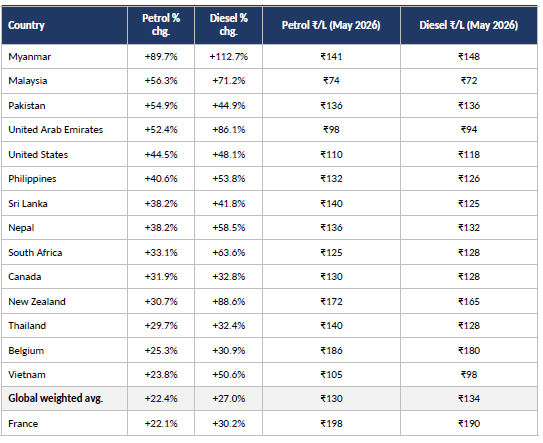
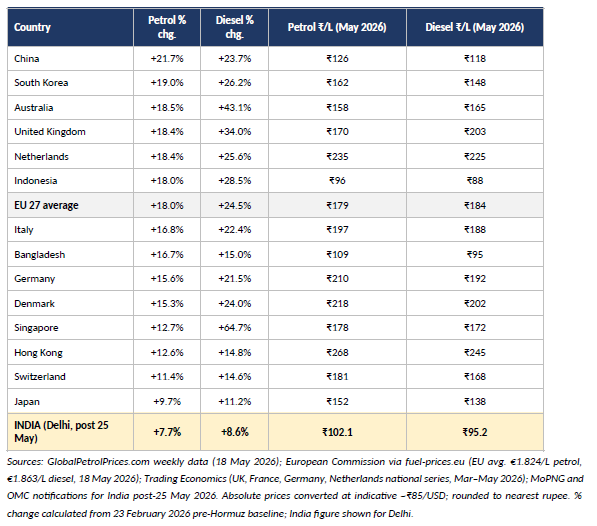
The contrast operates on two dimensions: India had one of the smaller percentage increases, and it sits on one of the lower absolute price levels among non-subsidising economies. The global weighted average is shown in grey for reference.
Decoding the numbers
1. Every major developed economy now retails petrol above ₹150 a litre and most above ₹180; the EU 27 weighted average sits at ₹179 on petrol and ₹184 on diesel.
2. India’s two large neighbours — Pakistan and Nepal — have moved well past ₹135 a litre on petrol despite lower nominal incomes; Sri Lanka, Myanmar, and the Philippines have crossed ₹130.
3. The only economies retailing petrol consistently below the Indian range are direct subsidisers (the UAE and Malaysia) or the US, which has structurally low fuel taxation. India therefore prices petrol and diesel at or below most of the developing world and at roughly half the European pump, while still raising less than any non-subsidising peer through the present disruption.
The data suggests Indian revision of just over seven rupees a litre, equivalent to roughly seven and a half per cent off the Delhi base, is the smallest material upward movement of any major economy outside the directly subsidising Gulf producers — smaller than Japan, smaller than every European economy, smaller even than the South Asian peers that lack India’s buffers.
India is the only major economy to cut retail fuel prices through 2 energy crises
Between the Russia–Ukraine war that began in February 2022 and the Hormuz disruption that began in February 2026, the international price of crude oil has been through two of the sharpest disturbances since the 1970s. Brent has crossed one hundred and twenty dollars a barrel twice in that window. Every major importing economy in the world has passed on the cost to its consumers, in some cases several times over. India has done the opposite. Across the same four years the Indian government has cut the retail price of petrol and diesel four times, the last of those cuts coming on the eve of the Hormuz disruption itself.
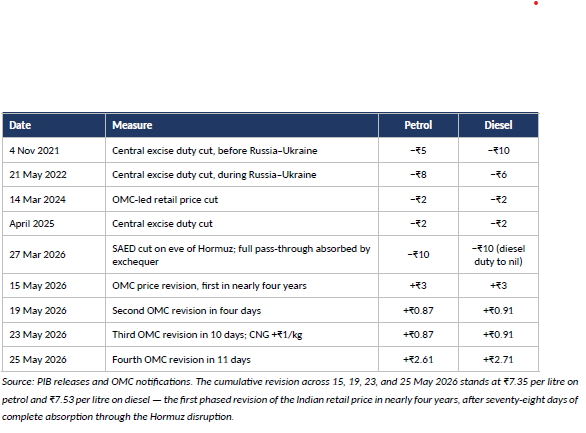
Through the Russia–Ukraine window, India was the only G20 economy to reduce the retail price of petrol and diesel. The November 2021 and May 2022 cuts together took eighteen rupees off petrol over six months and sixteen rupees off diesel. Through the Hormuz disruption, the SAED cut of 27 March 2026 reduced petrol excise to three rupees a litre and took diesel excise to zero. The pass-through of higher crude was not made to the consumer; it was absorbed by the exchequer.
Losses and compensation
At peak Brent of around one hundred and twenty-six dollars a barrel during the Hormuz disruption, the Government of India was absorbing approximately twenty-four rupees a litre on petrol and thirty rupees a litre on diesel. PIB figures of 27 March 2026 reported under-recoveries at the refinery gate of twenty-six rupees a litre on petrol and eighty-one rupees and ninety paise a litre on diesel. The 27 March SAED cut transferred ten rupees of the petrol gap and ten rupees of the diesel gap from the consumer to the exchequer. The four phased OMC revisions of 15, 19, 23, and 25 May together passed roughly ₹7.35 on petrol and ₹7.53 on diesel into the retail price, reducing daily OMC under-recoveries from ₹1,000 crore a day at the height of the disruption to a substantially lower run-rate. The remaining loss is still being absorbed.
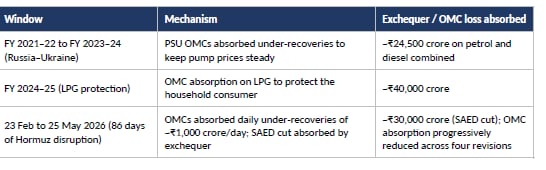

An export levy was imposed simultaneously with the 27 March 2026 cut, at twenty-one rupees and fifty paise a litre on diesel and twenty-nine rupees and fifty paise a litre on ATF, to keep Indian-produced fuel in the Indian market and prevent the domestic supply from being pulled out by international price arbitrage. The export levy contributed to the SAED cut being a net protection of the Indian consumer rather than a revenue giveaway to refiners.
The retail price of petrol and diesel in Delhi had moved by under one per cent in either direction over the four years from February 2022 to February 2026, against a Brent benchmark that has moved sharply in both directions across the same period. The four OMC revisions of 15, 19, 23, and 25 May 2026, cumulatively ₹7.35 on petrol and ₹7.53 on diesel, are the first material upward movements of the retail price in nearly four years.
The summary
Through four years that included the Russia–Ukraine war and the closure of the Strait of Hormuz, the Government of India cut the central excise on petrol and diesel four times, absorbed approximately ₹30,000 crore of revenue at the exchequer in the most recent cut alone, and redeemed over ₹1.30 lakh crore of UPA-era oil bonds, principal alone.
India is the only major economy in the world to have cut retail fuel prices through the Russia–Ukraine window. India is the only major economy in the world to have held retail fuel prices essentially unchanged through the first 78 days of the Hormuz disruption.
The cumulative OMC revision of just over ₹7 a litre across 15, 19, 23, and 25 May 2026 is the smallest material upward movement of any major economy outside the directly subsidising Gulf producers, off one of the lowest absolute pump prices in the non-subsidising world.
The states that tax fuel most heavily are governed by the political opposition — Congress, INDIA bloc, AAP, and the TVK–Congress alliance in Tamil Nadu. The architecture of consumer protection, the redemption of past liabilities, and the absorption of present losses are the work of the present government.
Handpicked stories, in your inbox
A newsletter with the best of our journalism
News india Rs 7.5 In 4 Tranches: India’s Petrol, Diesel Price Hike Is The Lowest In The World
Disclaimer: Comments reflect users’ views, not News18’s. Please keep discussions respectful and constructive. Abusive, defamatory, or illegal comments will be removed. News18 may disable any comment at its discretion. By posting, you agree to our Terms of Use and Privacy Policy.
Read More




 English (US) ·