

 1 hour ago
4
1 hour ago
4
ARTICLE AD BOX
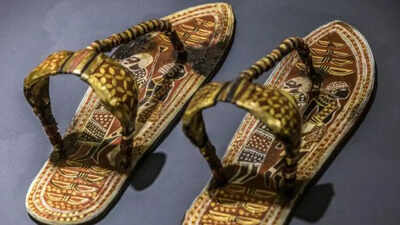
King Tutankhamun's tomb yielded a fascinating pair of sandals, intricately designed with depictions of his vanquished enemies on the soles. These symbolic shoes, made of wood and bark, represented the young pharaoh's triumph over Egypt's foes. Discovered among thousands of artifacts, these sandals offer a unique glimpse into ancient Egyptian beliefs and royal power.
Out of all the Egyptian pharaohs who graced the ancient land, Tutankhamun is remembered by people to date. The young king who died at the mere age of 17, is still remembered for his enigmatic life and magnificent tomb.
Among all the artefacts found buried alongside King Tut were a pair of sandals, whose shocking detail has raised many eyebrows.British archaeologist Howard Carter discovered and excavated King Tut’s tomb with other local Egyptians in 1922. Animals, statues, and a huge amount of gold were some of the 5,000 objects found in there. The most iconic treasure in the king’s burial chamber was his death mask made of gold, glass and semiprecious stones.
Also present were dozens of pairs of sandals, meant to carry the king to the afterlife.But what is interesting about the pair of footwear is not just their association with the pharaoh, but also the details in the soles. They contain depictions of King Tut’s defeated enemies on their insoles, symbolising him walking over them and establishing his superiority. They were made of wood and covered with a veneer of bark, green leather and pieces of golf foil on top of a layer of white paint.
In the arch area, there are depictions of two people bound with lotus and papyrus. Each sandal also contains eight bow weapons, four near the toes and four at the heel. Moreover, the strap is also shaped as a bow, thus making the number of bows, nine, the collective symbol for the enemies of Egypt. According to Carter’s original object card, the sandals measured 11.2 by 3.6 inches making them approximately 11.5 in US men’s size.
They were discovered lying underneath a basket in the tomb. However, if that was their original location as many objects had been moved around and also looted in antiquity.
A chance to look at history
The sandals are currently on display at the Egyptian Museum in Cairo. The information card notes that the bound captives refer to King Tut’s power and that the Nine Bows are “situated so that the king’s feet step on them, reifying the trampling of Egypt’s enemies by the monarch.”Tutankhamun was the 11th pharaoh of Egypt’s 18th dynasty. He was born as Tutankhaten around 1341 BC in ancient Egypt. He inherited the throne at the young age of eight or nine in the 14th century BC. His father, Akhenaten, was a revolutionary pharaoh, whereas the name of his biological mother remains unknown.Growing up, he married his half-sister Queen Ankhesenamun and the couple had twin daughters who were stillborn.
Their foetuses were buried in jars in the pharaoh’s tomb. The tomb of King Tut’s wife is yet to be found. She is believed to have eventually married an official Ay, who became a pharaoh.A 2010 study of the king’s remains, published in the journal JAMA revealed he had a variety of health conditions including malaria and Kohler disease, a rare bone disorder of the foot. Archaeologists also found numerous canes in his tombs, probably suggesting a difficulty in walking.
He died about a decade later after ascending to the throne. The causes of his death are severely debated with theories ranging from assassination to hunting accident.
It was only in 2025 that the complete contents of his tomb were put on display in a museum near the Great Pyramid of Khufu at Giza. When King Tut’s mummy was discovered, he was found wearing bright gold sandals and gold toe covers. However, it remains unknown if the other footwear discovered alongside was worn by the king or not. While his possessions remain on display, his mummy remains at rest in the Valley of the Kings, near modern-day Luxor, where it was found.









 English (US) ·