

 3 days ago
8
3 days ago
8
ARTICLE AD BOX
Muslims who were permitted to offer Friday prayers at the Bhojshala complex had just over a dozen persons, brought in through a back gate, wearing volunteer jackets to render them indistinguishable from security personnel as they were moved to a designated spot at the complex where the dome of the structure was concealed with a white cloth. Around them, officers carrying automatic weapons maintained tight perimeters while armoured vehicles idled nearby, engines running.
Hindu devotees – thousands were part of processions that had been building since dawn – arrived through the front gates.
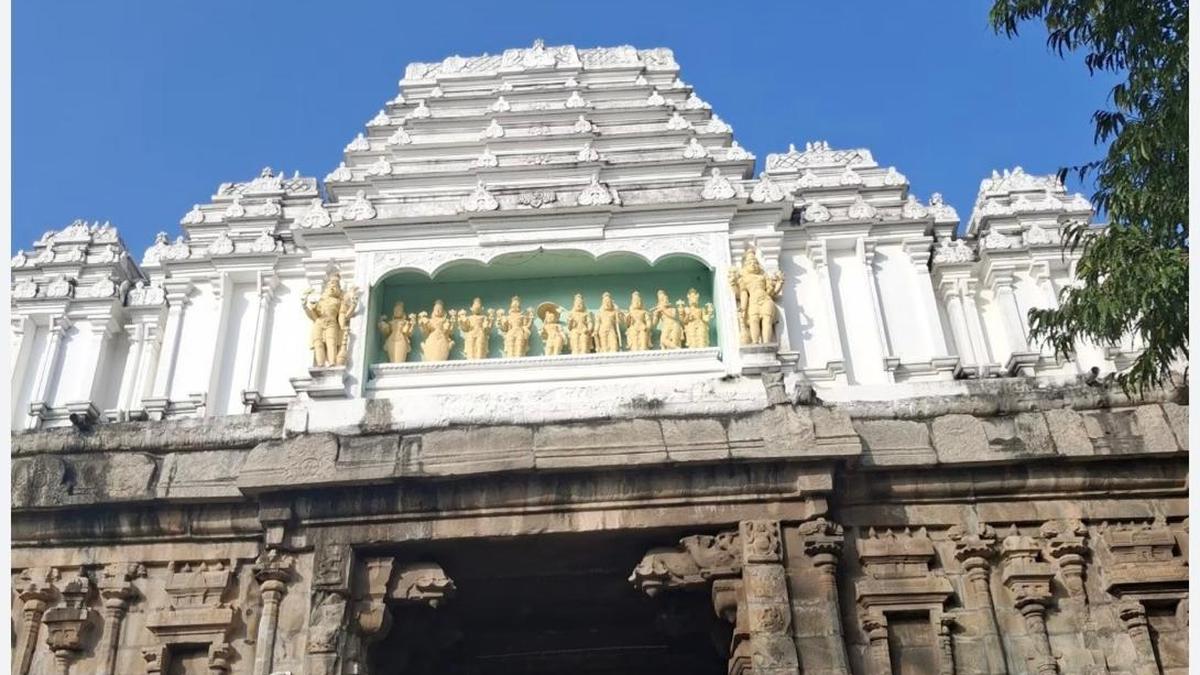
The Supreme Court had on Thursday issued directions to allow simultaneous Basant Panchami puja and namaz at the Archaeological Survey of India-protected Bhojshala Temple/Kamal Maula Mosque complex in Madhya Pradesh’s Dhar district on Friday. The court allowed prayers on a plea by an organisation, the Hindu Front for Justice (HFJ), on the occasion of Basant Panchami. The day heralds the arrival of spring and involves worshipping Saraswati, the goddess of knowledge.
This marks the latest chapter in the dispute over the 11th-Century monument. Since the early 2000s, various right-wing groups have been seeking the closure of the mosque, a ban on Friday namaz there, and the installation of a Saraswati idol in the complex.
On Friday, the Dhar administration was prepared. Every corner of the city – from narrow bylanes to crowded markets and rooftops – was mapped in 3D. From a central control room, police monitored live feeds across the city, while over 20 AI-enabled drones flew regular circuits, relaying real-time data on crowd density. Over 8,000 police officers from the surrounding regions were called in along with eight Rapid Action Force platoons and 933 women police personnel, erecting an unprecedented security cordon.
By mid-morning, the narrow approach roads to the Bhojshala had turned saffron. Triangular flags fluttered from bamboo poles strung across lanes and rooftops. Young men in white kurtas raised slogans, while women in mustard, vermilion and deep orange saris moved in clusters, clapping and raising their hands in rhythm.
Story continues below this ad
Riot police walked alongside the procession in helmets and body armour. Shuttered shops and tangled overhead wires framed a town briefly transformed into a corridor of devotion and discipline. “Chalo Bhojshala” blared from DJ-mounted vehicles as processions organised by various outfits advanced.
Shantilal, waiting with his ten-year-old son, spoke quietly about rights rather than rituals. “The Supreme Court has allowed both communities to enter today,” he said. “Basant Panchami has happened peacefully before, too. We don’t pay much attention to Hindu–Muslim issues. All we want is the right to pray the whole day in our Saraswati mandir.”
Others chose not to wait. Shivani, visiting Bhojshala for the first time, turned back with her children. “There is too much of a crowd,” she said. “I came because of the mahaul around Friday namaz. Basant Panchami is bigger than ever this time, but I can’t risk bringing my children into such a huge gathering.”
Among the crowd, young participants spoke of a changed moment. Rajesh, Gopal and Kartik, polytechnic students, said Bhojshala now felt like a national issue rather than a local one. “Earlier, people only thought about it when Basant Panchami fell on a Friday,” one of them said. “Now, politicians and media keep reminding us this is a temple. After the ASI said the structure was made from reused temple parts, it’s hard to ignore.” Gunjan Pipilofiya echoed the sense of scale and impatience. “The court order is good,” she said, “but we want access the whole year now. We have nothing against the Muslim community.”
Story continues below this ad
Yet even this tightly managed exercise produced dissent. Imran Khan, one of those selected to offer namaz, alleged that the administration failed to follow through. He said officials met them around 11 pm the previous night and promised to take them for namaz, but later dropped them near the mosque with a single watchman. “We were 15–20 people in total, and we could not read the namaz,” he claimed. “We even made sure we came in small numbers as per their request. The administration cheated us.”
However, Dhar Collector Priyank Mishra dismissed the allegations: “Over 15-17 individuals from the Muslim community offered prayers at a designated site as per the Supreme Court orders and both processions went on peacefully.”
While right-wing groups have been seeking the closure of the mosque and a ban on Friday namaz, in April 2003, the ASI had arranged to find a solution under which Hindus would perform puja in the premises on Tuesdays, while Muslims would offer namaz there on Fridays.
On May 2, 2022, a PIL was filed by the HFJ, challenging the ASI order, which restricted daily worship for Hindus. The plea cited that the former rulers of Dhar had installed the statue of Saraswati there in the year 1034, and it was taken to London in 1857 by the British. In 2024, the Madhya Pradesh High Court ordered an ASI survey of the Dhar district, observing that its nature and character need to be “demystified and freed from the shackles of confusion”. The report later stated that the “existing structure was made from the parts of earlier temples”.
Story continues below this ad
Right adjacent to the disputed site, Alok Kumar, the international president of the Vishwa Hindu Parishad, declared that the Bhojshala dispute was “not a religious issue, but an issue of encroachment”.
“The battle of Dhar is the battle of the whole country. This is the battle of the whole Hindu society, and we have to fight this battle together. We want happiness, peace and prosperity for everyone. But this cannot be our weakness. This is our strength. Today’s situation shows that this awakened society is no longer ready to tolerate insult. It has come onto the streets and into the field to protect itself,” he said.
Those old enough to remember the Saraswati Pooja before it took a political colour say the celebration has changed over the years. Sitaram (57), a local businessman, said, “The crowds are huge, the security is unprecedented. We never had so much political spotlight on the issue. We just celebrated Raja Bhoja’s achievements and Vaidehi Devi. Earlier, the temple demands were raked up during elections, and forgotten. Now it’s a permanent position of the people.”


 English (US) ·