

 1 hour ago
5
1 hour ago
5
ARTICLE AD BOX
Japan earthquake and tsunami of 2011, also called the Great Sendai Earthquake or Great Tohoku Earthquake occurred in northeastern Japan on March 11, 2011. Image Credit: AP
More than a decade after the devastating 2011 Tohoku earthquake, scientists have uncovered an unexpected aftermath that stretches far beyond the initial destruction. Scientists have found out that the seismic waves caused by the magnitude 9.0 earthquake travelled to the inner part of the earth, where they bounced off boundaries near its core and travelled back, coinciding with tiny, measurable crustal movements in Japan of a fraction of a millimetre.As revealed in research conducted by seismologist Sunyoung Park and colleagues, the reflected wave was strong enough to coincide with fault movements across a broad range of Japanese plate boundaries. This research is said to be among the first to suggest that a wave reflected from Earth's core may be linked to fault slip.This scientific discovery has been reported by Science News, where the unusual series of activities caused by the earthquake was first discovered through seismic and GPS archived data.How the wave propagated through the Earth’s interiorThere are several types of seismic waves generated by an earthquake, including those that travel through the Earth's interior. In this case, scientists have discovered what they call a core-reflected S-wave, which travels almost 2,900 kilometres through Earth's rocky mantle and then reflects off the boundary of the molten outer core, bouncing back towards the surface.It is not unique to this event for such waves to exist since seismologists know about them, but rather the fact that they could apparently cause another movement of the fault line as they were travelling back to the surface.
According to a PubMed-indexed study, the research team found that this wave reached the Earth’s surface approximately 15 minutes after the major shock wave of the Tohoku earthquake on 11 March 2011. Around this time, Japanese GPS stations registered a very small but ongoing movement of the Earth’s crust.Movement of Japan’s surface took place in real timeIt is extremely small, in millimetres, but important from a geological perspective. Information from GPS sensors revealed that post-seismic movement was observed not in one single spot but rather throughout Japan’s territory, from northern Hokkaido to southern Kyushu.This indicates that the seismic event did not cause only a disturbance on one particular fault line. Rather, it seems that the tsunami caused slipping along many parts of the tectonic boundaries extending over several thousand kilometres.According to seismologists participating in the study, at least 3,000 kilometres of fault lines showed signs of triggered activity.
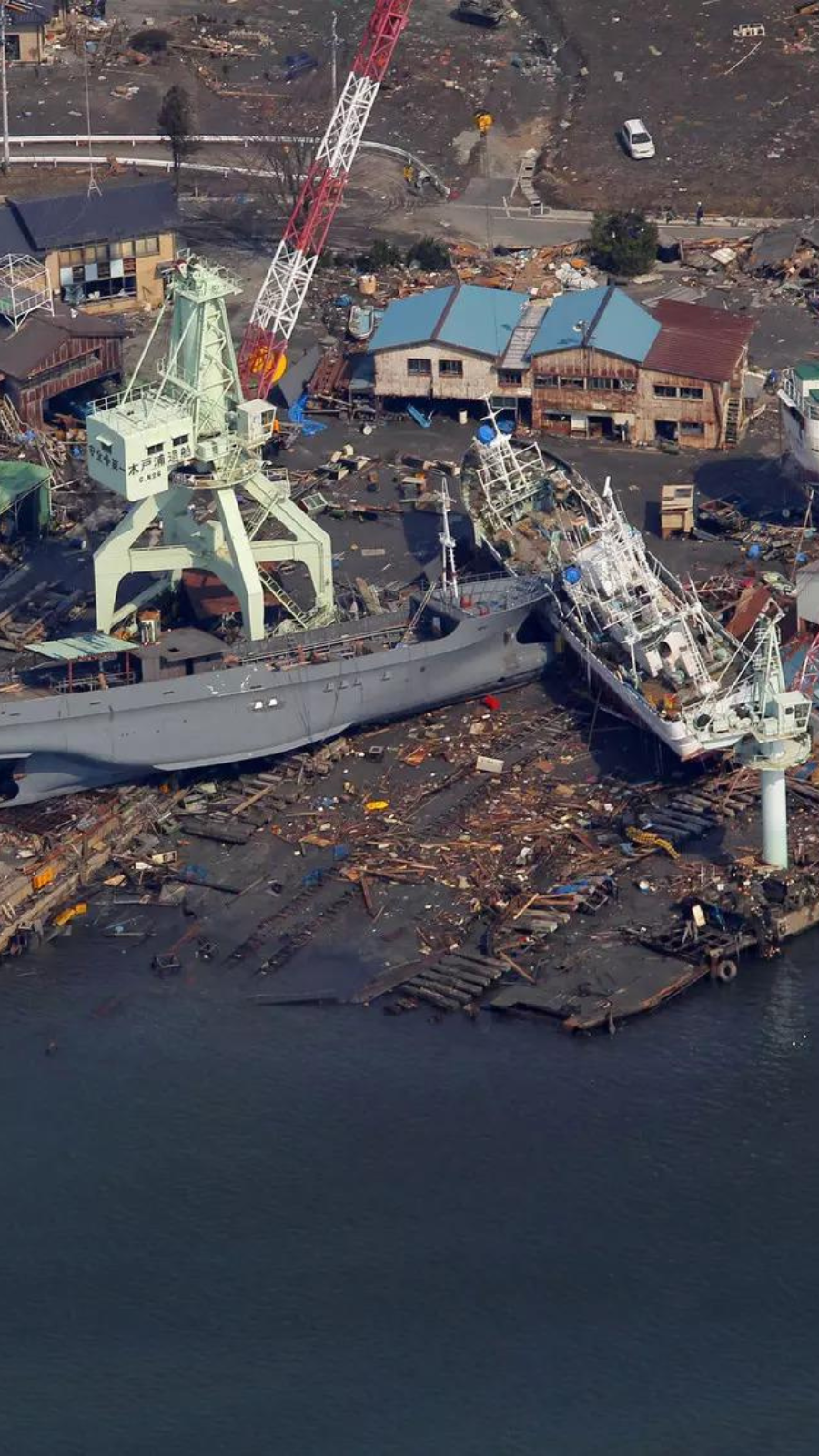
Japan earthquake and tsunami of 2011, also called the Great Sendai Earthquake or Great Tohoku Earthquake occurred in northeastern Japan on March 11, 2011. Image Credit: AP
The reasons why the scientific community considers this observation uniqueEarthquakes often create disturbances in the land, especially those close to the epicentre.
But they generally do not lead to any displacement of the whole nation after the primary earthquake is over.According to Zachary Ross, a geophysicist from the California Institute of Technology who was not part of the research team, the GPS data reflect something more than post-earthquake relaxation. The observation shows that the fault systems were primed for action, and the reflected earthquake was just the push needed to make the faults slip.Geophysicists have found the explanation to be reasonable. Previously, Andrea Donnellan from Purdue University stated that the reflected waves can act as a trigger to fault slippage when there has been accumulated stress on the faults for some time.New insights into the science of earthquakesThe most significant aspect of this study is the insight it offers into earthquake dynamics. In the past, the reflection of seismic waves from the core of the Earth has not been seen as being able to cause major fault slip.This study highlights what the researchers refer to as a possible instance where a wave reflection from within the deep Earth may have been associated with fault slip. This is an interesting finding because it implies that we might need to rethink seismic hazard models that consider the interaction between deep seismic energy and the stressed fault network.What is significant about this discovery is that the fault movement would have gone unnoticed by humans.
This movement took place over the course of several minutes and was widespread in nature.Implications for the futureDespite there being no additional damage caused by the secondary wave in the 2011 case, scientists have noted that similar events might take place in a different manner in other places. In cases where fault lines are near their stress limit, a reflected wave might become an additional trigger of fault line ruptures.This paper does not claim that reflections of seismic waves at the core-mantle boundary are the main source of an earthquake.
However, it emphasises the possibility that they may act as a secondary trigger in a vulnerable system.In terms of seismology, this paper makes one think about yet another element of stress distribution and release in the Earth's crust. The importance of permanent monitoring through dense GPS networks is emphasised in this case.An example of interconnected systems on EarthWhile the Tohoku earthquake is well known because of its destructive tsunami and widespread effects on Japan, the recent study provides evidence of yet another effect from this earthquake, namely, how the energy produced by it travelled deep inside the planet and may have influenced fault lines elsewhere.This is an example of how the interior of our planet is not separate from events taking place on its surface. On the contrary, it is interconnected and capable of transporting energy through enormous distances.









 English (US) ·