

 1 hour ago
4
1 hour ago
4
ARTICLE AD BOX
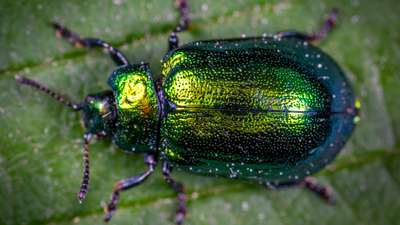
The image of biological discovery is usually tied to distant rainforests, isolated islands or mountain ranges that few people ever visit. University campuses rarely feature in that picture.
Yet a small pine tree growing on the grounds of a Japanese university has become the source of a surprising scientific finding.While reviewing a group of tiny ladybird beetles found across Japan, entomologists uncovered a species that had gone unnoticed despite living within sight of the buildings where the research was being carried out. The beetle, barely larger than a grain of sand, had spent decades escaping attention in a place visited by students and researchers every day.
The finding emerged from a wider effort to re-examine a poorly understood group of beetles whose classification had not received a comprehensive review in Japan for more than half a century.
Parastethorus pinicola: The newly identified beetle species from Japan
According to the review published in Acta Entomologica Musei Nationalis Pragae, titled “Review of the genera Stethorus and Parastethorus from Japan (Coleoptera: Coccinellidae)”, the newly identified species belongs to a group of minute ladybird beetles known as Stethorini. Unlike the brightly coloured ladybirds familiar to many people, these insects are extremely small, dark in colour and remarkably difficult to distinguish from one another.
The species was found living on Japanese black pine trees at Kyushu University's Hakozaki Satellite campus. Its scientific name, Parastethorus pinicola, reflects that association with pine trees, with the name essentially meaning a pine-dwelling beetle.At roughly one millimetre in length, the insect is so small that most people would never notice it even when standing directly beside the tree where it lives.
According to the review, members of this group are predators that feed on spider mites and other tiny arthropods, making them part of the intricate web of organisms that help regulate insect populations.
How scientists distinguished the new beetle species from similar insects
Size was only part of the problem. These beetles belong to a category of insects that taxonomists often regard as particularly challenging. Many species share nearly identical appearances, with differences too subtle to detect through ordinary observation.
External colour patterns offer little help because most species are uniformly dark and possess similar body shapes.As a result, accurate identification frequently requires detailed microscopic examination of anatomical features, including reproductive structures. Without that level of analysis, different species can easily be mistaken for one another.As per the review, the discovery involved the examination of around 1,700 specimens collected from different parts of Japan.
Looking at such a large sample allowed researchers to compare populations more carefully and separate genuine species from historical misidentifications that had accumulated over time.
Researchers resolve decades-old confusion in beetle classification
The work did more than reveal a previously unknown species. During the review, scientists concluded that one beetle long treated as a distinct Japanese species was actually the same species as another already known from a much wider area stretching across East and Southeast Asia.
This correction helped simplify the classification of the group and brought Japanese records into line with those from neighbouring countries.Such revisions may sound technical, but they are important for ecological research. Species names form the basis of biodiversity records, conservation assessments and studies of insect distribution. If organisms are incorrectly identified, the data built upon those records can become unreliable.Clarifying the identity of these beetles also makes it easier for researchers across different countries to compare findings and track species ranges more accurately.
Researchers discover a second new beetle species in Japan
The campus discovery was not the only unexpected outcome. The review also revealed another previously undescribed species from Hokkaido in northern Japan. Named Stethorus takakoae, the beetle was identified as distinct after detailed comparisons with closely related species that had long been grouped.According to the study, recognised both new species while also updating the known distribution of several others. In doing so, it provided one of the most comprehensive modern assessments of these tiny predatory ladybirds in Japan.









 English (US) ·