

 1 week ago
8
1 week ago
8
ARTICLE AD BOX
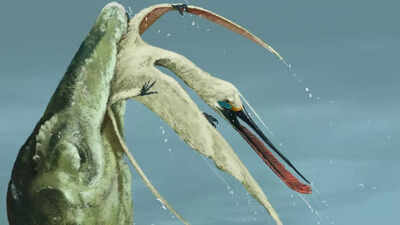
In a groundbreaking discovery, scientists have identified a remarkable new flying reptile species, Bakiribu waridza, a 100-million-year-old regurgitate (scientific name), or fossilised dinosaur vomit.
Retrieved from the Romualdo Formation in Northeast Brazil’s Araripe basin, this discovery marks the world’s first time an extinct species has been described entirely from fossilised puke. According to the study, ‘A regurgitator reveals a new filter-feeding pterosaur from the Santana Group’ published in Scientific Reports, the study shows that the fossil was preserved alongside other specimens from the Araripe region, including bones from two individuals of the recently discovered filter-feeding pterosaur species Bakiribu waridza and four fossil fish.
Mystery of the Regurgitalite: How fossilised puke preserved a new flying reptile species
This scientific study of Bakiribu waridza gives a boost to the scientists who study fossils. According to the research study published in Scientific Reports, unlike other species found in sediment. This new flying reptile species has been discovered in material vomited by a dinosaur. This is a very rare thing that could happen because there is a possibility that the predator's stomach acid doesn’t dissolve the remaining completely.
And the fragile bones of this filter-feeding pterosaur remained intact for 100 million years.
Identifying the predator behind the discovery
There can be many questions that can be put on the discovery of Bakiribu waridza, and one of those could be- who is possibly the one responsible who could swallow a flying reptile? According to the researchers, it could be a Spinosaurid dinosaur. It has been found in a study that these large predators had a kingdom 100 million years ago in the Araripe basin, Brazil.
The dinosaur vomit didn't just contain a pterosaur but also four fish.
As stated in Scientific Reports, this ‘head-first’ alignment is exactly how modern fish-eating birds swallow prey to avoid choking on sharp fins, providing a rare ‘crime scene' look at ancient feeding habits.
How did the comb-mouth pterosaur eat?
The question any person who studies fossils has wondered is How could a large flying reptile share the same space as other large dinosaurs a 100 million years ago? One of the main aspects of Bakiribu waridza’s unique evolutionary characteristics was that it had a comb-mouth that allowed it to filter feed in the same way that modern-day flamingos do, by straining microorganisms from water while on the move. Its jaws and mouth have several hundred long, thin, needle-like teeth that serve as a sieve to separate the organisms/meals from the water. Bakiribu waridza waded through shallow areas of water or flew at low altitudes to sift out the organisms (for food), and there was no competition with other larger and predatory animals during the time that this animal lived. Thus, Bakiribu waridza flourished in the warm tropical environment of Brazil, prior to the dinosaurs.
The details of scientific reports indicate that without the distinct variable of feeding and filtering for food, there would be no Bakiribu waridza.








 English (US) ·