

 1 hour ago
5
1 hour ago
5
ARTICLE AD BOX

Invasive plants removed during habitat restoration, as scientists say understanding how these species reproduce could help prevent future biological invasions. Image Credits: Wikimedia Commons
Just one plant species can be enough to trigger an ecological invasion. Studies have shown that some tropical plants have evolved to reproduce without a mate, allowing a single individual to start a new colony.
Just one plant species alone is enough to cause an ecological invasion. Studies have revealed that some tropical plants have evolved a mode of reproduction wherein the plants do not need a mate to reproduce; this allows a single individual to start a new colony of plants. This discovery helps scientists identify which plants are most likely to become aggressive invaders, enabling them to predict future invasions and prevent them before they pose a serious ecological threat.According to research conducted by researchers at the Centre for Ecological Sciences at the Indian Institute of Science (IISc), published in the journal Biological Invasions, the mode of self-fertilisation or reproducing without a compatible partner turned out to be one of the key characteristics of successful invasion of tropical plants.As invasive species spread, scientists are tracking their impact on biodiversity. As invasive species continue to spread across the globe, scientists are warning of their growing impact on biodiversity.
Once established, invasive plants can displace native vegetation, modify soil chemistry, disrupt food webs and degrade ecosystems, underscoring the need for effective monitoring and early management.A single plant can establish an entire populationMost flowering plants depend on pollen from another individual of the same species to produce seeds. This reliance on pollinators and compatible mates can limit their ability to establish in unfamiliar environments.
However, some species possess an alternative strategy: they can fertilise themselves using their own pollen or, in certain cases, produce seeds without fertilisation through a process known as apomixis.Ecologists have long described this reproductive independence through Baker's law, a hypothesis that says plants able to reproduce without partners are more likely to colonise distant habitats. Until now, however, experimental evidence supporting this theory in tropical invasive plants had remained limited.To investigate the idea, researchers studied 28 species belonging to the daisy family (Asteraceae), one of the world's most widespread groups of flowering plants. Their sample included 11 invasive alien species, eight non-invasive alien species, and nine native species collected from roadsides, grasslands, and disturbed habitats across Karnataka and Tamil Nadu.Nearly 900 plants were grown and monitored. The team compared flowers that were artificially self-pollinated with those exposed to natural pollination and analysed seed formation using fluorescent microscopy.
They also tested whether the resulting seeds were capable of germinating successfully. The experiments allowed scientists to determine whether each species relied on cross-pollination, self-fertilisation or apomixis to reproduce.The results showed a clear pattern. Every invasive species examined in the study was capable of reproducing without a mate, whereas most native and non-invasive alien species remained self-incompatible, meaning they generally required pollen from another plant to produce viable seeds.
The results were striking. Every invasive species examined in the study was capable of reproducing without a partner, whereas most native and non-invasive alien species remained self-incompatible, meaning they generally required pollen from another plant to produce viable seeds.
According to the researchers, this simple reproductive advantage may explain why certain introduced plants become widespread invaders while many others never establish permanent populations.Invasive plants evolved after arriving in new environmentsIn addition to this, the researchers also found that invasions themselves could cause evolution. Two especially invasive weeds, Ageratum conyzoides and Bidens pilosa, which showed a notable change in reproductive mechanisms. These weeds were mostly self-incompatible in their native habitat in Mexico and required cross-pollination. However, when they grew in India, the population evolved to the point that they were able to reproduce without assistance from other members of the species.This suggests natural selection favoured weeds that could reproduce on their own in the new environment, so a single self-compatible plant had a better chance of founding a population.The study suggests that biological invasions are not just movements of species from one continent to another; they can also involve rapid evolutionary changes that improve survival in new ecological settings. The authors stated that what previously appeared to be a rather unrealistic concept, the ability of plants to evolve their reproductive system in the course of invasion, is well proven by their experiments.It fits well with previous research carried out by King's College London, according to which plants with complex evolutionary histories from competitive environments tend to succeed when introduced to other areas.
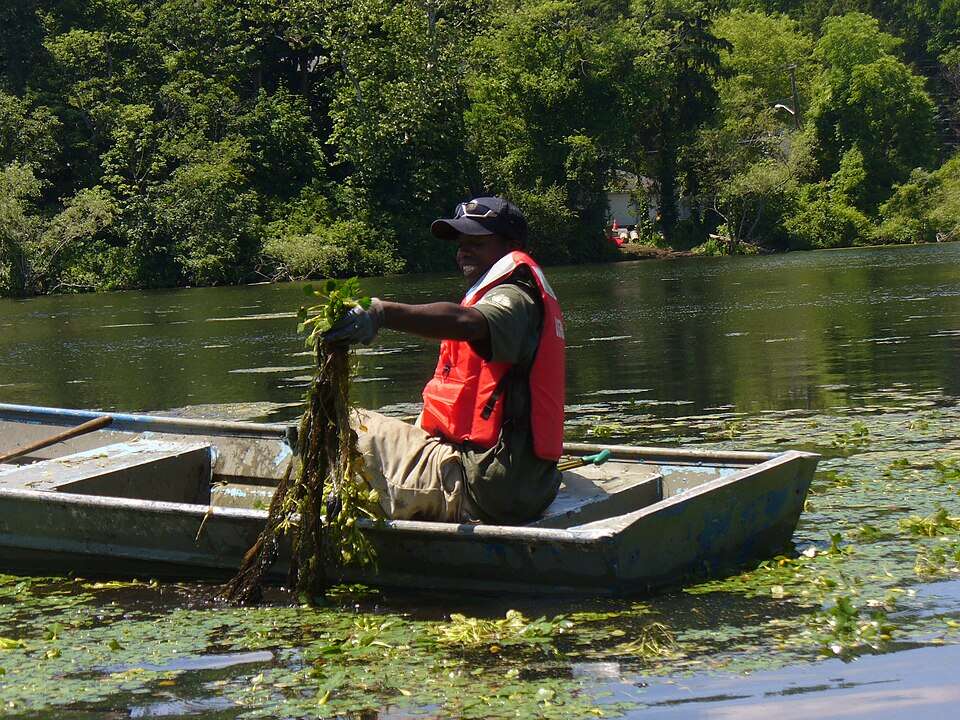
Workers remove invasive aquatic plants from a waterbody, highlighting efforts to control species that can rapidly spread and disrupt native ecosystems. Image Credits: Wikimedia Commons
Why the findings matter for conservationScientists say the results could improve the way governments identify potentially invasive plants before they spread. Current weed-risk assessments often focus on characteristics such as rapid growth, seed production, or environmental tolerance.
The new research suggests that reproductive strategy should become another important criterion. If an introduced species can reproduce without partners, it may pose a much greater invasion risk than previously recognised.The implications extend beyond individual species. Invasive plants can replace native vegetation, reduce biodiversity, alter nutrient cycles, and change the structure of forests, grasslands, and wetlands.
Once widespread, they are often extremely difficult and expensive to remove.The study also aligns with broader research showing that plant invasions are likely to become an even greater challenge under climate change. A recent global analysis published in Nature Ecology & Evolution projected that invasion hotspots will shift towards temperate regions as temperatures rise and land-use patterns change, exposing new ecosystems to invasive alien plants.The study shows that the success of invasive plants may depend not only on where they are introduced, but also on how they adapt after arrival. By evolving the ability to reproduce without a partner, some tropical plants gained a powerful advantage that allowed them to establish new populations from a single individual. As invasive species continue to threaten biodiversity worldwide, understanding these evolutionary changes could help scientists develop better strategies to predict, prevent and manage future plant invasions before they reshape native ecosystems.









 English (US) ·