

 1 day ago
3
1 day ago
3
ARTICLE AD BOX
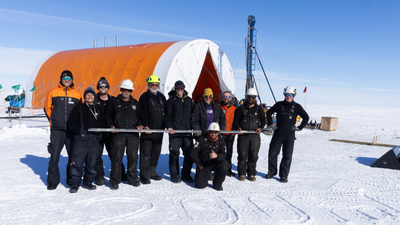
Members of the team pose with the core that passed 200m. Image Credit: Ana-Tovey/SWAIS2C via Phys.org
Far beneath the ice of West Antarctica, the core sample could provide valuable information about the planet’s climate history. Scientists drilled 523 meters through Antarctic ice and recovered 228 meters of sediment core that could help explain how the West Antarctic Ice Sheet responded to past warming.
This scientific feat was made possible by SWAIS2C (Sensitivity of the West Antarctic Ice Sheet to 2°C), a research project involving scientists from several countries. The team worked at Crary Ice Rise, a remote site in West Antarctica, hundreds of kilometers from any settlement.According to the official SWAIS2C project update, the team’s hot water drill melted a 523-metre hole through the ice at Crary Ice Rise. Scientists then lowered more than 1,300 metres of riser and drill-string pipes through the opening before using a rotary drill to extract sections of sediment core from beneath the ice.The update says the team recovered 228 metres of sediment core, surpassing its 200-metre target, and that the material should preserve an unprecedented record of West Antarctic Ice Sheet history stretching back millions of years. It also notes that initial observations suggest the core contains evidence of environmental change during earlier warming periods.Geological time capsule buried in AntarcticaThe sediment core is unlike any previously recovered from beneath an Antarctic ice sheet.
Scientists have said that it could hold a record of the environment that goes back millions of years. It might give a record of what changes were occurring as temperatures went up or down. The core contains several layers of mud, sand, and rock. Researchers have dated the layers and will analyze them in the lab for clues about past ice cover, temperatures, and sea levels.The initial dating process has been helped by the finding of marine microfossils in several layers.
The fossils will help scientists determine when the area beneath the ice sheet was exposed to the ocean.The SWAIS2C team said some layers appear to date from periods when grounded ice covered the site, while others formed when the area was open ocean.Past evidence of warmer AntarcticaAntarctica, now known for its vast ice sheets, was not always covered by permanent ice. Geological evidence suggests that some regions of Antarctica have witnessed massive ice melting in the course of warm epochs of the Earth’s history.
The newly extracted sediment core will allow researchers to study how the West Antarctic Ice Sheet behaved during warmer periods similar to those expected in the future.Scientists are specifically interested in the periods when there were higher concentrations of carbon dioxide and higher temperatures than today, as it might be helpful to predict Antarctica’s reaction to climate change. It is stated in the article, published in Nature, that geological evidence from Antarctica shows partial melting of the West Antarctic Ice Sheet in the past.In the paper, Pollard and DeConto use a combined ice-sheet or ice-shelf model with high-resolution grounding-line dynamics to reconstruct Antarctic evolution over the past five million years. They conclude that West Antarctic ice-sheet transitions could be rapid, taking only one to several thousand years, and that their simulation matches the ANDRILL AND-1B sediment record, including major retreats around marine isotope stage 31, about 1.07 million years ago.
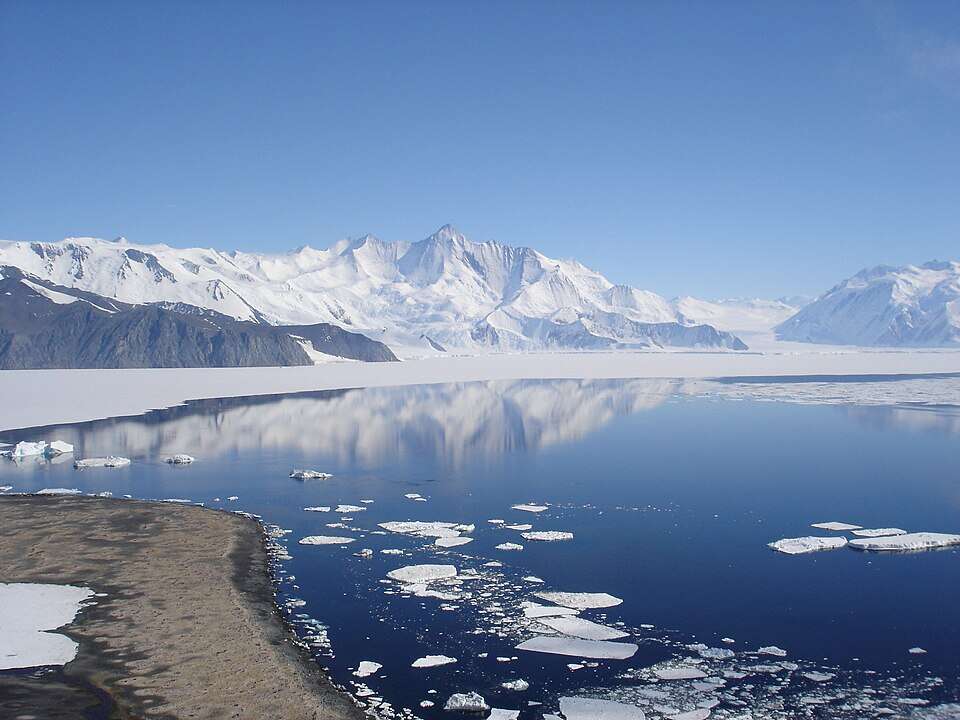
Mt Herschel, Antarctica. Image Credit: Wikimedia Commons
Importance of West Antarctica for future sea levelsWest Antarctica is referred to as one of the most vulnerable areas of the Earth’s ice cover. Contrary to most of the ice cover of East Antarctica, the western ice sheets stand on below-sea-level bedrock, and therefore, they are highly sensitive to warming seawater.An increased amount of ice melting has been registered in some parts of West Antarctica over recent decades. The study published in Nature Geoscience indicates that there was an acceleration of ice melting in the West Antarctic Ice Sheet, which resulted in a global sea level increase.
The complete melting of the West Antarctic Ice Sheet can result in a several-meter increase in global sea levels. Nevertheless, the scientific community notes that such a process will take a lot of time.The key question is how quickly changes in Antarctica’s ice cover can begin.Window to the Earth's climatic futureThe SWAIS2C project was designed for researching how the West Antarctic Ice Sheet would react if temperatures increased by about 2 degrees Celsius compared to pre-industrial times, as mentioned in the Paris Agreement.This sediment core may help show whether similar temperature increases in Earth’s history led to substantial melting of the West Antarctic Ice Sheet. In the coming years, specialists will analyze fossil organisms and the core’s geochemical and mineral composition to reconstruct past climates and ice-sheet changes.Climate records from Antarctica can help reduce uncertainty in sea-level projections.








 English (US) ·