

 1 week ago
5
1 week ago
5
ARTICLE AD BOX
Small songbirds forage on dusty ground amidst discarded lead pollution, a somber scene of environmental degradation. Image Credits: TIL Creatives
Travelling birds could experience significantly higher levels of lead toxicity than birds living in one area, according to an international review that could affect how pollution is measured in wild animals.Published in the peer-reviewed Ecotoxicology journal, available through Springer Nature, the research indicates that animal behavior plays a larger part in their chemical exposure than has been previously thought. The study found that birds with larger home ranges had more variable lead exposure, especially ground-foraging species.The paper is a meta-analysis of site-specific feather lead data from terrestrial birds, and the authors screened 2,060 unique studies before extracting lead measurements and home-range estimates.
They quantified exposure variability with the coefficient of variation, then found that feather lead levels were significantly more variable in species with larger home ranges, with the effect strongest in ground-foraging birds and absent in generalists and arboreal-aerial foragers.This study, available through Springer Nature, conducted by researchers Max M. Gillings, Riccardo Ton and Simon C. Griffith, analyzed information from 44 peer-reviewed papers regarding 28 terrestrial bird species, 101 polluted locations and more than 3,000 birds sampled individually.
Why are some birds more exposed to lead?Despite regulations to reduce the use of lead in petrol and paints, the pollutant is still present in the environment and enters ecosystems through legacy contamination, mining and smelting, industry, military training areas and hunting ammunition. Based on the results of the recent Ecotoxicology paper, bird species with larger home ranges tend to have more exposure to several pollution sources during their daily routines.
Therefore, members of the same species might be exposed to different amounts of lead contamination even if they belong to the same population.Birds that foraged on the ground were found to be more susceptible to lead pollution than those that foraged in trees or in flight. Larger home range size was found to be associated with more variability of exposure to lead for ground-foraging birds. Such species come into direct contact with the pollutant while foraging on the ground or eating contaminated insects and seeds.There was no statistically significant association between larger home range size and higher variability in lead exposure for other groups of birds.
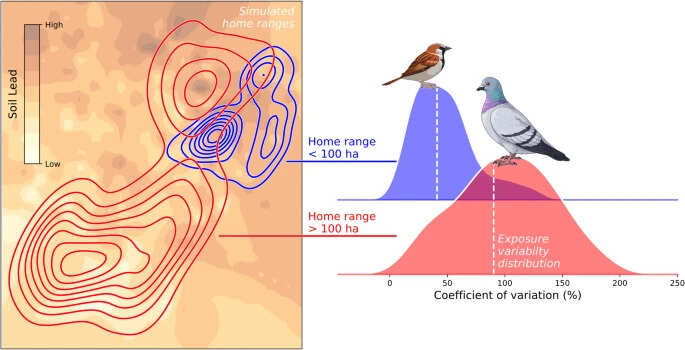
Ecological risk assessments estimate chemical exposures in wildlife from contaminant concentrations within their surrounding environment. Image Credit: Ecotoxicology via Springer Nature
Feathers can uncover secret pollutionInstead of measuring lead levels in blood or organs, the authors measured lead concentration in feathers, which provides non-invasive data.Moreover, the study revealed that different types of feathers led to more or less reliable results. Contour feathers, which usually cover most of the bird's body, showed lower variability than wing, tail, or mixed feathers.
The authors note that using contour feathers may increase the effectiveness of future pollution monitoring programs.Significance of findingsEnvironmental risk assessments often use mean pollution levels to estimate wildlife exposure in an area. In this regard, the authors suggest that this practice fails to take into account a critical fact. Namely, animals do not utilise all portions of their habitats evenly. On the contrary, they tend to keep returning to their favourite feeding grounds and nests, as well as travelling routes.
As a consequence, even two birds residing in the same location can be exposed to highly divergent amounts of pollutants.It follows from the findings that accounting for animal movements can increase the accuracy of ecological risk assessment.An environmental caution of broader scopeFurthermore, the results underscore the concern about the ongoing effects of lead pollution on wildlife species.The review found that lead pollution is associated with lower survival, reproductive problems, and neurological damage in birds.
Past studies have shown that even small quantities of the pollutant can be detected through changes in behaviour, learning ability, and reproductive capacity. The authors say sedentary birds with smaller ranges may be better environmental indicators because their exposure levels more closely reflect local contamination.
As opposed to those who have a wider roaming range, more careful tracking of such species would be needed.From what can be understood from the article, in view of the growing complexities involved in pollution in the modern era, studying the behaviour of animals could also be as crucial as testing for toxins. The authors believe that combining the science of movement ecology with the study of wildlife would add to the ecological significance of pollution assessments and help scientists better determine the chemicals that pose risks.The paper, titled Home range size and foraging niche predict lead exposure variability in terrestrial birds, was published in the journal Ecotoxicology.









 English (US) ·