

 1 week ago
9
1 week ago
9
ARTICLE AD BOX
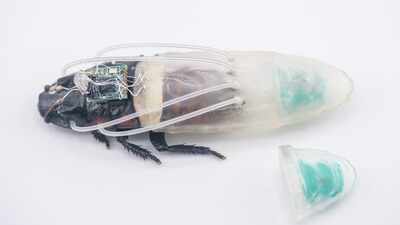
Scientists have engineered a groundbreaking 3D-printed suit for insects, enabling them to operate underwater. This innovation transforms resilient creatures like Madagascar hissing cockroaches into amphibious scouts for disaster relief. Image Credits: NTU Singapore
When we think about the future of disaster relief and emergency response, our minds usually drift toward a very specific image of high-tech machinery. We imagine massive aerial drones scanning collapsed buildings from above, heavy-duty treaded vehicles clearing away tons of concrete blockages, and complex metallic humanoids carefully navigating through unstable ruins.
For a long time, traditional engineering has taught us that the best way to handle dangerous environments is to build larger, stronger, and more intricate robotic systems. The common belief is that heavy mechanical structures are necessary to safely cross over hazardous terrain and carry heavy electronic sensors into crisis zones.But when an actual earthquake or flash flood strikes a major urban centre, those massive machines often run into severe physical limitations.
Giant mechanical search units frequently get stuck trying to move over deeply piled rubble, while smaller wheeled devices find themselves entirely blocked by narrow cracks, drainage pipes, and dark gaps. To solve these critical accessibility issues, an innovative field of bio-robotic research is completely changing how we view disaster management.
Rather than trying to build miniature robots from scratch, modern scientists are turning to nature’s most resilient survivalists to carry sensitive detection equipment deep into places no human or traditional machine could ever reach.
This biological approach has taken a massive leap forward through an international engineering initiative published in the journal Nature Communications. The research study, titled 3D-printed suit for cyborg insects extends operations underwater, outlines how a team of robotics researchers adapted insects for underwater operation in laboratory tests. By designing a specialised microscopic breathing apparatus, the researchers managed to expand the physical capabilities of remote-controlled bugs, allowing them to cross through fully flooded environments without losing their natural mobility or risking their lives.Transforming a natural survivor into an amphibious scoutTo fully appreciate why this technical development is so important for emergency services, it helps to look at how insects handle water in the wild. The researchers based their experiments on the Madagascar hissing cockroach, a large and exceptionally robust species that is highly popular in bio-robotic studies because it lacks wings and can easily carry small electronic backpacks.
While these insects are legendary for surviving extreme conditions on dry land, their natural respiratory networks are fundamentally unsuited for aquatic travel.
Cockroaches do not have lungs; instead, they breathe through a series of tiny external ports called spiracles located along the sides of their bodies.When a land bug falls into a deep puddle or enters a flooded drainage channel, water can block these breathing ports, cutting off its oxygen supply and limiting its movement. The academic project report shared by Nanyang Technological University, Singapore, highlights that this specific biological vulnerability has long kept cyborg scouts from exploring partially submerged disaster areas.
If a rescue worker steered a modified insect into a flooded cellar or a waterlogged trench, the creature would quickly become immobilised by the environment, ending the reconnaissance mission before any survivors could be located.To overcome this natural barrier, researchers led by Professor Hirotaka Sato at Nanyang Technological University worked alongside engineering experts at Waseda University in Japan to create a fully wearable miniature diving suit.
This innovative setup consists of a flexible, lightweight waterproof shell that wraps securely around the insect's midsection. The system seals off the delicate breathing ports from external moisture while utilising four microscopic silicone delivery lines to channel a steady stream of fresh air directly into the insect's respiratory system, essentially mimicking the function of a human scuba tank.
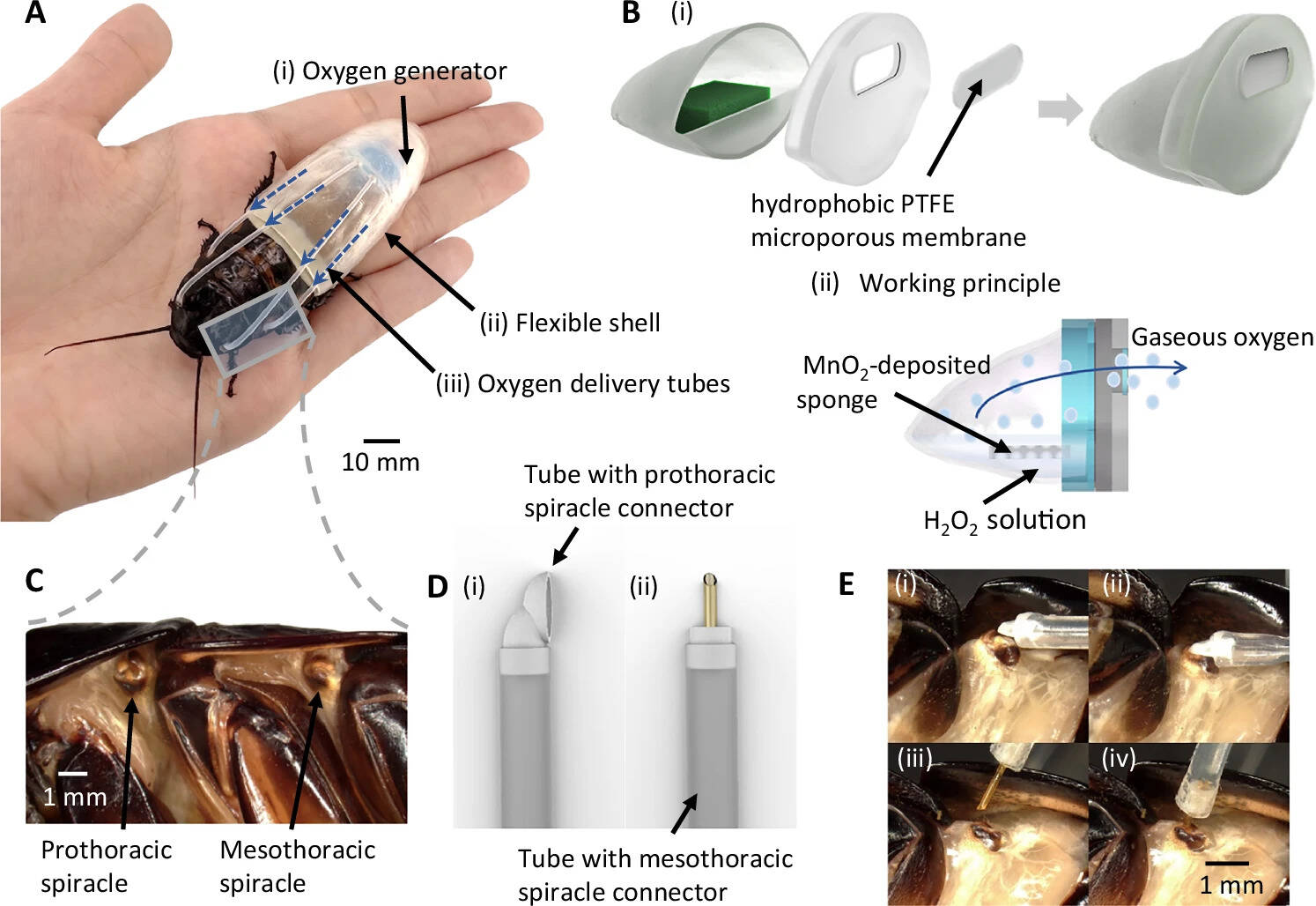
By providing a microscopic breathing apparatus, these cyborg insects can now navigate flooded environments, extending their reconnaissance capabilities into previously inaccessible crisis zones and potentially saving lives. Image Credits: 3D-printed suit for cyborg insects extends operations underwater Fig 2
The microscopic engineering behind a chemical oxygen tankThe tiny diving suit uses a chemical power unit that generates oxygen on demand without heavy cylinders or external power cords.
According to the technical design specifications detailed in the Nature Communications paper, the entire breathing apparatus is crafted out of a lightweight, transparent polymer material using advanced resin 3D printing techniques. Inside the main processing compartment, the engineering team placed a tiny sponge coated with a specialised layer of manganese dioxide, which serves as a highly active chemical catalyst.To activate the underwater breathing system before deployment, handlers inject a small amount of a diluted liquid compound into the integrated storage reservoir. When this fluid interacts with the treated sponge catalyst, it triggers a continuous, controlled chemical breakdown that produces pure, breathable oxygen gas. The newly generated air is then directed through the flexible internal pathways of the shell, keeping the insect fully conscious and active even when it is completely submerged under deep water or trapped inside tight spaces filled with hazardous gases like carbon dioxide.Laboratory testing protocols confirmed that the equipped insects could easily walk and navigate through flooded test tubes and artificial underwater obstacles for up to three hours at a time. This extended operational window could help researchers test how the insects move through flooded spaces and debris. Once the test is complete, the silicone breathing tubes can be detached without causing long-term harm to the insects.This intersection of additive manufacturing and biological engineering offers a new approach to search-and-rescue technology. By showing that a lightweight, 3D-printed suit can protect a land-dwelling organism from a lethal environment, the study suggests that we can successfully combine artificial components with natural biological systems to solve complex real-world problems. As this bio-robotic framework develops, the insects could one day help researchers explore hazardous environments.








 English (US) ·