

 6 days ago
4
6 days ago
4
ARTICLE AD BOX

Bergen's World Cup celebrations caused subtle tremors detected by a university seismometer, revealing the immense kinetic energy of synchronized crowds. (AP Photo/Pamela Smith)
Even past midnight, Bergen was settling down. In many places throughout the town, there were crowds of people watching the World Cup football game between Norway and another country, following it live on TV or their cell phones.
There was one thing that no one knew about, though, and that was that a very delicate scientific device in the University of Bergen was detecting something out of the ordinary. Each time there was a pivotal moment during the match, when the fans would react in a certain way, the seismometer started registering subtle tremors in the earth. These were not caused by earthquakes or any natural phenomenon, but rather seemed to be connected with the activity of the fans watching the match.The bedrock was vibrating in response to the synchronised movements of thousands of people celebrating at the same moment. When a whole city reacts to an intense event all at once, that massive burst of human kinetic energy pushes right down into the local soil. Scientists looking at the readouts found a measurable physical effect from crowds moving together. This rare overlap between local life and geophysics illustrates how human activity can produce measurable ground vibrations.
This strange link between neighbourhood celebration and ground movement was studied by geologists in the Department of Earth Sciences at the University of Bergen. According to EurekAlert, researchers explained how they tracked these local patterns. By digging into data from their central city sensor, the academic team found wave patterns that lined up with key moments from the recent FIFA World Cup match, suggesting how much force an excited crowd can exert on its surroundings.A sensitive instrument records a city's vibrationsTo pick up these tiny city movements, geologists use a highly specialised basement seismometer that can measure ground shifts as small as a millionth of a millimetre. Most of the time, these machines are set up far out in the wilderness so they can track deep crustal plates without any interference. But since this particular device sits directly under the pavement in downtown Bergen, it serves as a strange, accidental diary of daily city life, tracking everything from heavy delivery trucks to late-night foot traffic.When a huge moment happens in a game, the sudden movements of people jumping and pacing around can send low-frequency shockwaves through the floors and into the earth. The records kept by the University of Bergen team showed that the ground would alter its baseline behaviour right when matches began. Even smaller details, like a referee making a big call or a sudden change in play, appeared as blips on the digital charts, suggesting how closely the community was following the match.The result has shown that there is a sudden spike in the sensors when Erling Haaland scored a goal, which happens during the celebration of the goal. There is an observable spike that occurs on the waveform as compared to the normal background noise of the city. Human impacts can clearly be observed on the device measuring the movement of the planet.
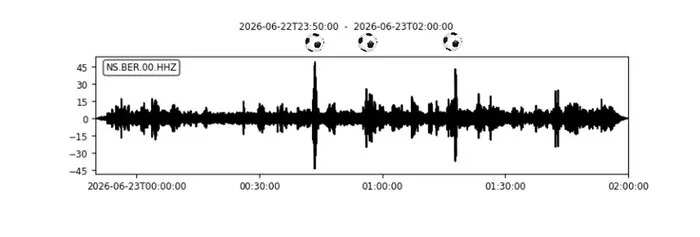
The graph shows the measured seismic signal during Norway’s goals in the match against Senegal. Image Credit: University of Bergen
The surprising physics behind collective celebrationThis ground shaking is not just a strange anomaly unique to Norway, since similar ground movements have turned up at music festivals and crowded stadium events around the world. According to a separate data breakdown by the national seismological institute NORSAR, titled Norge vant og Bergen ristet i natt, these specific tremors usually happen because of two main things.
First, thousands of fans stomping and jumping can send vibrations into the ground. Second, synchronised shouting may also contribute to vibrations in nearby walls and topsoil.For the tracking team, these brief spikes are more than a piece of local trivia. Watching how human-made waves move through a crowded urban space gives structural engineers and geologists useful clues about how local soil behaves under pressure.
It lets researchers study how energy flows through different rock layers beneath a city, offering a safer way to look for weak spots in the ground without using test explosives.As cities grow more crowded and shared entertainment events draw large audiences, the connection between daily life and geophysics becomes easier to observe. Knowing that an athlete's victory can rattle building blocks away is a reminder of how connected people are to their environment. It suggests that large crowds can generate enough energy to make the ground vibrate.







 English (US) ·