

 1 week ago
9
1 week ago
9
ARTICLE AD BOX
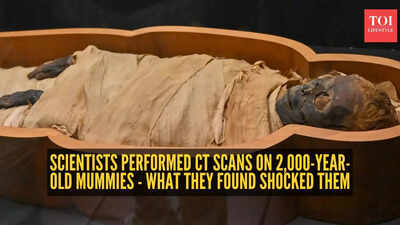
It’s kind of mind-blowing to think about this, but science is now helping us learn real details about people who lived more than 2,000 years ago. Not just who they were, but what they suffered from, how they aged, and even whether they may have had medical treatment.
Recently, researchers at the University of Southern California used advanced CT scans to look inside two Egyptian mummies, and what they discovered was both surprising and deeply human.
Nes-Min and Nes-Hor: What the scans showed
As mentioned in a report by Forbes, one of the mummies is Nes-Min. He likely died in his forties around 330 BCE. The scans revealed that he had a collapsed vertebra and broken ribs. But there was something even more interesting.Summer Decker, head of 3D imaging for Keck Medicine of USC, said, “We actually see what we think could be potentially tool marks or some kind of holes that are not necessarily natural.
We’re trying to investigate that right now, but what we’re thinking it could be is potentially some sort of early surgical intervention.”In simple terms, researchers believe he may have undergone some form of early surgery thousands of years ago.According to the report, the second mummy, Nes-Hor, died in his sixties around 190 BCE. He had serious dental problems and a badly worn hip. Walking would likely have been painful for him.
It’s striking to realize that even in ancient times, people dealt with aging, joint pain, and health problems, just like we do today.
How they looked inside without opening them
The team used a powerful 320-slice CT scanner that captures images as thin as 0.5 millimeters. As mentioned in the Forbes report, the mummies remained in the lower halves of their sarcophagi while the machine created highly detailed images.Using those scans, researchers built full 3D digital models of the priests.
It’s almost like creating a virtual version of their bodies.
The ethical question
Not everyone is fully comfortable with this kind of research.Professor Christina Riggs from Durham University explained to Forbes in an email, “Ancient Egyptian burials – and the wrapped, embalmed bodies that are reduced to the term 'mummy' – were based on sacred rites and materials, conducted in secret, that emphasized the divine, eternal qualities of the deceased and created a hidden, sacred, secret place in which their cyclical regeneration could recur.”She also said, “There is no ‘non-invasive’ technology or entirely respectful museum display of the dead if we consider what ancient Egyptian belief systems sought to create for the deceased.”Her point highlights an important debate about respect, belief systems, and modern science.At the same time, Diane Perlov from the California Science Center shared another perspective. As quoted by Forbes, she said, “This modern scientific technology offers us a powerful window into the world of ancient people and past civilizations that might otherwise be lost.”Thumb image: Canva (for representative purposes only)







 English (US) ·