

 1 hour ago
6
1 hour ago
6
ARTICLE AD BOX
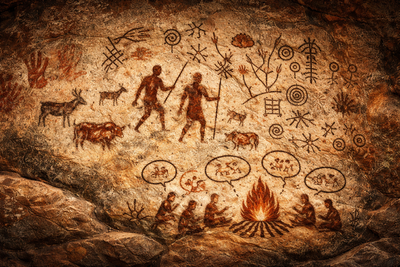
The mystery of the origin of human language has captivated scientists for centuries, and it remains one of the most intriguing problems in the field. How did humans manage to progress from simple sounds and gestures to complex sentences, shared narratives, and rich cultures? New research promises to provide more answers to this question than ever before.
By combining genetics, archaeology, and linguistics, scientists believe they are getting close to an estimate of when language first appeared and how it developed over time. It’s not likely that scientists will find the answer to the entire mystery, but new evidence suggests that language may be older and more closely related to the development of humans than previously thought, an evolution that stretches back hundreds of thousands of years.
When did human language first emerge
However, one significant breakthrough is being seen as a result of recent genetic studies. Humans may have had the ability to speak as long as 135,000 years ago, but speaking as a general phenomenon occurred later. This is in agreement with older studies on evolutionary linguistics. The Proceedings of the National Library of Medicine publications highlight that the origins of language could be as old as 150,000 to 200,000 years, corresponding with the advent of Homo sapiens.
Language is an attribute of all humans on this earth. Everyone speaks. This shows that the ability for language must have predated the migration of humans from their point of origin. The genetic record shows that humans diverged into different populations about 135,000 years ago. This shows that language must have been around or close to being around at least by this time. In other words, language did not suddenly spring into existence from thin air.
It has evolved alongside humans.
How did language begin: From gestures to speech
The mystery of the origins of language is a complex puzzle. Most scientists think that it never began with words in the first place, but rather started with gestures and raw vocal noises.As per a linguistic theory, one of the most popular theories of the origins of language is the gestural theory, which suggests that humans used hand movements as a way of communication before the development of speech, with areas in the brain used for speech also being used for motor functions, especially those involving hand movements.Over time, these hand movements either disappeared or were accompanied by vocal noises, a process that occurred gradually as our bodies developed.This was around 100,000 years ago, when humans developed the physical structures necessary for producing complex sounds, such as changes in the mouth, tongue, and throat.Evolution is another aspect that has been attributed as a major factor in the development of language.
Most scientists believe that it was an evolutionary advantage for humans to communicate better, as it helped them to work together, hunt, and ultimately survive.
The role of the brain and genetics in language evolution
It must be noted that language is not just the study of sounds; it goes deeper than that, into the brain itself. Recent research has indicated that the pathways in the brain for language development are both incredibly complex and ancient. Research carried out by the Max Planck Society has indicated that the areas of the brain that govern language may be traced back millions of years, before the emergence of humans as we know them today.
Therefore, it may be noted that the raw material for language development was present in the forebears of humans, but the way it was used was not.Genetics also plays a role in the development of language. It must be noted that scientists often look to the role of genetics in the development of language, as indicated in the role of the FOXP2 gene in the development of the ability for speech and language in humans.
Did early humans speak like us
The initial stages of language development were, in all likelihood, much simpler compared to what we have in the present day.
Some researchers in Constructing a Protolanguage believe that there was a "proto-language," which was a basic combination of sounds and symbols without grammar. This basic form of communication gradually developed into a much more complex system as it was passed down through the centuries, ultimately blossoming into the structured language we have today.Archaeology supports the theory of gradual development. The presence of symbolism, such as art, rituals, and tool development, seems to have been prevalent in the 50,000-100,000-year time period, which suggests that structured language developed in this period.
This period also seems to align with what scientists call "behavioural modernity," or the time when humans began thinking and communicating as we do today.
Why language was crucial for human survival
Language didn’t just evolve for the sake of communication; it became one of humanity’s greatest survival tools.With language, early humans could:
- Share knowledge about food and danger
- Coordinate group activities like hunting
- Pass down skills across generations
- Build social bonds and communities
Language enabled humans to team up in ways that no other species ever could, and that gave the human line an important advantage in evolution.
Scholars suggest that the development of language likely stemmed from the social and environmental need to cooperate and survive.
Why Scientists Still Debate the Origin of Language
Despite increased knowledge, the mystery of the origins of language remains partially unsolved. Unlike bones or tools, language does not fossilise, and we cannot refer to a specific specimen as proof. Instead, we are forced to make an educated guess based on genetic, neurological, and cultural evidence.
As a review in Scientific Research (SCIRP) frankly admits, we “simply do not know… how or when language began.
”Different theories still compete:
- Some suggest language began over a million years ago
- Others argue it is unique to modern humans
- Many believe it evolved gradually in stages
The truth may lie somewhere in between.
A story still being written
A clearer, more intricate picture is being created than ever before. Language, it seems, began with simple gestures and sounds, which gradually developed into the complex systems we depend on today. Language has been around for at least 135,000 years, and it is inextricably linked with human biology, culture, and survival.The reason this story is so captivating, however, isn’t the numbers themselves. It’s what it says about us as a people. It hasn’t been created in an instant; it has been given to us as a gift. It has been built up through countless generations of thought, adaptation, and connection with others.Even as scientists are closer than ever to the answer, the story of language goes on, word by word.









 English (US) ·