

 54 minutes ago
5
54 minutes ago
5
ARTICLE AD BOX
German school students buried a skeleton from their biology lab after discovering it was likely of an Indian man exported during the colonial-era bone trade. This came even as a joke on cadavers in medical colleges by an Indian doctor, Sejal Pawar, triggered outrage.
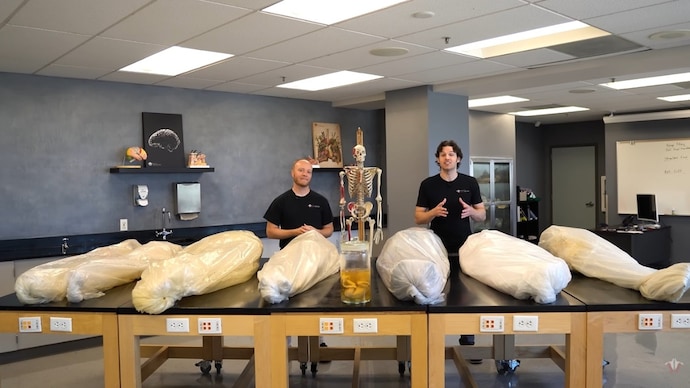
A remark at a comedy show in India has reignited an uncomfortable debate about how the dead are treated in India. (Image: YouTube/Institute of Human Anatomy)
New Delhi,UPDATED: Jun 12, 2026 07:00 IST
School students in Germany recently did something long pending for a man whose identity nobody knows. He was most likely an Indian, who had been dead for decades, perhaps longer. They gathered to bury "Niran", a classroom skeleton that hung in their biology lab as a teaching prop. Ribs exposed, jaw wired into place, missing bones replaced by plaster. They gave the skeleton a name because they discovered that Niran was a real man, likely from India, and was one among thousands of cadavers exported to Europe during the British era for medical research.
The students decided Niran deserved dignity in death, and finally gave him a burial.
The story, reported by Germany-based news outlet Deutsche Welle (DW), surfaced coincidentally close to the controversy surrounding a doctor's remarks at comedian Pranit More's show, where she casually joked about cadavers and the sizes of their penis from anatomy lab days.
The two incidents are contrasting. One recognised that even the anonymous deserve to be treated with respect. The other reduced the dead to objects of crass humour. The latter is problematic because it might discourage people from donating their bodies for medical research and studies.
WHAT IS PRANIT MORE RS 370 BIRYANI ALL ABOUT?
For the uninitiated, at a recent comedy gig by Pranit More, Sejal Pawar, a doctor, casually narrated how she and her classmates joked about male cadavers during anatomy dissections in medical college. The audience laughed as Pawar, linked to Mumbai's KEM Hospital, described conversations around penis sizes of dead bodies brought into the anatomy lab, recalling how students would save "the main part" for last while working through dissections.
As clips targeting a youth in the "Rs 370 biryani" Pranit More controversy went viral, videos of Pawar from the same show were circulated by a section of social media users to counter the former group.
Whether the "Rs 370 biryani" and the joke about cadavers deserve equal outrage is an entirely separate debate. But the backlash over the latter has also reopened how casually the dead can become objects of neglect.
HOW GERMAN STUDENTS BID FAREWELL TO NIRAN
Meanwhile, just days before, around 6,000 km away, in Germany, in a classroom there, school students bid farewell to Niran as they thought it was time to let him rest in peace.
Niran was part of the massive skeleton trade that once supplied western institutions, something that changed over the years. Thousands of such skeletons from India still hang in classrooms and laboratories across the Europe, used as educational tools to teach anatomy and to aid in medical research.
But the gesture by the German students was poignant because they stopped seeing Niran as an object.
The students discussed his history not only in biology class, but in ethics lessons too, reported DW. Eventually, with the help of teachers and funeral workers, they organised a burial for him. The skeleton received a final resting place, decades after becoming anonymous teaching material in another continent.
The episode also shines a light on the massive skeleton and cadaver trade that flourished under British colonial rule. Even in death, Indians were not spared exploitation. Thousands of bodies and skeletons, many believed to belong to poor and unclaimed Indians with little agency or protection, were shipped to Europe and North America to serve medical education and scientific advancement.
THE LARGER STORY ABOUT THE DEAD IN INDIA
The German students' action and Sejal Pawar's joke lead us to an uncomfortable story about India's dead.
The business of bones and cadavers survived well into independent India and was banned only in 1985.
The German students who buried Niran were confronting that dark legacy. It is a reminder that countless unnamed Indians became scientific material in death, often without consent or ceremony.
But the question of dignity in death is not confined to colonial history.
Take for example the Odisha episode. A 52-year-old man, Jitu Munda, exhumed his sister's skeletal remains and carried them to a bank because officials allegedly refused to release her savings without proof of death. Videos showed him transporting a cadaver wrapped in burial cloth after repeated failures by the bank pushed him to desperation.
The image was horrifying not only because a grave had been exhumed, but because the system appeared to leave him believing this was his only option.
Now, the joke about cadavers has revived a serious question of how we treat the dead.
Bodies are abandoned in hospital morgues for months because families cannot afford transport. Poor people have often been forced to carry bodies on bicycles, carts and shoulders because ambulances were unavailable or unaffordable.
Even body donation and organ donation continue to struggle because of mistrust. Many families fear that once handed over, bodies will not be treated respectfully. Medical institutions themselves refer to cadavers as "first teachers", acknowledging the enormous gift donors make to science and education. Which is perhaps why public jokes about dissected bodies triggered such strong reactions.
To be fair, gallows humour has long existed in professions that constantly encounter death. Doctors, emergency workers and soldiers often develop dark humour as a coping mechanism. Anatomy labs can be emotionally difficult spaces, especially for young students confronting human dissection for the first time.
But there remains a difference between coping with death and becoming careless about it. More so, while sharing details in a public space.
The German students who buried Niran seemed to recognise something essential: that even anonymous remains belonged to a human being who once lived a full life. Someone who laughed, feared, loved, ate, worked and existed beyond the skeleton hanging in a classroom.
That recognition, which was simple, humane and delayed by decades, perhaps says more about dignity than any ceremonial oath.
The dead cannot demand respect for themselves. That responsibility rests entirely with the living.
- Ends
Published By:
Anand Singh
Published On:
Jun 12, 2026 07:00 IST




 English (US) ·