

 41 minutes ago
4
41 minutes ago
4
ARTICLE AD BOX
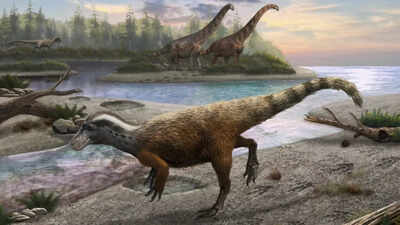
There’s nothing quite like stumbling across a dinosaur trackway, especially when it refuses to fit the big, toothy predator stereotype. Deep in northern China, scientists are piecing together the life of a carnivorous dinosaur not as it sprinted after prey, but as it strolled, practically dragging its feet.
Turns out, ancient predators didn’t always move with the wild urgency we see in the movies.
The latest discovery: What we know about it
The story centers on a huge dinosaur footprint site near Zhangjiakou in Hebei province. Per China Times, researchers found fossil trails from a theropod (that’s the group famous for T. rex and its kin) there that point to an absurdly slow walking speed. Take note that we’re talking about 0.28 meters a second, or just about 1 kilometer an hour.
That’s a crawl, and one of the slowest paces ever recorded for a meat-eating dinosaur.This finding is stirring up the old ideas about carnivorous dinosaurs. If the bite marks and dramatic scenes in pop culture suggest they were always running and in attack mode, these footprints say otherwise. Instead, they hint at times when predators poked around, took in their surroundings, or tested tricky ground. This wasn’t a one-country effort: researchers from China, Brazil, and Australia all chipped in.
The slow-walking dinosaur has quickly become a hot topic worldwide, mostly because it challenges our action-hero view of these ancient animals.
What did the scientists actually find?
The tracks, preserved in ancient mud flats now turned to stone, come from the Tuchengzi Formation. That’s a slice of rock dating from about 154 to 134 million years ago, which points to the time of late Jurassic bleeding into the early Cretaceous. Out in the open, they counted 16 big prints, each about 23 to 27 centimeters long, and 11 smaller ones, all between 10 and 14 centimeters.The most eyebrow-raising discovery was a string of five three-toed footprints — all super close together. The strides stretched from just 32 to 46 centimeters. Picture a toddler waddling across a sandy beach, and you’ve got the gist. Once they did the math, the scientists realized the dinosaur didn’t just slow down for a moment; rather, it kept to that cautious pace for a while.This mattered because theropods usually show up as quick, driven animals, not lazy wanderers.
We’re used to thinking of them as the terrors of the Mesozoic, always on the hunt. But not much survived from their down times, as it takes just the right sticky mud and set of conditions to preserve those slower moments.Lead researcher Xing Lida, a geoscientist at China University of Geosciences, thinks the dinosaur had a purpose, not just aimlessly meandering. It might have been hunting for smaller creatures, watching its step on shifting ground, or stopping often to check its surroundings.
Those short strides aren’t just random; they suggest real caution with every step.The footprints came from a “neotheropod,” which is the paleontologist's way of saying a three-toed, meat-eating dinosaur that walked upright, leaving straight, narrow tracks. The trackmaker wasn’t a monster like T. rex, but more of a medium-build predator.
Why is the discovery making waves?
The scale of the site makes it even more remarkable. Back in 2020, geologists found nearly 30,000 square meters of exposed fossil-rich ground here.
They’ve counted more than 5,000 dinosaur prints so far, from huge plant-eaters to many other meat-eaters too. The location is now considered one of the most important dinosaur footprint sites in China, maybe the world. For people who study ancient tracks — ichnologists, technically — it’s a kind of paradise.The detail and preservation of these prints are stunning, thanks to ancient microbial mats, which acted like a sticky film that held the prints together until time turned mud into stone.
Without them, most details would have vanished long ago.Fossil skeletons are like mugshots — they show you what dinosaurs looked like and how big they were. But prints like these? They’re more like candid snapshots. They capture movement, hesitation, and the everyday walk rather than just fight scenes. Scientists can actually measure stride, speed, and sometimes behavior from these traces.
What’s next?
Interestingly, not all dinosaurs at the Zhangjiakou site were this lazy! Tracks from the same rock patch show some meat-eaters zipping along at 9 to 14 kilometers per hour.
There was a whole range of dinosaur behaviors, even side by side.And all this chips away at the Hollywood version of dinosaurs, painting a messier but much more interesting picture. Life wasn’t a nonstop chase. Sometimes, even the fiercest predators just slowed right down and strolled.Scientists are still sifting through thousands of tracks at the site, hoping for glimpses into herd behavior, dinosaur interactions, and maybe species nobody’s ever seen before. In the end, that’s the magic of fossil footprints: they freeze a moment from a vanished world. Every step, even the tiniest, tells a truly historic story.







 English (US) ·