

 1 week ago
6
1 week ago
6
ARTICLE AD BOX
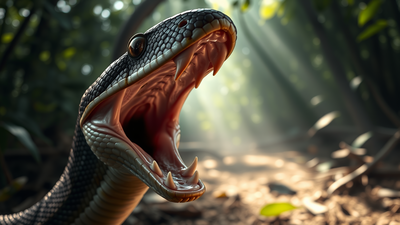
If you've ever watched a snake slowly open its mouth as wide as it will go, hold it there for a few seconds, and then close it again, you might have assumed it was tired. It looks, unmistakably, like a yawn.
But snakes don't yawn the way mammals do; they're not fighting fatigue or getting more oxygen to a sleepy brain. What you're actually watching is something more mechanical and, when you understand the anatomy involved, considerably more impressive. The behaviour is called mouth gaping, and herpetologists are careful to distinguish it from the yawning we know. It serves a set of specific physiological functions that are unique to the way snake skulls are built and it says a lot about how these animals have evolved to eat in a way no other vertebrate quite manages.
The snake jaw: why unfused mandibles and the quadrate bone make gaping necessary
To understand why snakes need to perform this reset at all, you have to start with what makes a snake's jaw so different from that of most other animals.In humans and most mammals, the lower jaw is a single rigid bone, fused at the chin and anchored firmly to the skull. It opens and closes, and that's about all it does. A snake's jaw works on an entirely different principle. The two halves of the lower jaw, the mandibles, are not fused to each other at all.
Instead, they're connected at the front by a highly elastic ligament, closer in function to a rubber band than a bone joint.
This means each side of the lower jaw can move independently, spreading outward to dramatically increase the width of the snake's mouth opening.Connecting the lower jaw to the skull is a bone called the quadrate bone, and this is where things get particularly interesting. In most reptiles, this joint offers limited movement.
In snakes, the quadrate is highly mobile in multiple directions it can rotate backwards and outward, sometimes nearly 90 degrees from its resting position, effectively extending how wide the mouth can open. When a snake is consuming large prey, the quadrate bones on each side pivot dramatically, the mandibles spread apart, and the elastic skin around the jaw stretches to accommodate whatever is being swallowed, sometimes prey up to three times wider than the snake's own head.After all that movement, the jaw bones need to come back to their normal resting position. That's what the gaping is for.
Mouth gaping as post-meal jaw realignment: what's actually happening inside
Once a snake finishes swallowing, the quadrate bone, the mandibles, and the various ligaments connecting them have all been pushed well outside their usual positions. The snake needs to reset everything back into alignment before it can function normally again, hunt, defend itself, or simply rest comfortably.The gaping motion accomplishes this through a sequence of stretches and lateral movements. As the snake opens its mouth wide, the bones are guided back toward their resting positions by the tension of the elastic ligaments pulling them home. The jaw shifts from side to side slightly, the quadrate resets, and gradually everything returns to its normal configuration. What looks from the outside like a lazy, dramatic yawn is actually a fairly precise mechanical reset.The behaviour isn't limited to after eating. Snakes also gape when waking from long periods of inactivity, before a meal as a warm-up stretch, and sometimes after handling by humans, when the jaw may have been jostled or held in an awkward position. In each case, the function is the same, restoring the jaw to a state where it can work as intended.
The Jacobson's organ connection: how gaping helps snakes detect chemical cues
There's a secondary function to mouth gaping that's less obvious but worth noting.
Snakes are famous for their tongue-flicking. They use their forked tongues to collect scent particles from the air and transfer them to a sensory organ on the roof of the mouth called the Jacobson's organ, or vomeronasal organ. This system lets snakes detect chemical traces of prey, predators, and mates with remarkable precision.When a snake gapes, the Jacobson's organ is brought into closer contact with the surrounding environment.
Some researchers suggest that the wide-open gape position allows the organ to sample airborne chemicals more effectively than it can with the mouth closed. This may be why snakes sometimes gape in new environments or when they seem to be investigating something; the behaviour doubles as a form of enhanced environmental scanning, layered on top of its mechanical jaw-resetting function.
When gaping is a warning sign: distinguishing normal jaw reset from respiratory illness
For anyone keeping snakes as pets or simply observing them, understanding the difference between routine gaping and something more concerning is useful.Normal mouth gaping is typically brief, a few seconds infrequent, and associated with obvious triggers like a recent meal, waking up, or a new enclosure. The snake should otherwise appear alert, its scales healthy, and its breathing silent. This kind of gaping requires no intervention. The jaw will realign itself naturally.Gaping that is persistent, accompanied by wheezing, bubbling around the nostrils, mucus around the mouth, or frequent rubbing of the mouth against enclosure surfaces can indicate a respiratory infection or mouth rot, a bacterial condition technically called stomatitis.
In these cases, the snake is opening its mouth not to reset its jaw but because it's struggling to breathe or experiencing discomfort in the mouth.
A veterinary check is warranted.The distinction matters because the two behaviours can look similar to an untrained eye. The key is context and frequency. A snake that gapes once after a meal and goes back to resting normally is doing exactly what it should. A snake that gapes repeatedly, gasps, or shows other physical symptoms is telling you something different entirely.
What snake jaw mechanics have inspired in engineering and robotics
The snake jaw has attracted attention outside herpetology, too. Biomedical engineers have drawn on the mechanics of snake feeding, specifically the combination of rigid structural elements with highly elastic connectors, when designing flexible surgical instruments that need to navigate narrow, winding internal pathways in the human body. Robotics researchers have built articulated snake-inspired robots using similar principles, where segmented sections mimic the independent movement of snake jaw bones for search-and-rescue applications in confined spaces.
Materials scientists have studied the elastic properties of snake jaw ligaments to develop synthetic materials that can stretch significantly without losing structural integrity.The snake's jaw, in other words, is not just an elegant evolutionary solution to the problem of swallowing large prey. It's a working model that engineers are still learning from a reminder that what looks like a yawn can carry a lot more inside it than first appears.









 English (US) ·