

 1 hour ago
3
1 hour ago
3
ARTICLE AD BOX
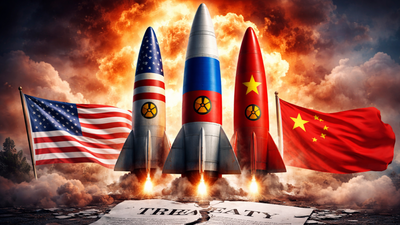
The expiration of the New START treaty, the last remaining nuclear arms control agreement between the United States and Russia, has raised fears of a renewed global arms race, even as Washington and Moscow signal the need for urgent talks and the US steps up pressure on China to join a future nuclear pact.The Kremlin said on Friday that Russian and US negotiators agreed on the need to quickly launch new arms control talks after New START formally expired, leaving the world’s two largest nuclear powers without any binding limits on their strategic arsenals for the first time in more than five decades.At the same time, the United States accused China of conducting covert nuclear explosive tests and reiterated that any future arms control agreement must include Beijing, a demand China has firmly rejected.
New START expires, removing nuclear caps
New START, signed in 2010 by then US President Barack Obama and Russian President Dmitry Medvedev, officially expired on Thursday after a single five-year extension ended. The treaty capped each side at 1,550 deployed nuclear warheads and 700 deployed missiles and bombers, and provided for inspections and data exchanges to reduce the risk of miscalculation.With the treaty’s expiration, there are now no formal limits on the nuclear arsenals of the United States and Russia.
Russian President Vladimir Putin had earlier offered to continue observing New START limits for another year if Washington did the same, but no agreement was reached before the deadline.
Russia, US agree talks are urgently needed
Kremlin spokesman Dmitry Peskov said Russian and US negotiators discussed the future of nuclear arms control during talks held in Abu Dhabi, where delegations from Russia, Ukraine and the United States also met to discuss a possible peace settlement in Ukraine.“There is an understanding, and they talked about it in Abu Dhabi, that both parties will take responsible positions and both parties realize the need to start talks on the issue as soon as possible,” Peskov said.Asked about reports of a possible informal agreement to continue observing New START limits for six months, Peskov dismissed the idea.“It's hard to imagine any informal extension in this sphere," he said.Even as New START expired, the US and Russia agreed to restore high-level military-to-military dialogue, which had been suspended since 2021 amid worsening relations ahead of the Ukraine war.
Why Washington wants China in a new treaty
US President Donald Trump has said he wants to maintain limits on nuclear weapons but insists that China must be part of any new arms control agreement. During his first term, Trump unsuccessfully sought a three-way nuclear pact with Russia and China, an effort Beijing rejected.US Secretary of State Marco Rubio reiterated Washington’s position, warning that a bilateral deal would be insufficient.“An arms control arrangement that does not account for China’s build-up, which Russia is supporting, will undoubtedly leave the United States and our allies less safe," Rubio said.Rubio said the US was “pursuing all avenues” to fulfill Trump’s desire for fewer nuclear weapons, but stressed that Washington would not remain passive as Russia and China expand their arsenals.“Since 2020, China has increased its nuclear weapons stockpile from the low 200s to more than 600 and is on pace to have more than 1,000 warheads by 2030,” Rubio wrote on Substack.
US says New START limits no longer fit today’s threats
Speaking at the Conference on Disarmament in Geneva, Thomas DiNanno, the US Under Secretary for Arms Control and International Security, described the treaty’s expiration as a turning point.“Today marks the end of one era of arms control and hopefully the beginning of a new one,” DiNanno said.He said Trump wants a “better agreement” that reflects current realities, arguing that New START imposed unilateral constraints on the United States while failing to address China’s rapid nuclear expansion and Russia’s development of new nuclear systems.“As we sit here today, China’s entire nuclear arsenal has no limits, no transparency, no declarations and no controls,” DiNanno said.
US accuses China of covert nuclear tests
DiNanno went further, accusing Beijing of secretly conducting nuclear explosive tests in violation of its testing commitments.“Today, I can reveal that the U.S. Government is aware that China has conducted nuclear explosive tests, including preparing for tests with designated yields in the hundreds of tons,” he said.He alleged that China attempted to conceal the tests by masking seismic signals.“The PLA sought to conceal testing by obfuscating the nuclear explosions because it recognizes these tests violate test ban commitments,” DiNanno said, adding that China conducted one such test on June 22, 2020.
China rejects allegations, refuses to join talks
China strongly denied the US accusations. Ambassador Shen Jian called them “false narratives and unfounded accusations by the United States.”“We abide by our commitment to suspend nuclear testing,” Shen said.He accused Washington of shifting blame for its own disarmament obligations.“The U.S.’s continuous hyping up of China’s nuclear arsenal expansion is essentially aimed at shifting its own responsibility for nuclear disarmament and seeking excuses for promoting nuclear hegemony,” Shen said.Shen reiterated that China would not participate in nuclear disarmament negotiations at this stage, arguing that its arsenal is far smaller than those of the United States and Russia. He also said Beijing regretted New START’s expiration and urged Washington to accept Moscow’s offer to continue observing the treaty’s limits and resume talks with Russia.
End of an era, uncertainty ahead
Analysts warn that the collapse of New START ends more than five decades of formal nuclear arms control between Washington and Moscow, increasing the risk of an unconstrained arms race driven by mistrust and worst-case assumptions.While both the US and Russia say they want talks, deep disagreements over China’s role, allegations of treaty violations and broader geopolitical tensions raise questions about whether a new agreement can be reached soon.For now, the expiration of New START has left global nuclear stability in uncharted territory, with Washington making clear that any future arms control framework will need to reflect a multipolar nuclear world rather than a Cold War-era balance.








 English (US) ·