

 1 hour ago
4
1 hour ago
4
ARTICLE AD BOX
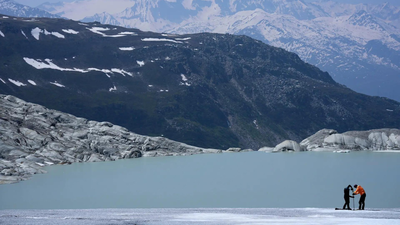
File photo: Switzerland's glaciers are on course to lose an enormous amount of ice this year
Switzerland's glaciers are on course to lose an enormous amount of ice this year as the ongoing European heatwave accelerates melting, with the country expected to reach "glacier loss day" by Monday, the second-earliest date ever recordedThe milestone marks the point when all the snow and ice accumulated during the previous winter has melted away.
From then until October, every additional day of melting results in a net loss of glacier ice, shrinking the glaciers further."We're just seeing enormous ablation, ice melt rates and snow melt rates all over the Alps," Matthias Huss, head of Glacier Monitoring in Switzerland (GLAMOS), said on Friday, as quoted by news agency AFP."We are three months too early compared to a healthy state", Huss added.
Heatwave accelerates melting across the Alps
The only earlier glacier loss day since records began in 2000 was in 2022, when it fell on June 26.
This year's early arrival has been driven by an intense heatwave sweeping Europe, another unusually warm spell in May, and poor snowfall during winter.Huss said he recently revisited the Rhone Glacier and found that around one metre of ice had melted vertically in just 10 days."It's very impressive to see, and this is just the effect of the heatwave," he said.He stressed that a single heatwave is not the biggest threat.
"The problem is rather that we have very high temperatures that last for a very long time," he said, adding that prolonged periods of extreme warmth are "very bad for the glaciers."
Poor snowfall, Sahara dust worsen situation
As per AFP, this year's conditions closely resemble 2022, which remains the worst year on record for Alpine glacier melt.Huss said Switzerland received about 25 per cent less snow on its glaciers than the 2010-2020 average. A warm May caused snow to disappear earlier than usual, exposing darker glacier ice that absorbs more solar radiation and speeds up melting.He also pointed to dust blown from the Sahara Desert in March as another factor worsening glacier conditions by reducing the reflectivity of snow.While the full extent of ice loss will be assessed in September, Huss said, "it is clear already now that we will have very strong ice loss also this year."
Climate change driving Europe's extreme heat
The glacier melt comes as scientists increasingly link Europe's record-breaking heat to climate change.A rapid attribution study by the World Weather Attribution group found the current heatwave would have been virtually impossible without human-induced climate change, with similar events now around 200 times more likely than they were just two decades ago.Researchers described the ongoing event as the most severe heatwave ever recorded across the region studied.Scientists found temperatures during comparable events in the 1970s would have been several degrees cooler. Europe, the world's fastest-warming continent, has seen temperatures rise at roughly twice the global average since the 1980s, according to AP.Researchers also warned that greenhouse gas emissions from burning fossil fuels continue to make extreme heat more frequent and intense, reported Reuters.
Thousands of glaciers already lost
Swiss glaciers have been retreating for around 170 years, but melting has accelerated sharply in recent decades as the climate has warmed.The volume of Switzerland's glaciers shrank by 38 per cent between 2000 and 2024.Huss said the country has already lost around 1,200 glaciers over the past 50 years, leaving about 1,300 remaining today."If warming continues as it did over the last decades, by 2100 we will only be left with some little remnants of ice," he warned.The shrinking glaciers also threaten Europe's major river systems, as meltwater from the Swiss Alps feeds rivers including the Rhine and the Rhone, making the long-term consequences significant for water supplies across the continent.









 English (US) ·