

 2 hours ago
4
2 hours ago
4
ARTICLE AD BOX
In the seconds that the ball ballooned high up in the skies and as Max O’Dowd ran in from long-on, Faheem Ashraf did perhaps what the whole of Pakistan was up to. “I just looked up and prayed to God as hard as I could. Not just from my mouth, my whole body was praying for it to be dropped,” Ashraf would reveal later. Paul van Meekeren, whose double-wicket maiden in the 13th over triggered a sensational batting collapse, had no doubt in his mind that had the catch been taken, the Netherlands would “have potentially sent Pakistan home today”. He won’t end there. “Pakistan didn’t win the game today; we lost the game against ourselves,” van Meekeren would go on to add.
Van Meekeren wasn’t exaggerating. The consequences for Pakistan, had O’Dowd latched onto the catch after covering good ground and getting both hands to it before it slipped off his palms, were endless. With just tail-enders to follow, and two wickets left, they would have needed 23 runs off 10 deliveries. Having chosen to forfeit their group stage match against India on February 15 – as of now, at least – had they lost this fixture, the chances of qualification would have been under serious doubt and they would have needed help from other teams. It may have even precipitated a U-turn with regard to taking the field against India, particularly after putting up a brave face all along that they can go through to the Super 8s by winning their three matches against the Associates. Having already lost to USA at the last T20 World Cup edition, this fixture was another reminder for Pakistan that in this fickle format, there are no guarantees.
After that dropped chance, there was no looking back for Ashraf and Pakistan. Off the next four deliveries, the left-hander hit two sixes and a boundary as the 19th over, which started with 29 needed, ended with five required from the last over. As Bas de Leede delivered a full-toss, Ashraf ensured there were no more heart-stoppages, creaming it for a boundary that brought smiles in the Pakistan dugout. “You feel a sense of peace,” Ashraf said. “The most peaceful feeling is that you have won the first match of the World Cup and you scored the winning runs.”
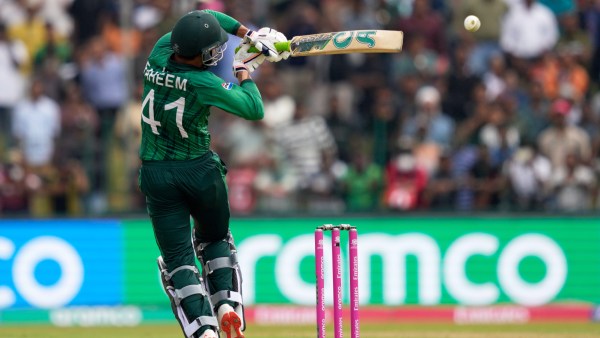 Faheem Ashraf’s 11-ball 29 helped Pakistan beat Netherlands in the T20 World Cup 2026 opener in Colombo. (PHOTO: AP)
It is all that mattered for Pakistan. And amongst the collective sigh of relief, coach Mike Hesson and Salman Agha would have quietly patted each other for their decision to go with Ashraf, which strengthened their batting depth. Since the start of May last year, out of the 34 T20Is that Pakistan have played – all with an eye on this T20 World Cup – Ashraf has been central to their plans. A utility all-rounder, he has been consistent. When other big-name pacers in the side have off-days, Ashraf tends to provide crucial breakthroughs. And if some quick runs are needed down the order, it is Ashraf they turn to.
The recent performance of the batting unit has been such that Ashraf hasn’t been needed to perform jail-break efforts like the one here. Despite being an integral cog in the wheel, many in Pakistan were not convinced of Ashraf’s spot. A frontline bowler could easily take it, was the perception. But Hesson, a shrewd T20 coach, knows the value of depth in batting and bowling.
Story continues below this ad
Their bowling unit, with an emphasis on spinners, is thoroughly prepared for the conditions in Sri Lanka; their base for the duration of the T20 World Cup is in good shape. Batting, however, needs more attention. While Pakistan have improved in this regard, the batting line-up is still short on firepower in the middle-order. To ensure the T20 intent flows throughout, Hesson has used batting depth as a cushion, where even in the case of wickets falling, batsmen are encouraged to go for the shots. Still, it remains a line-up that is susceptible to collapses, which is why Babar Azam – who was denied strike by Steve Smith in the Big Bash because he can’t hit sixes — is still part of the mix. Which is why, among all the dismissals of Pakistan batsmen on Saturday, it was Babar’s that would have stung the most. The platform was there for him to get the job done on his strengths; instead, he was holed out in the deep looking to play against the turn.
By all means, Pakistan have a team that is suited for the conditions where a total in the range of 160-180 could get the job done. The onus, however, remains on their batsmen.








 English (US) ·