

 1 week ago
12
1 week ago
12
ARTICLE AD BOX
6 min readChennaiFeb 25, 2026 06:45 PM IST
 India’s coach Gautam Gambhir, right, Sanju Samson during a practice session ahead of the ICC Men's T20 World Cup 2026 cricket match between India and Zimbabwe, at M. A. Chidambaram Stadium in Chennai, Tuesday, Feb. 24, 2026. (PTI Photo/R SenthilKumar) (PTI02_24_2026_000441B)
For a team that was supposed to sleepwalk to the T20 World Cup crown, Thursday will be D-Day. India were not supposed to be in this spot of bother. No signs, in the 18 months leading up to the tournament, suggested otherwise. With a power-packed batting line-up that was oozing confidence and a T20 baby, Abhishek Sharma, the face of it, they were supposed to power their way through to the final and make history by becoming the first team to defend the World T20 title.
Yet, here they are. Two games remain in the Super 8s stage, but a match not involving them (South Africa vs West Indies) is most prominent for India and its faithful. Before they take the field against Zimbabwe in front of a packed house at Chepauk, India will keenly be following the proceedings in Ahmedabad, hoping South Africa do them a favour, by beating West Indies in the afternoon fixture. And then when India take the field, they would look to annihilate Zimbabwe and make a statement.
This is not how India had expected this tournament to pan out. Favourites from the get-go, thanks to their batting might, India are now in a spot where not just their results but others too have to go their way. So, how did they find themselves in this situation? The answer very much lies in how the high-flying batting unit hasn’t been able to scale the highs of the last 18 months. It has meant that they haven’t been able to go full throttle in any of the matches, a concerning pattern which requires immediate attention.
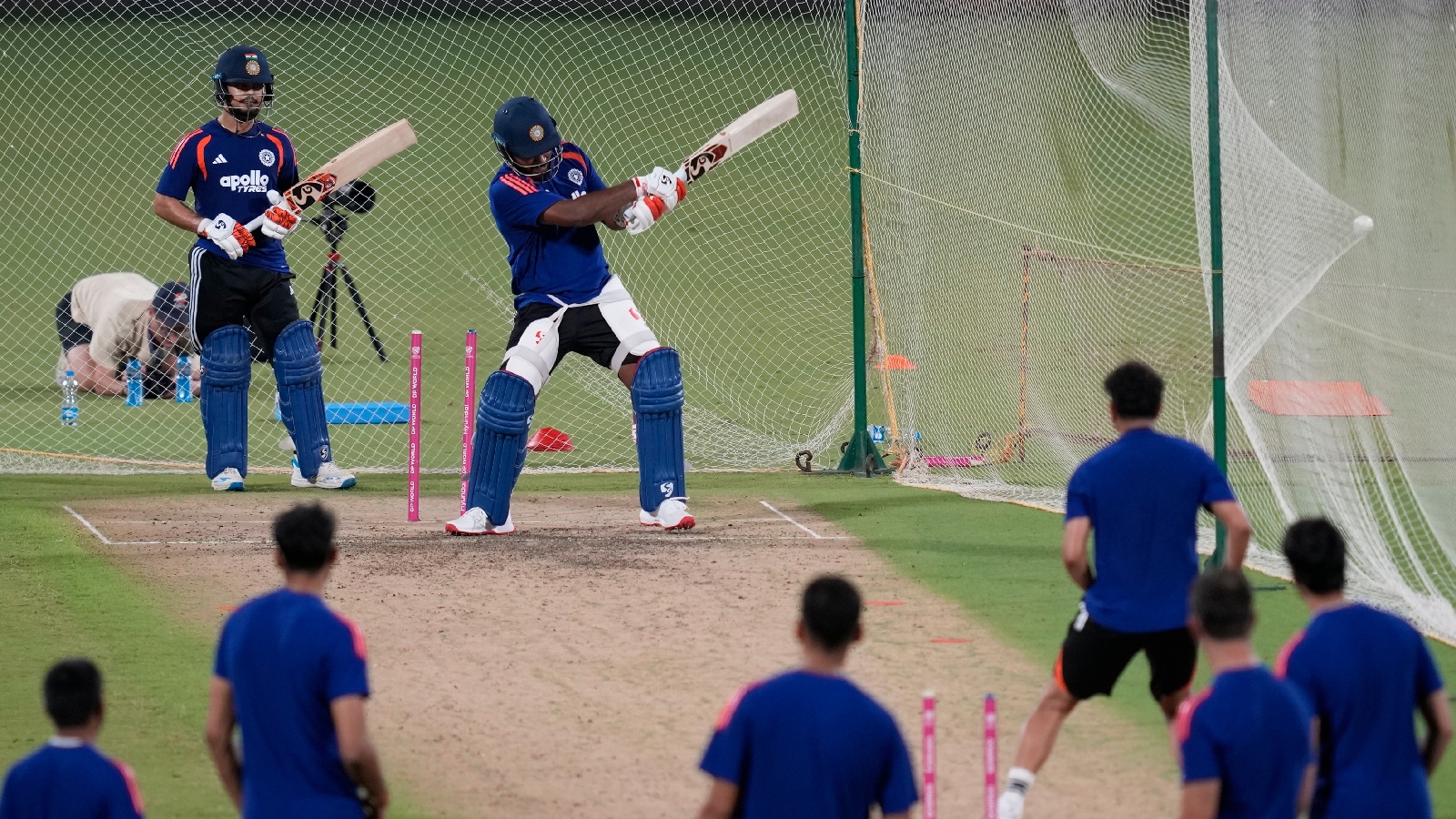 India’s Sanju Samson, centre, during a practice session ahead of the ICC Men’s T20 World Cup 2026 cricket match between India and Zimbabwe, at M. A. Chidambaram Stadium in Chennai, Tuesday, Feb. 24, 2026. (PTI Photo)
Much of their problems start at the top, which was supposed to be their biggest strength. And going into the match against Zimbabwe, India are confronting a key question: whether to go with a new set of openers on Thursday. While the Abhishek-Sanju Samson combo appeared the sealed pair for the T20 World Cup, the arrival of Shubman Gill for the Asia Cup made India take a new route. And just a month before the tournament, Gill made way for Ishan Kishan, who by the time the tournament started, emerged as the first-choice ahead of the struggling Samson. And five matches into the campaign, the highest opening stand is 25, made against Namibia in New Delhi. It was Samson and Ishan at the top of the order that day, with first-choice opener Abhishek missing out with illness.
As opposition sides have used off-spinners to good effect and India have been pushed to the brink, they are now pushed into unfamiliar territory where they are made to react rather than be proactive. It means the struggling Samson is back in the conversation and could open the batting, with those well-versed with the team management hinting that a surprise could be in store on Thursday. If that means Abhishek makes way, or if there will be a rejig of the batting order, is anyone’s guess. But what is guaranteed is that India have been brought out of their comfort zone.
The batting has become such a huge cause for concern that India’s think-tank has been weighing the pros and cons of potential changes. “There can be changes, yes,” India’s batting coach Sitanshu Kotak said. “Obviously, it goes without saying that we discussed (the issues), because there are two left-handed openers, number three is left-handed and the opposition is bowling off-spin. I personally don’t think that there is any problem there also. But because we lost a wicket in the first over in three games, any team would think of spinners. So we are thinking (of changes) and we will see how it goes,” Kotak said.
While Samson taking one of Abhishek’s or Ishan’s slots may not force a total rejig of the batting order, in case India prefer to have all three, then they would be forced to shuffle the pack. That in itself will be a clear sign of the team’s lack of clarity. India may be concerned whether they will be able to rediscover their old selves at all, but going back to another opener (Samson) who is also struggling for form, comes across as a desperate move. That India’s openers are struggling means, for a side that used to dominate the powerplays, they have had to consolidate and have been rarely able to hit top gear unless otherwise forced, without any option. While the lack of huge partnerships doesn’t really paint a true story of the batting performances in T20s, in five matches, there have been only four stands in excess of 50, an indication of a side that is lacking momentum.
Story continues below this ad
With two must-win fixtures coming their way, and the one against the West Indies having the potential to be determined by which batting side performs best on the day, time is ticking for India to fire.
On Thursday, from Ahmedabad to Chennai, India will be hoping for winds of change on D-day, the kind that fortuitously blow in their direction.




 English (US) ·