

 2 hours ago
5
2 hours ago
5
ARTICLE AD BOX
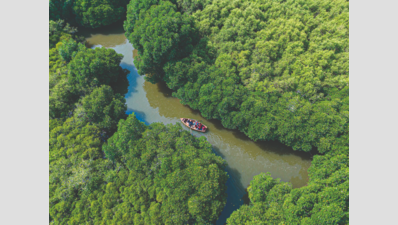
Tamil Nadu is mapping its mangroves such as the one in Pichavaram as precise estimates are needed to trade carbon stored in these ecosystems in the global market
Tamil Nadu has about 90sqkm of mangroves, 800sqkm of seagrass beds and 64sqkm of tidal marshlands. But, really, no one knows for sure. The ecosystems remain poorly mapped, and figures, largely derived by extrapolating limited field samples across large ecosystems, vary between state and national assessments.Experts say precise estimates are essential if carbon stored in these ecosystems is to be traded in the global carbon market, which is why city scientists are now planning to undertake high-resolution mapping of mangroves, seagrass meadows and tidal marshlands using drones, artificial intelligence and cloud computing, to generate pixel-level carbon data to global standards and develop a Blue Carbon Atlas for Tamil Nadu.
“Mangroves store five times more carbon than terrestrial forests,” says R Nagarajan, head of GIS and remote sensing at M S Swaminathan Research Foundation (MSSRF), which is leading the project in collaboration with Tamil Nadu forest department and supported by Microsoft.“The project will give us the exact number on the spread of mangroves. We will also map degraded lands to know the restoration potential so the state govt can invest and conserve them,” adds Nagarajan.
Microsoft is supporting algorithm development and with cloud-based processing through their platform Azure, enabling automated classification of species and carbon estimation at scale.“We will develop both a digital and hard-copy Blue Carbon Atlas for Tamil Nadu,” says Nagarajan. Creating the marshland atlas~ Army-grade drones fitted with multispectral sensors will capture imagery at a 2cm–5cm resolution, sharper than earlier satellite-based mapping at 10m resolution. The sensors will enable detailed analysis of vegetation~ Light Detection and Ranging (LiDAR)-based measurements will determine canopy height, a key parameter to estimate forest biomass. The captured imagery will be processed to classify different mangrove species~ Drone data will be combined with satellite information to estimate both above-ground and below-ground biomass. Ground data from field sampling will be used to validate drone observations. In the final imagery, each pixel will be assigned a specific carbon value, enabling precise carbon mapping and allowing scientists to quantify carbon stored in mangroves~ Tidal marshlands alongside mangrove ecosystems will also be mapped as part of the study~ Mapping seagrass poses additional challenges, as drones flown at 15m height can detect seagrass only up to 5m underwater, making deeper beds harder to map. Key regions such as the Gulf of Mannar and Palk Bay, which host extensive seagrass ecosystems and serve as habitats for dugongs under a designated conservation programme, will be covered under the project
Mangroves, seagrass meadows and tidal marshes are among the most efficient natural systems for storing carbon, often referred to as blue carbon ecosystems. Mangroves protect coastlines from storms and erosion while serving as breeding and nursery grounds for fish, crabs and prawns that support coastal livelihoods. Seagrass meadows stabilise sediments, improve water quality and provide habitat for marine species such as dugongs and turtles, while tidal marshes trap sediments and store large amounts of carbon in their soils







 English (US) ·