

 1 hour ago
4
1 hour ago
4
ARTICLE AD BOX
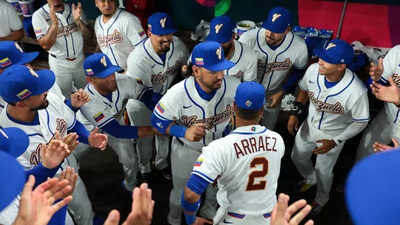
Team Venezuela (Image via: IG/X)
At the World Baseball Classic, every team has its own way of getting ready before the first pitch. Some players stretch quietly. Others listen to music or talk with teammates. Team Venezuela, however, begins its games with something much more lively.
Inside the dugout, players form a circle while pitcher Eduard Bazardo starts beating a drum known as el tambor. One by one, teammates jump into the middle and dance while the rest clap and cheer. The moment lasts only a short time, but it has quickly become one of the most talked about scenes around the team. What looks like a fun celebration is actually connected to a long standing cultural tradition in Venezuela. For the players, the short dance is a reminder of home and the joyful way baseball is often played in their country.
The team’s pregame drum and dance show how baseball and culture come together for Venezuela
Before each game, Bazardo taps the drum while teammates gather around him in a circle. Players take turns stepping forward to dance for a few seconds before returning to the group. “I would say it's very Caribbean, because you can also see some tambores dances in Puerto Rico or the Dominican Republic. I think there might be some tweaks in every nation, but it's very traditional in Venezuela,” said Daniel Alvarez, the co-founder and director of El Extrabase, and a writer who covers the Marlins and Latin and Venezuelan baseball.
Venezuela manager Omar López said the moment perfectly reflects how people in his country enjoy the sport. “What you see right there, that's us,” Venezuela manager Omar López said. “That's our country. That's us. That's winter ball. That's how we enjoy our baseball. We understand everybody has a different culture.”“You go to Puerto Rico, they have a different way. La Plena in Puerto Rico, that's amazing. It's kind of the same, but it’s a different type of music.
In the Dominican, it's Merengue, Ripiao, it's Bachata, Dembow. There's a lot of ways prior to the game they get loose and identify who they are and who we are.”“You can go to the beach, for example. Let's say you go to Ocumare de la Cosa, which is where Eduard [Bazardo] basically grew up. It's a beach near Maracay. If you go there, they're gonna be dancing tambores all the time,” Alvarez said. “If you go to La Sabana or La Guaira, which is where Ronald [Acuña Jr.]
and Maikel [Garcia] are from, you're gonna have tambores. At any Venezuelan party, you can have salsa, you can have merengue, you can have reggaeton, but at some point in the night you're going to have tambores.
”During big celebrations like weddings, the music often appears late in the night during what people call “hora loca,” or the crazy hour. “Hora loca is the part of the wedding where they stop playing the dance music, like merengue, salsa and all that stuff,” Allan Hrastoviak Arbelaez, the social media coordinator for the World Baseball Softball Confederation, said. “That’s when they put music on that everybody can sing and dance to and part of that is tambores.
”For Venezuelan players at the World Baseball Classic, bringing this tradition into the dugout is a way to show pride in their culture.



 English (US) ·