

 1 hour ago
5
1 hour ago
5
ARTICLE AD BOX

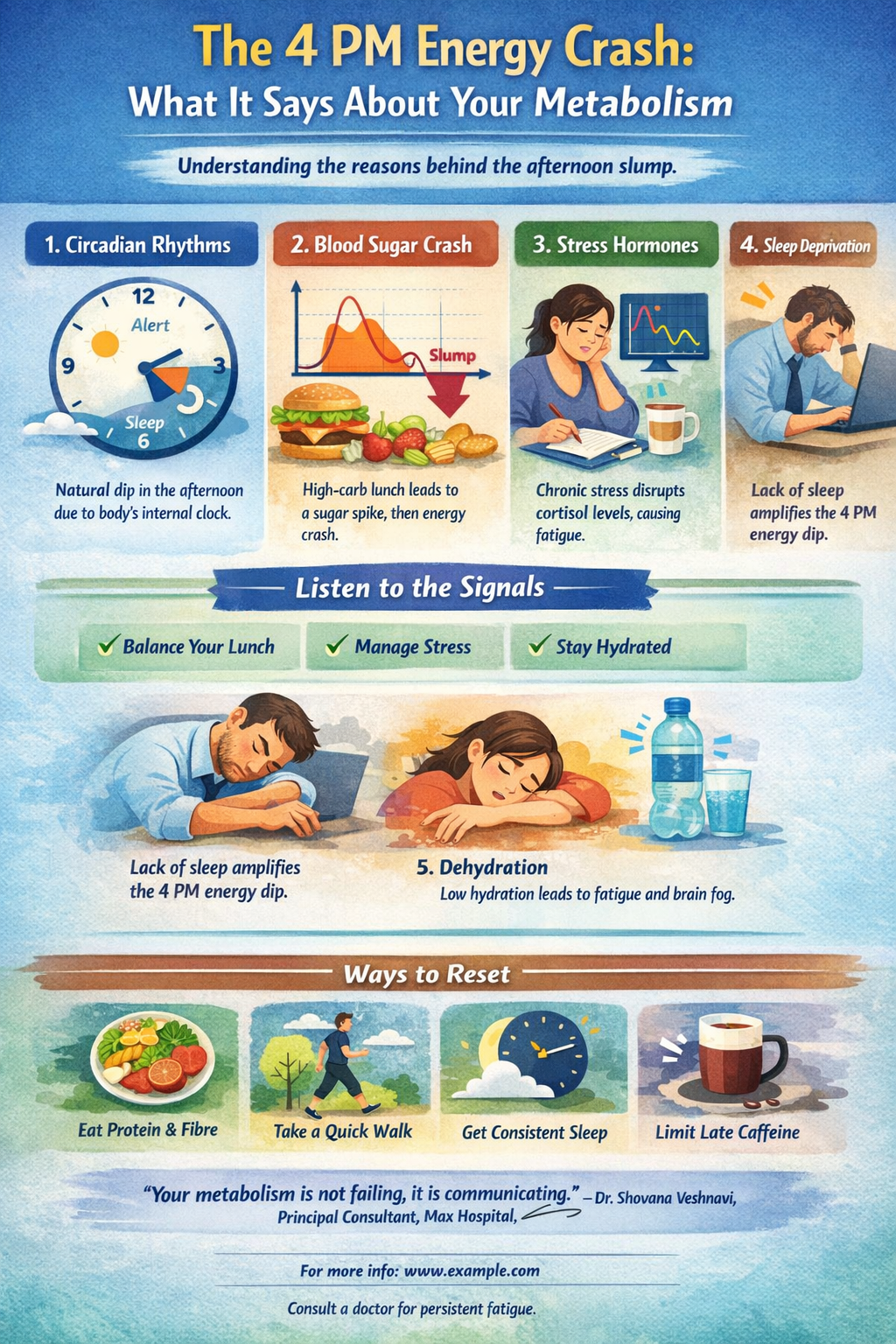
Many experience a 4 pm slump, but it's not laziness. Experts explain that this dip in alertness stems from our body's natural 24 - hour clock, influenced by lunch choices, stress, and sleep debt. Understanding these biological cues can help manage energy levels effectively, rather than just reaching for caffeine.
By late afternoon, something shifts.The emails blur. The eyelids feel heavy. A craving for tea, coffee, or something sweet begins to whisper. For many, 4 pm feels like walking through fog.
This is dismissed as laziness or lack of discipline.
But the body rarely behaves without reason.We spoke to Dr Shovana Veshnavi, Principal Consultant, Internal Medicine, Max Super Speciality Hospital, Noida, who explains it clearly, “Many people experience a noticeable dip in alertness around 4 pm. Concentration wanes, eyelids grow heavy, and the temptation for caffeine or sugar intensifies. This is not mere indiscipline.
It reflects an interplay between circadian biology and metabolic regulation.”The 4 pm crash is not random. It is biology at work.
The body’s clock is still in charge
The human body runs on a 24-hour internal clock. This clock sits in a small region of the brain called the suprachiasmatic nucleus. It regulates sleep, hormones, temperature, and alertness.Dr Veshnavi notes, “Human physiology follows a 24 hour internal clock governed by the suprachiasmatic nucleus.
Core body temperature, cortisol secretion and cognitive performance fluctuate predictably.”Research from the National Institute of General Medical Sciences (NIH) explains how circadian rhythms influence hormone release and alertness patterns across the day.Even in well-rested adults, alertness dips in the mid-afternoon. The body temperature falls slightly. Reaction time slows. Focus softens. It is a natural trough.Dr Veshnavi adds, “A mild dip in vigilance typically occurs in the mid afternoon, even in well rested individuals.
If sleep has been insufficient, this physiological trough becomes more pronounced.”So the slump is not a flaw. It is timing.

The 4 pm crash is not random. It is biology at work.
Lunch may be writing the 4 PM script
What was on the lunch plate matters more than most realise.A meal heavy in refined carbohydrates can raise blood glucose quickly. The pancreas responds with insulin. If that insulin surge is strong, blood glucose can drop rapidly afterwards. That drop feels like fatigue.Dr Veshnavi explains, “A meal rich in refined carbohydrates provokes a rapid rise in blood glucose, followed by a compensatory insulin surge.
As glucose levels subsequently fall, reactive fatigue may ensue.”This does not automatically mean diabetes. It can signal unstable fuel use.The National Institute of Diabetes and Digestive and Kidney Diseases (NIDDK) describes how carbohydrates influence blood glucose and insulin dynamics.Dr Veshnavi clarifies, “This pattern does not necessarily indicate diabetes, but it does reflect metabolic volatility. Stable energy is more likely when meals contain fibre, protein and healthy fats that moderate glycemic fluctuations.”In simple words, steady fuel equals steady energy.
Stress is quietly reshaping hormones
Cortisol is called the stress hormone. But it also helps regulate energy. Under healthy conditions, cortisol peaks in the morning. Then it gradually declines through the day. Chronic stress disrupts this rhythm.Dr Veshnavi notes, “Chronic psychological stress alters cortisol rhythms. Instead of a robust morning peak and gradual decline, levels may become blunted or erratic.”Studies from the International Journal of Molecular Sciences discuss how chronic stress can alter cortisol patterns and circadian alignment.When cortisol patterns flatten, afternoon fatigue can intensify. Add poor sleep, and the crash feels sharper.The 4 pm slump may be less about energy and more about accumulated strain.
Sleep debt amplifies the crash
A single night of short sleep changes metabolism. It alters glucose tolerance and increases hunger hormones. Repeated sleep restriction magnifies these effects.Data from the Centers for Disease Control and Prevention (CDC) shows that insufficient sleep is linked to metabolic disturbances and reduced alertness.If someone sleeps five to six hours for weeks, the 4 pm dip deepens. The body is asking for recovery.The crash is often a delayed echo of last night.
Even in well-rested adults, alertness dips in the mid-afternoon.
Dehydration and hidden fatigue
Even mild dehydration can impair concentration and mood. Many adults consume most fluids in the morning, then forget through the day.Low fluid levels reduce blood volume slightly.
The heart works harder. The brain notices.That mid-afternoon heaviness may simply be thirst in disguise.What the crash is really telling youDr Veshnavi puts it plainly, “An occasional afternoon lull is physiologically normal. However, a severe or daily crash suggests sleep debt, suboptimal nutrition, dehydration or sustained stress.”The body is not malfunctioning. It is communicating.Instead of masking the dip with another coffee, observe patterns:
- Was lunch balanced?
- Was sleep consistent?
- Has stress been rising?
- Is hydration adequate?
These are metabolic clues.
Resetting the 4 PM narrative
Small adjustments stabilise energy:
- Include protein and fibre at lunch.
- Step outside for 10 minutes of daylight exposure.
- Walk briskly for 5 to 15 minutes.
- Maintain consistent sleep timing.
- Limit heavy caffeine after 3 pm.
None of these are dramatic. Yet metabolism responds to rhythm and repetition.Dr Veshnavi offers a final perspective, “Rather than masking the slump with another coffee, consider it a biological cue. Your metabolism is not failing. It is communicating.”That message deserves attention.Medical experts consulted This article includes expert inputs shared with TOI Health by: Dr Shovana Veshnavi, Principal Consultant, Internal Medicine, Max Super Speciality Hospital, NoidaInputs were used to explain why the 4 pm energy crash may signal underlying metabolic imbalances, and why consulting a doctor is important before relying on caffeine, sugar or quick-fix energy boosters.









 English (US) ·