

 11 hours ago
11
11 hours ago
11
ARTICLE AD BOX
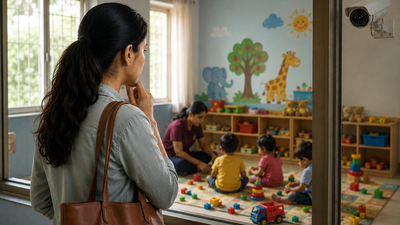
What is the Motherhood Penalty and why it doesn't end at the office door
It is every parent’s nightmare. To read the words “child” and “abuse” in the same sentence. But we live in a cruel world. The Capgemini-linked day care child abuse case is horrifying for every parent – irrespective of gender.
But societies don’t work that way. The fear of mothers all over India can be heard. It is palpable. Because beneath all the deserved outrage lies another, quieter tragedy that rarely receives equal attention. Every such incident also becomes a public trial of mothers.The Capgemini-linked day-care facility has reopened a question that millions of working women silently wrestle with every single day: Who can I trust with my child? It is a question that carries no satisfying answer because the stakes are impossibly high.
In societies where motherhood continues to be regarded as a woman's defining identity, every decision she makes about work, childcare and ambition is scrutinised, and when something goes wrong, it is almost always the mother who is asked to explain herself before anyone questions the system that failed her. This is what economists and sociologists describe as the “motherhood penalty”.
What is the Motherhood Penalty?
The term originally referred to the measurable disadvantages mothers face in hiring, promotions, salaries and career progression compared to fathers and women without children, but it’s the emotional dimensions that are proving to be far more devastating in our times.
The penalty is no longer confined to pay gaps or stalled careers. It has become an invisible emotional tax extracted every day from women who are expected to be endlessly available to their children while simultaneously performing as ideal employees, ideal daughters-in-law, ideal wives and ideal mothers.
It is the unequal distribution of domestic care and emotional labour and the pressure to manage intense caregiving responsibilities that forces women to take extended career breaks, reset their career paths, or settle for lower-paying, more flexible rolesThis penalty, that the Japanese call ‘matahara’, is actually measurable. Globally, women perform 76.2% of all unpaid care work, and 708 million women are outside the labour force primarily because of unpaid caregiving responsibilities, according to the International Labour Organization. In India, the burden is equally stark. A recent National Statistics Office survey found that 69% of urban women outside the workforce cite childcare and household responsibilities as the main reason for not working. Those who do return often face interrupted careers, lower wages and fewer leadership opportunities, making motherhood one of the biggest determinants of women's economic inequality.
Mothers on trial
But statistics tell only one part of the story. The psychological burden begins long before maternity leave ends. Modern motherhood has evolved into a relentless exercise in risk management. Mothers are expected to research schools, verify caregivers, monitor CCTV feeds, scrutinise domestic workers, interview nannies, evaluate nutrition, regulate screen time, arrange enrichment activities and simultaneously remain productive professionals.
Every news report about child abuse, kidnapping, neglect or violence instantly expands the catalogue of fears they are expected to manage. The world grows more uncertain, while the responsibility placed upon mothers only grows heavier.The irony is especially cruel because the same society that urges women to become financially independent often fails to build trustworthy childcare ecosystems that make such independence possible.
India's urban centres have witnessed a steady increase in dual-income households, yet quality childcare remains expensive, unevenly regulated and often inaccessible. Corporate day-care facilities have become important workplace benefits, but isolated incidents of abuse or neglect can shatter confidence far beyond the institution where they occur.

Globally, women perform 76.2% of all unpaid care work, and 708 million women are outside the labour force primarily because of unpaid caregiving responsibilities.
Policing motherhood: can’t win either way
The emotional mathematics of motherhood therefore becomes impossible.
A woman who stays home is frequently asked why she invested so much in education only to leave her career. A woman who returns to work is asked why she chose work over her child. If her child struggles academically, people wonder whether she was “too busy”. If something terrible happens under someone else's care, whispers begin immediately. Why didn't she stay home? Why couldn't the grandparents look after the child? Why did she trust outsiders? Why have children at all if someone else is raising them? Fathers, meanwhile, are often congratulated merely for attending a parent-teacher meeting or taking parental leave.
Mothers are expected to account for every minute spent away.This relentless judgement extends well beyond workplaces. Families, neighbours and even strangers participate in policing motherhood. A grandmother may insist that no outsider can care for a child properly. An aunt questions why the baby was enrolled in day care “so early”. Neighbours remark that children today are “raised by househelps”.Social media amplifies these judgements, where anonymous commentators confidently assign blame within minutes of any tragedy.
Every headline about childcare failure becomes another cautionary tale directed at governments, employers and at mothers in equal measure. The implication is unmistakable: had the mother made different choices, disaster could have been avoided.
Psychological warfare of maternal guilt
Such expectations create what psychologists increasingly describe as maternal guilt that borders on chronic anxiety. Many working mothers report constantly questioning whether they are making the right decisions, even when there is no objective evidence that they are failing.
They worry during office meetings, refresh CCTV apps between presentations, apologise for leaving work early, apologise again for arriving home late and often end each day convinced they have fallen short in every role they occupy.
The result is not simply exhaustion but a persistent state of emotional hypervigilance in which motherhood becomes inseparable from fear.One of the most significant consequence is that these anxieties now shape the decisions of women who have not even become mothers yet.
Conversations around motherhood increasingly include not only biological clocks but career clocks, childcare costs, safety concerns and emotional sustainability. Young women openly admit that they fear having children because they do not believe society will support them afterwards.

Conversations around motherhood increasingly include not only biological clocks but career clocks, childcare costs, safety concerns and emotional sustainability
Even women who deeply desire motherhood wonder whether they possess the financial resources, emotional resilience and trustworthy support systems required to raise a child without sacrificing every other part of their identity.
The decision to have children is no longer only about love. It has become an assessment of institutional trust.This is not merely an individual crisis. It is an economic one. Countries facing declining fertility rates are beginning to recognise that women are delaying or avoiding motherhood not because they reject family life but because they reject unequal caregiving expectations.Research across advanced economies consistently shows that affordable childcare, flexible work arrangements, parental leave for fathers and supportive workplace cultures improve both women's workforce participation and family well-being.
India stands at a crossroads. It cannot aspire to become a global economic powerhouse while continuing to rely on women performing invisible, unpaid emotional labour that goes unrecognised by policy, employers and even families.Building safer childcare systems requires more than CCTV cameras after a scandal. It demands stronger regulation, frequent inspections, better caregiver training, transparent grievance mechanisms, meaningful parental leave for both parents and workplaces that understand caregiving as a social responsibility rather than a women's issue.Every time another childcare horror emerges, public anger understandably centres on the perpetrators. It should. But the conversation cannot end there. It must also confront the impossible bargain society continues to offer mothers. The real tragedy is not simply that mothers carry the motherhood penalty. It is that they carry it alone.








 English (US) ·