

 1 hour ago
6
1 hour ago
6
ARTICLE AD BOX
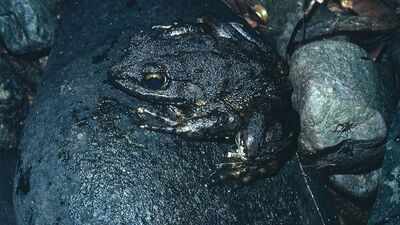
Deep within the rainforest rivers of western Central Africa lives a frog that seems to ignore many of the usual rules of amphibian life. The Goliath frog, already famous for its remarkable size, spends its days among rocky river channels, waterfalls and fast-moving currents that would challenge far smaller species.
For years, its enormous proportions attracted attention while much of its breeding behaviour remained largely unknown. Then, field observations along a river in Cameroon revealed something unexpected. Instead of simply laying eggs wherever suitable water happened to be available, these frogs appear to reshape parts of their environment, creating sheltered pools where their offspring can develop away from the force of the main river.
Goliath Frog: The world’s largest frog and its unique river environment
According to the San Diego Zoo, the Goliath frog, Conraua goliath, holds the title of the largest frog on Earth. Fully grown individuals can reach lengths approaching half a metre when their legs are extended and may weigh several kilograms. They are found only in a relatively small region spanning parts of Cameroon and Equatorial Guinea, where warm, humid forests border powerful rivers.Their preferred habitat is not the still water often associated with frogs.
Instead, they occupy stretches of river marked by rapids, cascades and rocky channels. The constant movement of water creates an environment rich in oxygen but also presents a challenge for reproduction. Eggs and young tadpoles are vulnerable to being swept away long before they can complete development. For a long time, scientists knew surprisingly little about how these giant amphibians solved that problem.
How Goliath Frogs build nursery ponds for their young
According to a study published in the Journal of Natural History, titled “ Goliath frogs build nests for spawning – the reason for their gigantism?”, they construct and maintain breeding sites that function as nursery ponds for their young. The research documented nineteen such sites along a section of the Mpoula River in western Cameroon.The nesting areas were not all the same. Some consisted of naturally occurring rock pools that had been cleared of leaves, sediment and debris. Others were shallow hollows already present along riverbanks, but appeared to have been enlarged or cleaned out before being used.
The most striking examples were entirely new depressions excavated into gravel banks beside the river.Creating these spaces can involve shifting loose stones, gravel, leaves and other material from the chosen site. Once prepared, the pools provide calmer conditions than the surrounding river channel. Eggs deposited there are less exposed to strong currents, while developing tadpoles remain in water that is relatively sheltered.The same sites are often reused. Some pools contained different groups of tadpoles at varying stages of growth, suggesting that successful nursery ponds may serve multiple breeding attempts over time.
Do Goliath frogs guard their nests
Field observations hinted that the ponds are not abandoned immediately after eggs are laid. Camera traps recorded adult frogs remaining close to nesting sites during the night. While many details of their behaviour remain uncertain, the observations suggest a degree of parental investment that is uncommon among large amphibians living in fast-flowing rivers.The placement of the ponds also appears deliberate. Rather than being scattered randomly, nests were frequently clustered in particular stretches of riverbank. Such locations may offer a balance between protection and access to flowing water, allowing young frogs to develop without facing the full force of the river.These nursery ponds create miniature habitats within a much larger and harsher environment.
For eggs and newly hatched tadpoles, that difference may be critical.
The link between nest building and Goliath Frog gigantism
The discovery of nest construction has prompted an intriguing possibility about the evolution of the species itself. Moving stones and clearing substantial amounts of material requires physical strength. Some of the objects associated with nest preparation are surprisingly large relative to the size of most frogs. A small amphibian would struggle to reshape a riverbank or create a depression capable of holding water through changing river conditions.As per the study, this demanding reproductive behaviour may help explain why Conraua goliath became so large in the first place. Individuals capable of building and maintaining effective nursery ponds would have given their offspring a better chance of survival. Over many generations, selection could have favoured increasingly powerful animals able to undertake the work required. The idea remains a hypothesis rather than a proven explanation.
Even so, it offers a rare example of how parenting behaviour might be linked to the evolution of extreme body size.For a species already known for breaking records, the discovery adds another distinction. The world's largest frog is not simply bigger than its relatives. It may also be one of the few that acts as a landscape engineer, reshaping small corners of a river to create nurseries for the next generation









 English (US) ·