

 1 hour ago
4
1 hour ago
4
ARTICLE AD BOX
Nimrod Mon Brokman doesn’t believe in easy. The Israeli sports psychologist, who works with athletes at his Behavioral Foresight facility, has been accompanying Lakshya Sen at the All England — and his methods are anything but conventional. The latest: cycling at a heart rate of 160-170 under hypoxic conditions, where arterial oxygen saturation drops below 90 percent.
“I use different, unconventional technologies and methods. This was about cognitive overload — forcing him to deal with two challenges at once,” says the Bangalore-based Mon. “Most athletes won’t like it. Lakshya says, ‘Bring it on.’ Even on match-days.”
That attitude, Mon says, is rare. Working with Sen since mid-2025, he sees in the Indian shuttler a quality he has otherwise encountered only in elite military units. “I see very little fear in him when it comes to hard stuff. He laughs in the face of these challenges — that kind of temperament, I’ve seen it only in Special Forces or 9 Para.” It’s why, Mon believes, Sen is in the All England semifinals.
The work between them began not with drills or techniques, but with dismantling a story. Mon felt Sen had absorbed a damaging misconception: that his fourth-place finish at the Paris Olympics was a failure.
“It was actually an extraordinary result. He qualified with just two tournaments left, while managing injury, and still had a brilliant run at the highest level of competition — something India should have highly appreciated,” Mon says. “Our early work was about clearing his mind of that wrong perception, and reminding him of how good he really was.”
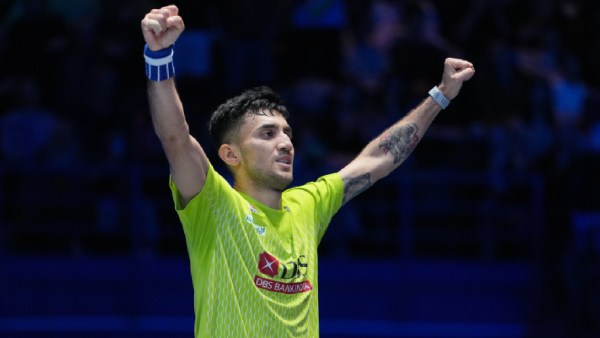 India’s Lakshya Sen celebrates after winning the men’s singles semifinal match against Canada’s Victor Lai at the All England Open Badminton Championships in Birmingham, England, Saturday, March 7, 2026. (AP Photo/Kin Cheung)
Sen, by Mon’s account, wasn’t drowning in self-criticism — but the noise around him was. “His approach is to look forward and not be stuck in the past. Our strategy was to deal with nothing from the Olympics, because there was nothing to deal with.”
Returning to Paris for the 2025 World Championships brought its own complications.
Story continues below this ad
Mon travelled alongside. Sen drew Shi Yuqi in the first round — the same opponent he would later face at the All England — and lost. But Mon saw something else in the defeat. “You might not see it on the scoreboard, but that match was a turning point. It told me he had put everything behind him.”
Injuries are a recurring subplot in Sen’s career. His back has a wretched history, and his retrieving style of play — grinding, relentless, built for long rallies — means he strains it more often than most. Mon is measured about this. “All athletes get injured. After the first few times, the mature ones settle into it — they understand loading and de-loading, the importance of recovery. Lakshya is brilliant at that. Inspiring, even.”
What Mon seems to prize most in Sen, though, is the absence of noise. “He doesn’t compare himself with others. He knows what to set aside and clear his path.”
The attitude-goal Mon and his team are sharpening in Sen is, he says, a blend of Muhammad Ali and Rafael Nadal — bravado fused with patience. “With Lakshya’s game-style, you need to be willing to get hit, to lose points, to have stretches where nothing is working, and still trust your game completely. Against Li Shifeng, he took blows — but he stayed patient and found his way.”
Story continues below this ad
The flip Sen has made this week is in how he handles momentum. An old habit — building a chunky lead, unravelling it, then getting lost in the wreckage of how it happened — has been quietly replaced by something steadier. “We’re working on minimising the effect of lost leads instead of reacting in panic mode,” Mon explains. At the All England, it has shown.
Mon will admit, with some amusement, that the learning has gone both ways.
The first time he travelled with Sen, he arrived at his room primed for an intense session — only to find the TV on, an American stand-up comedian playing in the background. “I wasn’t so sure about it,” Mon laughs. “But we went through that session with jokes and laughter, and I realised: you have to allow the brain to be open, even in heavy sessions. In the same conversation, we’d discuss the importance of a move in his game and something completely trivial.”
Sen, it turns out, taught the mind coach something about the mind. How to switch off. How to come back lighter. That, as much as hypoxia drills and cognitive overload, might be the real secret.





 English (US) ·