

 39 minutes ago
5
39 minutes ago
5
ARTICLE AD BOX
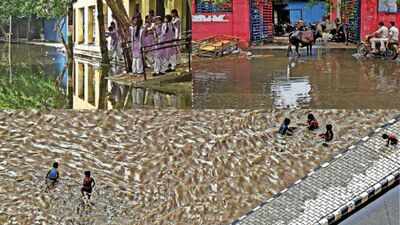
Heavy rains submerged roads and public spaces across Delhi after downpour.
Want to go inside? Sit on my bike. That’s the only way,” Krishna, who came for some work at Khajuri Khas police station, told TOI reporters who were wondering how to enter the premises Friday.On Thursday, the entire stretch outside the building and the one connecting to the main road had disappeared under water following heavy downpour. Roads turned into filthy waterways, cars were stranded in waist-deep water, and people had nowhere to put a foot.By Friday, the rain stopped, and much of the water elsewhere receded. But the road outside the police station was still flooded with black, sewage-laced water emitting an overpowering stench.
Cattle lounged beside the stagnant pool and vehicles crawled through it. Anyone headed to the police station first had to figure out one thing: how to get inside.
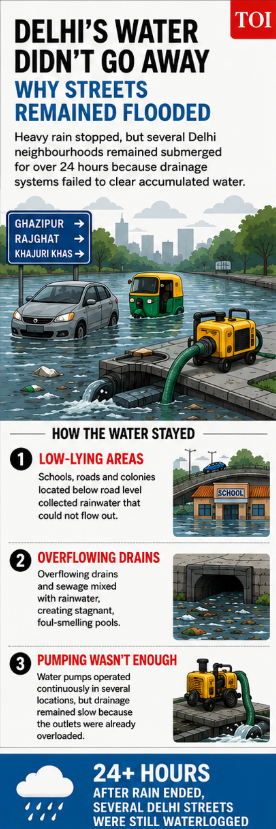
Tilak Singh discovered that firsthand. Summoned to the police station with his daughter, he stopped at the edge of the flooded stretch. There was no way across. He called up the officer inside. “How am I supposed to come in? I don’t have a vehicle. My daughter can’t walk through this,” he said.
Minutes later, another visitor rolled up his trousers and waded through the filthy water.For the cops sitting inside, every monsoon brings the same pain. “Yesterday, my uniform was drenched. It’s difficult for us and for the public. We have dedicated one of our vehicles to help people negotiate the stretch and enter the station. It’s sheer apathy. Please ask someone to solve this problem,” said a police officer.TOI found a water pump operating at the site, but it appeared inadequate to clear the accumulated water into a seemingly overflowing drain.
Even without fresh rain, the stagnant water showed little sign of receding.Khajuri Khas was not an isolated case. At the other end of the capital, in southeast Delhi’s Badarpur area, students were grappling with a familiar ordeal. At Govt Girls/ Boys Senior Secondary School No. 3 in Molarband Friday, the playground remained inundated, full of stagnant water and rendered inaccessible to students.A day earlier, its students had lost an entire day of classes after three to four feet of water submerged the school complex, reaching all the way to the main gate, school staff said.
For locals, such disruptions have become so routine that some said they have lost count of how many classes are wasted every monsoon.When TOI visited the school at noon Friday, students were seen standing outside their classrooms, staring at a large pool of stagnant water and sludge on the premises. With no electricity at the school at the time, it was a scene of total disruption that staff said was neither unusual. “This happens every year. This year, the authorities have raised the level of the main road, which is why all the water has been flowing into the school. We need to get our gate fixed to stop the water,” a school staffer said.
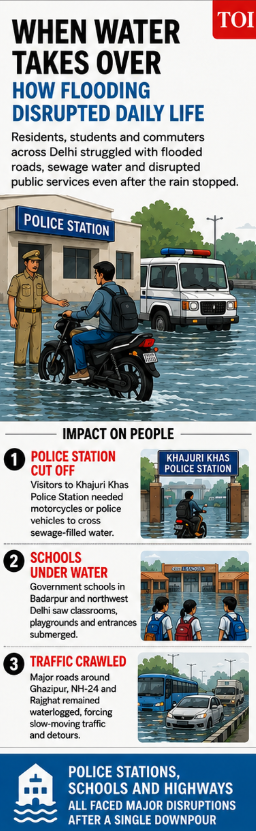
A Municipal Corporation of Delhi (MCD) official said, “This school and another, both under Delhi govt and located in Meethapur ward, are in a lowlying area, six to seven feet below the level of the adjoining road. So, waterlogging during the monsoon is a recurring issue. The work of pumping out water from the school premises is being carried out by Public Works Department (PWD) and irrigation and flood control department.”A govt school in northwest Delhi, too, reportedly grappled with knee-deep waterlogging, forcing authorities to suspend classes for a day. According to a teacher, it’s an annual disruption. “This is nothing new and children end up missing classes,” said a parent.A Delhi govt official said, “We have initiated an audit of all our schools. Such issues will be identified, mapped and addressed.”At Ghazipur, 24 hours after the rain had stopped, traffic police and National Highways Authority of India (NHAI) teams managed to clear National Highway-24 by continuously pumping out water. However, many other parts of the area remained submerged. The road from Ghazipur Mandi to EDM Mall along the highway no longer looked like a busy arterial corridor.
Instead, it resembled a foul-smelling canal that swallowed the carriageway.The flooded stretch branches into a Y-junction. One arm leads towards Ghazipur Road and the other towards Kaushambi Road. On the Ghazipur Road side, pumps worked continuously Thursday to drain out water, but large swathes remained flooded Friday morning. E-rickshaws approaching the stretch were seen turning back, while trucks tried to slowly move through the water, sending waves across the carriageway.The Kaushambi Road side, home to vegetable and flower mandis, offered little relief to locals and commuters. Water accumulated on some parts of this road, especially close to the Sabzi Mandi. People carefully waded through the stagnant, sewagelaced water.The problem, however, was hardly confined to the city’s fringes. In its heart, a service lane along the periphery of Rajghat — a site of national importance regularly visited by foreign dignitaries — remained submerged in knee-deep water at 2pm Friday.
Cars and two-wheelers slowed to a crawl as they crossed the flooded stretch. What made the sight even more striking was that the area got no rain Friday.The aftermath of Thursday’s downpour was also evident in the form of fresh potholes and rutting on some roads, causing inconvenience to commuters. For instance, the stretch outside Apollo Hospital on Mathura Road, a key thoroughfare used around the clock by ambulances carrying critical patients, bore scars of the shower.
The stretch is under NHAI’s jurisdiction. “Its maintenance is handled by an agency. If there are any issues, we will examine them and carry out work,” an NHAI official said.About 20 minutes from the Khajuri Khas police station, parts of a DDA park, close to Seelampur housing complex, were also submerged.
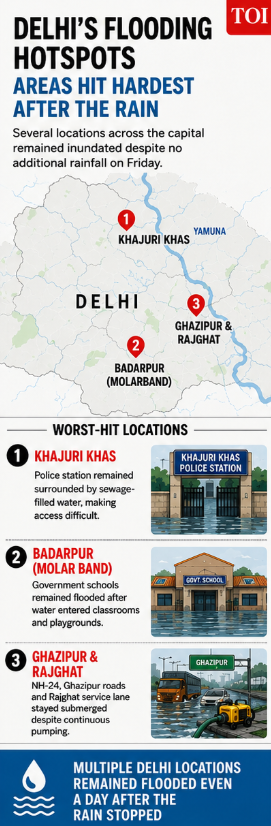
The police station, the park and the Ghazipur road are under the jurisdiction of Delhi Development Authority (DDA).“While the road around the police station has been handed over to the local body concerned, two adjoining roads remain under DDA’s jurisdiction. Owing to their poor condition, these roads witness temporary water accumulation during intense rainfall, which gradually drains through the existing network,” he said.He added that temporary waterlogging was reported in the low-lying Ghazipur village, but proactive desilting of drains helped the water drain. The rest of the water is expected to be cleared by Saturday morning, with pumps deployed.PWD, which maintains the Rajghat road, didn’t respond to TOI ’s queries regarding the situation on the ground.








 English (US) ·